

You know that AI search engines like Google AI Overview, ChatGPT, and Gemini don’t just pull from blog articles anymore.
They analyze YouTube videos, explore Reddit discussions, and surface other formats…all within a single answer.
So if your content strategy is still “write an article and hope for the best,” you’re leaving visibility on the table.
In this guide, I’ll walk you through how to build a multi-format content strategy for AI search, step by step, using a real example so you can follow along with your own topic.
By the end, you’ll have a detailed content plan that includes:
- Every topic you need to cover
- The search intent behind each one
- The best content format for each topic, whether that’s an article, a video, a forum discussion, or a free tool
You’ll end up with something like this:
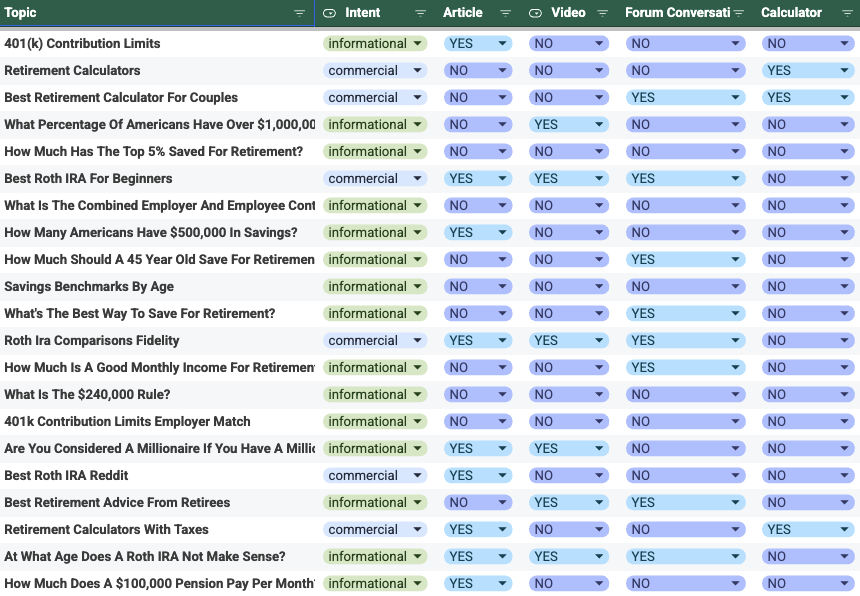
The whole process takes less than 30 minutes using thruuu’s keyword clustering, SERP analysis, and content optimization tools.
Here are the five steps we’ll cover:
- Step 1 – Build your keyword universe
- Step 2 – Cluster keywords by SERP similarity
- Step 3 – Identify search intent and content type
- Step 4 – Define the best content format per topic
- Step 5 – Set priorities and analyze each topic
Ready? Let’s dive in.
Table of Contents
Understanding AI Search and Why You Need a Multimodal Content Strategy
Before we jump into the steps, let’s quickly clarify what we mean by AI search.
When we talk about AI search, we’re talking about Google AI Overview, ChatGPT, Gemini, Google AI Mode and similar experiences.
They all work the same way: they generate a summary powered by AI, and they pull the information from multiple sources to build that summary.
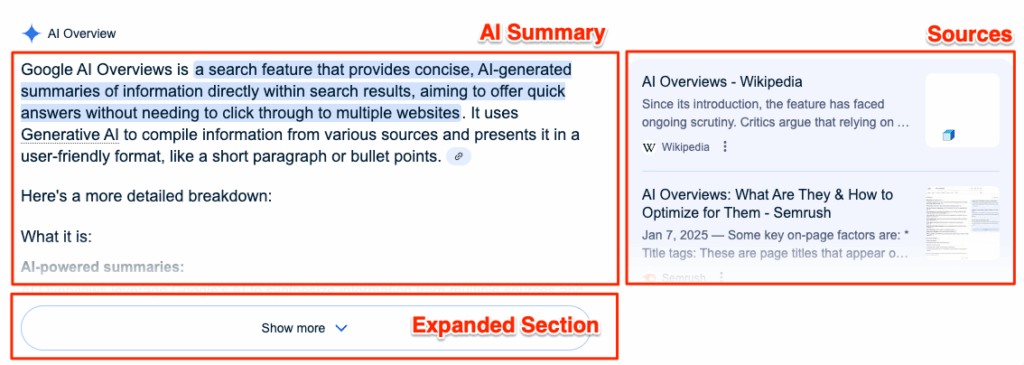
And here’s the key part: those sources aren’t just blog articles.
AI search engines retrieve information from:
- Blog posts and articles (traditional web content)
- YouTube videos: YouTube is cited in 18.8% to 29.5% of Google AI Overviews, making video a significant source for AI-generated answers.
- Forum discussions: Reddit is the #1 cited domain across major AI platforms, accounting for 40.1% of citations. User-generated content is not optional anymore.
The data speaks for itself. AI search is multimodal by design.
This is why SEO in 2026, or what many now call GEO (Generative Engine Optimization), needs to go multimodal too.
A text-only content strategy won’t cut it anymore. You need to think across formats and match the way AI search engines actually source their answers.
That’s exactly what we’re going to build together in this guide: a content strategy for AI search that covers articles, videos, forum engagement, and free tools, all driven by real SERP data.
Follow the steps below and/or watch this video.
Step 1: Build Your Keyword Universe
Your keyword universe is everything related to your main topic: keywords, long-tail variations, questions, prompts, and subtopics.
To make this practical, we’ll use a real example throughout this guide: “saving for retirement.”
Start with your seed keywords
List the core topics you want to cover. Here’s my starting list:
- What’s the best way to save for retirement?
- 401(k) contribution limits
- Roth IRA comparisons
- Retirement calculators
- Savings benchmarks by age
Obviously you can make a longer initial list. The best practice is to not go too broad and stay close to your main topic.
Think about your audience’s customer journey: what are the main questions or keywords they might search along the way?
Expand with People Also Ask and Related Searches
Now we need to extend this seed list with long-tail keywords, questions, and prompts.
This will also help us increase our chances of being picked up by AI search.
Why does this matter?
Because 57.9% of AI Overviews are triggered by question-based queries, and 68% of terms triggering AI summaries have fewer than 100 monthly searches.
In other words, long-tail and question-based content is exactly what AI search engines are looking for.
My favorite technique to expand a keyword list is to collect, for each keyword, the Google People Also Ask (PAA) and Related Searches, then iterate over the extended list and collect PAA and Related Searches again until I have enough material.
Google PAA is maybe the best database of questions out there. It’s not just a list of questions. It’s a direct map of the semantic associations Google’s LLMs use to understand a topic.
By scraping PAA at scale with thruuu, you’re essentially reverse-engineering the knowledge graph that AI search uses to build its summaries.
How to scrape PAA with thruuu
To scale this process, I use thruuu’s keyword clustering tool, which offers an option to scrape the related PAA for each keyword you upload.
Here’s how it works:
- Upload your seed keyword list to the clustering tool
- thruuu scrapes the SERP for each keyword and extracts all related PAA questions and Related Searches
- Export the results
You’ll find a goldmine of data. As you can see below, there’s a tab full of PAA questions, and another full of Related Searches.
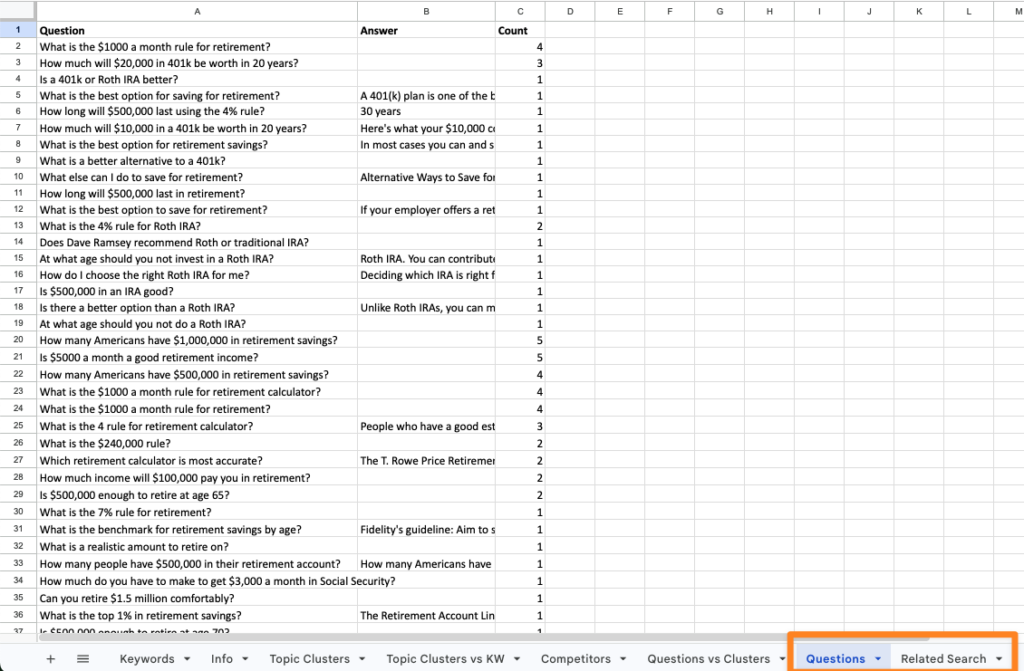
Now compile this data with your initial list to create an extended keyword list.
Then repeat the process.
Upload your extended list back into thruuu, collect a new round of PAA and Related Searches, and expand again. You can do this 2 or 3 times to build a comprehensive keyword universe.
In my example, I started with 6 seed keywords, expanded to 67 after the first round, and reached over 300 after the third. That’s the power of iterating.
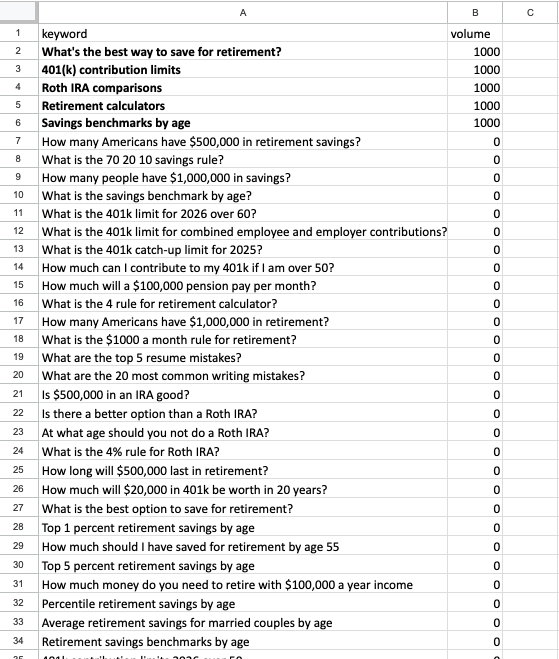
If you want to go deeper on this technique, I’ve written a complete guide on how to build a content plan using PAA.
Now we have our keyword universe. Let’s organize it.
Step 2: Cluster Keywords by SERP Similarity
Once you have a long list of keywords, the next step is to group them by SERP similarity.
Why? Because it removes the noise and reveals the actual topics you need to focus on.
Many keywords lead to the same Google results page, which means you don’t need to cover them separately.
Clustering shows you which keywords belong together and which ones deserve their own content.
Why keyword clustering is critical for AI Search
This isn’t just about organizing your spreadsheet. AI search engines like Google AI Overview, ChatGPT, and Gemini use Retrieval-Augmented Generation (RAG) to find the single most authoritative answer to a concept.
If you have five different pages targeting five similar keywords, you aren’t just confusing Google. You’re actively lowering your citation strength for AI summaries.
The data backs this up: one comprehensive page is 6.5x more likely to be cited by AI than multiple thin pages, and 60% of AI citations come from pages that rank outside the Top 20 but have the highest topic depth.
In short: depth beats duplication.
Clustering helps you consolidate your keywords into focused topics so you can build that depth.
How to cluster keywords with thruuu
If you followed Step 1, your last run of the keyword clustering tool already gives you a clustered view of your keywords.
thruuu groups keywords together based on how much their top Google results overlap. If two keywords share the same top-ranking URLs, they belong to the same topic.
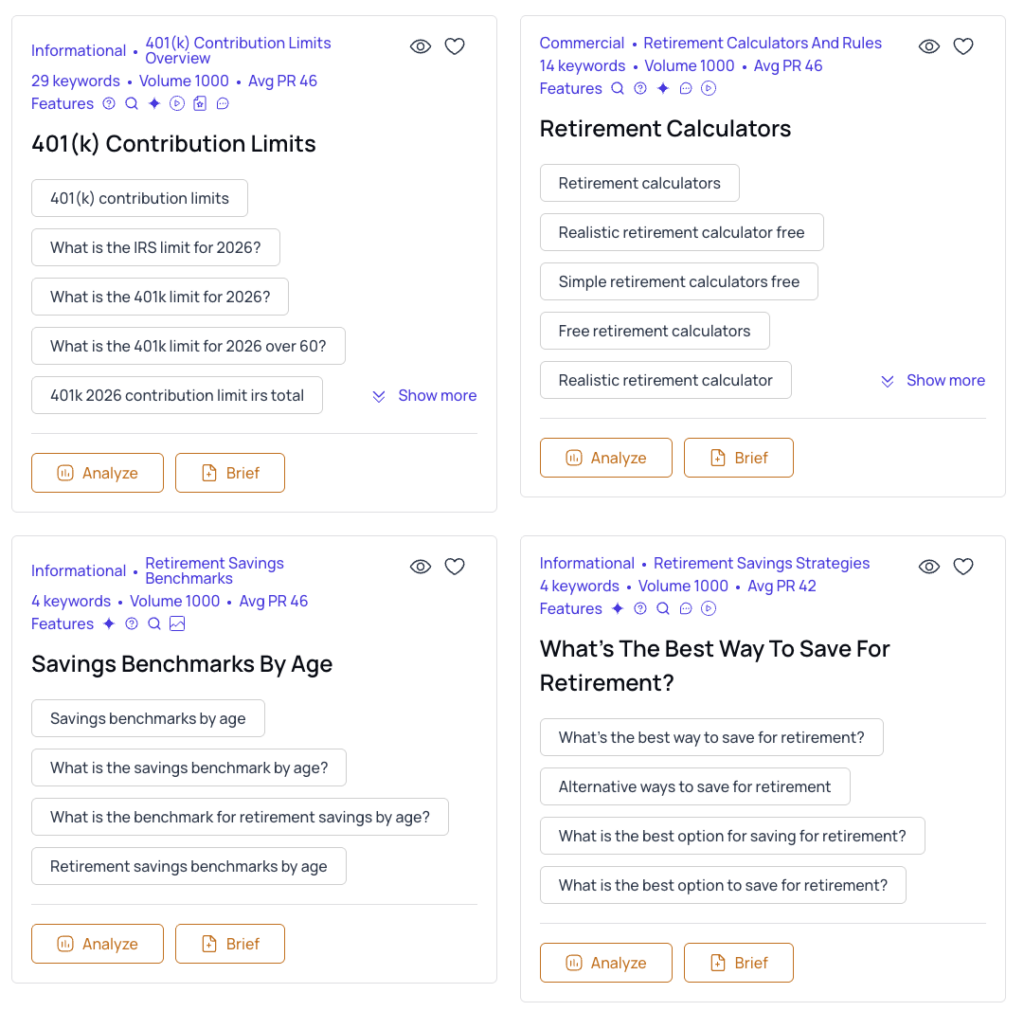
Each card shows a main topic with all its related keywords grouped together.
You’ll also see additional data like search volume, SERP features, and intent signals that we’ll use in the next step.
From my original list of 300+ keywords, thruuu condensed everything into clear, actionable topic clusters.
That’s a lot less noise and a much clearer picture of what content to create.
Step 3: Identify Search Intent and Content Type
This is where things get interesting.
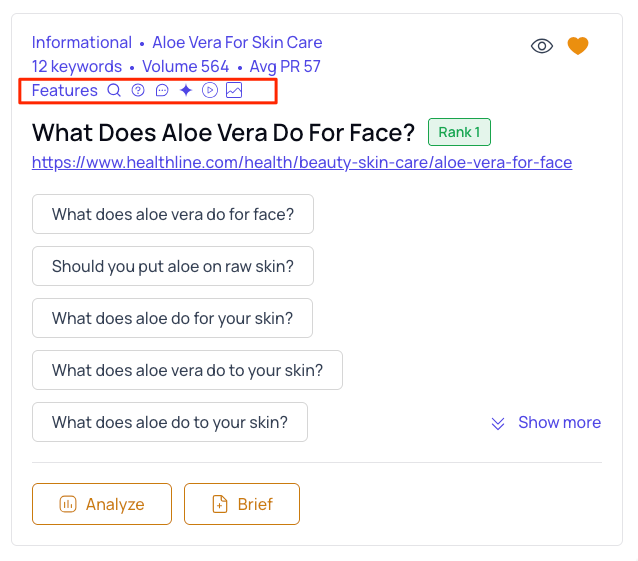
thruuu doesn’t just group keywords together. It goes beyond basic clustering and shows you, for each topic cluster, the search intent, which SERP features are dominant, and whether there’s a strong presence of videos, forums, AI Overviews, or other content types.
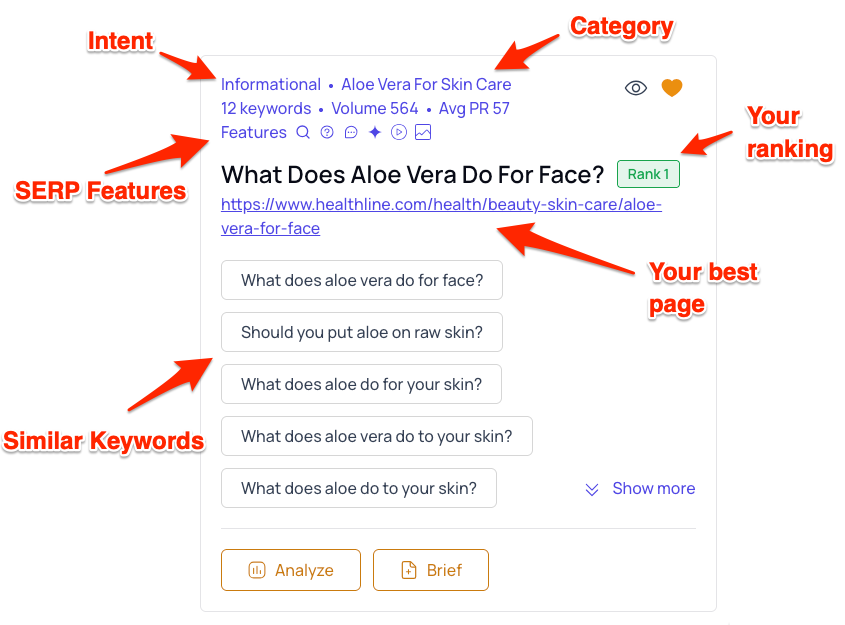
This matters because AI search engines don’t just pick the “best” text. They pick the best format to resolve the user’s intent.
If thruuu shows a cluster is dominated by videos, writing a 3,000-word blog post is a waste of time. The AI will likely cite a YouTube transcript instead.
On top of that, 88% of queries that trigger AI Overviews are informational. These are exactly the queries where format matters most.
Intent mapping isn’t a nice-to-have. It’s essential to decide where to invest your effort and which format will actually earn you visibility.
How to identify search intent and content type with thruuu
You can explore each cluster directly in the thruuu interface (we’ll do that in Step 5), but to fast-track the analysis, I recommend exporting the report.
Here’s how:
- Click on Report in your clustering project
- Open the Topic Cluster tab
- Focus on these columns:
- Intent: tells you whether the cluster is informational, commercial, transactional, or navigational
- SERP Features: shows the percentage of AI Overviews, video boxes, forum results, featured snippets, and more for each cluster
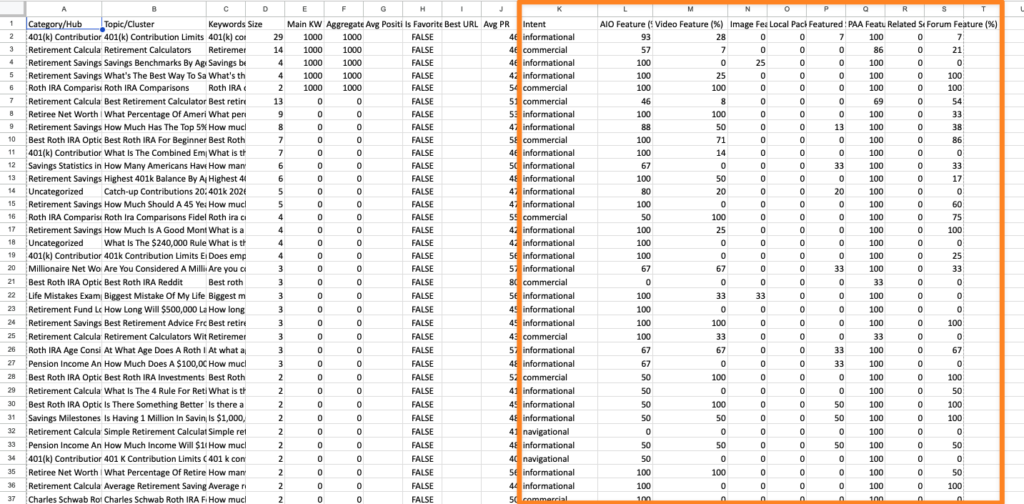
This export gives you a complete overview of every topic, its intent, and the content types that dominate the SERP.
It’s the foundation for the next step, where we’ll define exactly what format to create for each topic.
Step 4: Define the Best Content Format
Let me repeat our goal: we’re building an multi-format content strategy that covers text, video, forum discussions, and free tools. Not just articles.
Using the data from the thruuu export, we can now decide the best format for each topic cluster. I apply a simple set of rules based on the SERP feature data and intent signals:
- More than 50% video? Create a video.
- More than 50% forum? Engage in the discussion (Reddit, Quora, niche communities).
- Calculator topic? Build a free calculator or interactive tool.
- Commercial intent? Create an article. Commercial topics almost always benefit from a dedicated page.
- Too much AI Overview and informational intent? Maybe consider skipping the article.
Why “maybe”? Let’s pause here for a second.
We said previously that most queries triggering AI Overviews are informational. These are exactly the queries where AI summaries tend to absorb the click.
If the SERP is dominated by AI Overviews and the intent is purely informational, your article might feed the AI without driving any traffic.
But that doesn’t mean you should ignore AI Overviews entirely.
You still need to be visible in AI-generated answers. The key is to focus on AI Overviews that trigger brand mentions. That’s your new position 1.
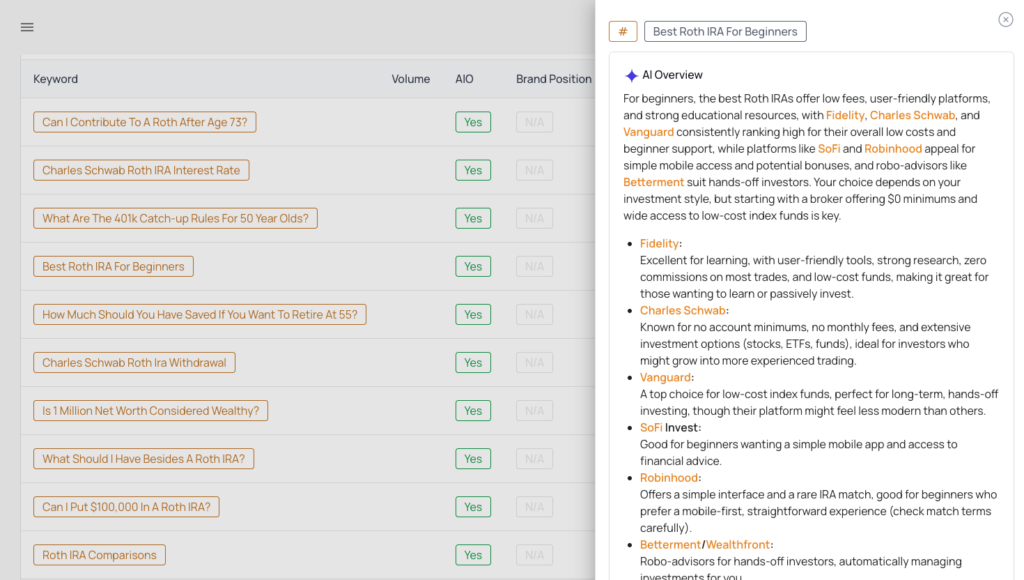
How to monitor brand visibility with thruuu
Upload your list of topics (not every keyword, just the main topic per cluster) to thruuu’s AI Overview monitoring tool to see which keywords trigger an AI Overview.
Then use the filters to check which ones include brand mentions.
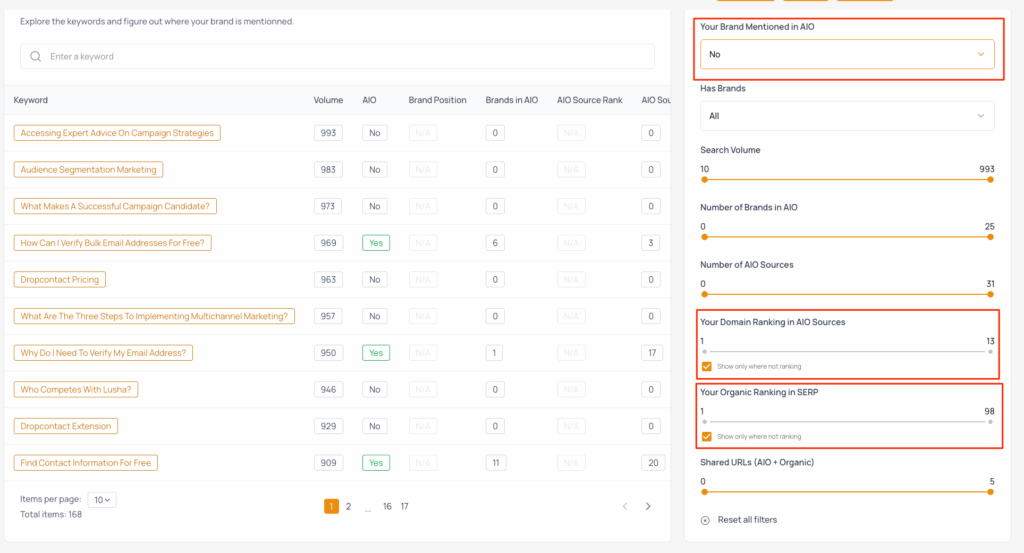
You can go deeper and identify where your brand is not mentioned.
These are the topics where you should focus your effort and make your brand visible in the AI-generated answer.
Learn more: Track and Monitor Your Visibility in Google’s AI Overviews with thruuu
Now back to the rules
Turning rules into formulas
I translate these rules into simple Excel or Google Sheets formulas and apply them directly on the thruuu export.
For each topic cluster, I create new columns:
- Video (yes/no),
- Forum (yes/no),
- Tool (yes/no),
- Article (yes/no).
The formulas are straightforward. For example, if the video box percentage column is above 50%, the Video column returns “yes.”
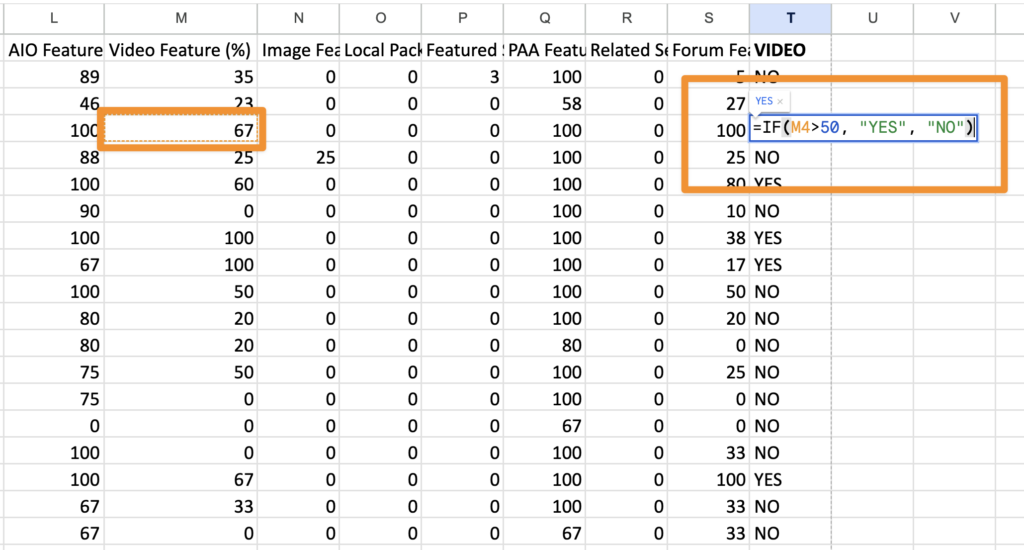
Same logic for forums, tools, and articles.
At the end, you have a clean file like this: every topic with its intent and the content formats you should create for each one.
Feel free to define your own. You have the data. Adapt the thresholds and logic based on your business goals and your brand’s strengths.
Should you cover every topic?
Probably not.
Up to this point, our goal was to identify what to create. But the process has its limits. Some topics might not be worth the effort, others might need to be combined, and you’ll need to factor in your resources and business priorities.
That’s what we’ll tackle in the next step: setting priorities and diving deeper into each topic.
Step 5: Set Priorities and Analyze Each Topic
Let’s be realistic. You probably can’t create every article, video, tool, and forum post on your list. Defining priorities is essential.
How to prioritize
The thruuu export already provides useful data to help you decide where to focus first. For instance:
- Average PR (Page Rank): This indicates the level of competition for a topic. High competition might mean you need stronger content or more authority to break through.
- Your existing rankings: If you already have a page ranking for a cluster, you might not need a new article. Maybe you just need to optimize the existing one.
- Search volume: Use the main keyword volume or the aggregated cluster volume to gauge potential impact.
Keep in mind that priorities are subjective. They depend on your business goals and the strength of your brand. A small brand might focus on building awareness through less competitive, long-tail topics. A big player might go after the high-volume, high-competition clusters.
You have all the data in the export. Apply your own formulas and logic to rank your topics.
I’ve done a dedicated video where I walk through how to set priorities on a thruuu export. Watch it for inspiration:
Analyze each topic in detail
Once your topics are prioritized, it’s time to go deeper.
Go back to the thruuu interface and open the cluster analysis for each topic you’ve selected.
This is where thruuu becomes your creative assistant. For each cluster, you’ll find:
- Competitors: Who ranks for this topic, what domains dominate, and how their content is structured
- Outlines: The headings and subtopics competitors cover, so you can spot gaps and angles
- Content briefs: You can create a content brief directly from the cluster analysis. This is the perfect flow for building an article.
- Forum discussions: See which Reddit threads, Quora answers, and community conversations show up for this topic. This tells you exactly where to engage.
- Videos: The top videos appearing on the SERP and within pages, giving you inspiration for your own video content.
thruuu gives you all the insights you need to create great content. It won’t do the creative work for you, but it will make sure you’re building on solid data.
Quality takes time
We built this entire content strategy in less than 30 minutes. But analyzing each topic and creating the actual content will take more time.
That’s the point. Don’t rush it. The whole reason we went through these steps is to make sure every piece of content you create is worth the effort.
Why This Content Strategy Works for AI Search
I’m not just dropping “AI search” into this article to surf on a trending topic.
I genuinely believe this strategy will increase your visibility on Google AI Overview, ChatGPT, Gemini, and whatever comes next.
Here’s why.
1. Your clustered keyword maps directly to Query Fan-Out
When you enter a prompt or question into an AI search engine, it doesn’t just run a single search.
It uses a process called Query Fan-Out (or Query Decomposition).
Here’s how it works: the AI takes your complex question and breaks it down into 5 to 15 sub-queries to build a comprehensive answer.
For instance, a prompt like “What’s the best way to save for retirement in my 30s?” could be decomposed into:
- What are the best retirement accounts for people in their 30s?
- How much should I have saved for retirement by age 35?
- 401(k) vs Roth IRA: which is better for long-term growth?
- What are common retirement saving mistakes to avoid?
- How do employer matching contributions work?
Look familiar? These are exactly the kinds of topics we uncovered in Steps 1 and 2 by building our keyword universe and clustering by SERP similarity.
By covering all these related angles, you’re essentially pre-creating the content that matches the AI’s sub-queries.
And the data supports this: if you cover all PAA and long-tail angles around a topic, you are 2.8x more likely to be the primary citation.
That’s because AI identifies thematic gaps. If your content fills them, you become the go-to source.
On top of that, AI builds answers in logical steps, following what researchers call reasoning chains.
Your structured topic clusters act as a roadmap that aligns with exactly how the AI constructs its response.
2. Multiformat content matches how AI actually sources its answers
In this AI Search era, text-only content is a disadvantage.
AI models are now truly multimodal. They don’t just read your content. They watch videos and analyze community discussions too.
Going beyond articles and strategically including YouTube videos and Reddit discussions directly increases your chance of being cited.
The numbers are clear:
- YouTube is a top-tier source: YouTube is now the #2 most-cited source in Gemini and Perplexity. In e-commerce queries, YouTube citations have increased by 121% year-over-year.
- Community content is the social proof signal: Reddit and other community platforms account for 48% of all AI citations. AI models use forum discussions to verify real-world experience (E-E-A-T) that a standard blog post often lacks.
This is why Step 3 and Step 4 matter so much.
By using thruuu’s SERP feature data to understand which topics need more video than others and which topics need more forum engagement than others, you’re not guessing. You’re making data-driven format decisions that align with how AI search engines actually build their answers.
The bottom line: build your keyword universe, cluster it, match the right format to each topic, and you’ll be positioned exactly where AI search is looking.
Empower Your Content Team
Our end-to-end content optimization solution empowers your team to crack the Google algorithm, craft exceptional content, and achieve remarkable organic search results.