

Most brand guidelines fail not because they’re wrong, but because they’re vague enough to be useless.
The one thing that keeps output consistent isn’t weekly standups or revision rounds… Well it helps… But…
Better create a documented brand guideline specific enough that a writer, or an AI tool, can apply it on the first draft and get close.
A brand guideline tells anyone producing content who you are, who you write for, how you sound, and what to avoid. Without one, every piece starts from zero.
In this article you will learn what a content-focused brand guideline needs to cover. And also get a free example to download and markdown file for your team.
Table of Contents
Most Content Teams Don’t Have a Brand Guideline
Most content teams don’t have a brand guideline. Those that do often have a one-page document listing three tone adjectives. That’s not a guideline. That’s a wish.
57% of marketers struggle to create the right content for their audience consistently. That’s not a talent problem. It’s a system problem.
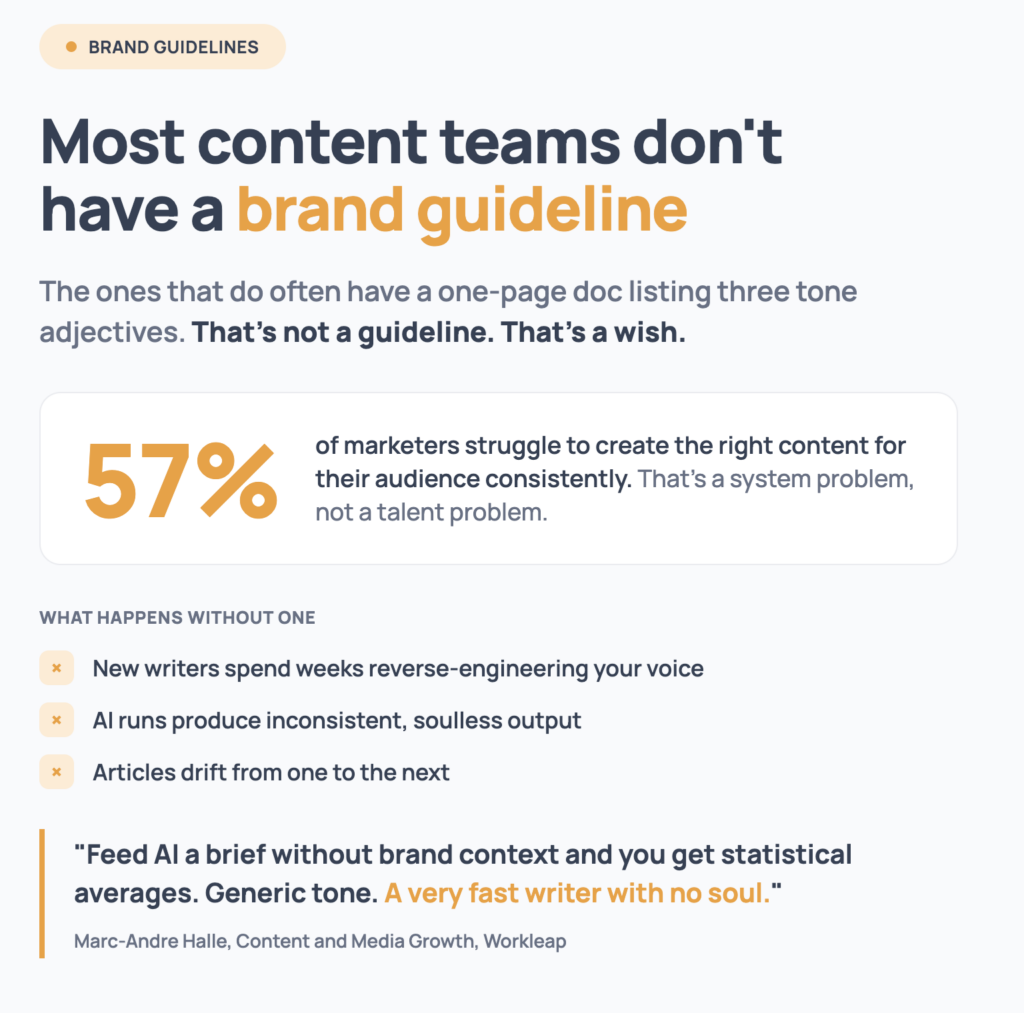
The AI dimension makes this worse. Marc-André Hallé, Manager of Content and Media Growth at Workleap, put it plainly: “If your brand voice and positioning aren’t documented in a way that’s machine-readable and kept live, your AI is just a very fast writer with no knowledge, no context, and no soul.”
He’s right.
Feed any AI tool a brief without brand context and you get statistical averages.
Generic tone. Generic structure. Output that sounds like no one in particular.
What happens without one?
New writers spend weeks reverse-engineering your voice from old posts. AI runs produce inconsistent output. Articles drift from one to the next.
The body of work looks like it was written by several different people, because it was.
A lean, well-built brand guideline fixes this at the source. It doesn’t need to be long. It needs to be specific enough to be usable. That distinction matters more than most teams realize.
What a Brand Guideline for Content Teams Actually Needs to Cover
A brand guideline for content teams is a documented system that defines who the brand is and how it communicates.
It’s not a logo spec or a color palette. Those belong in a design brief.
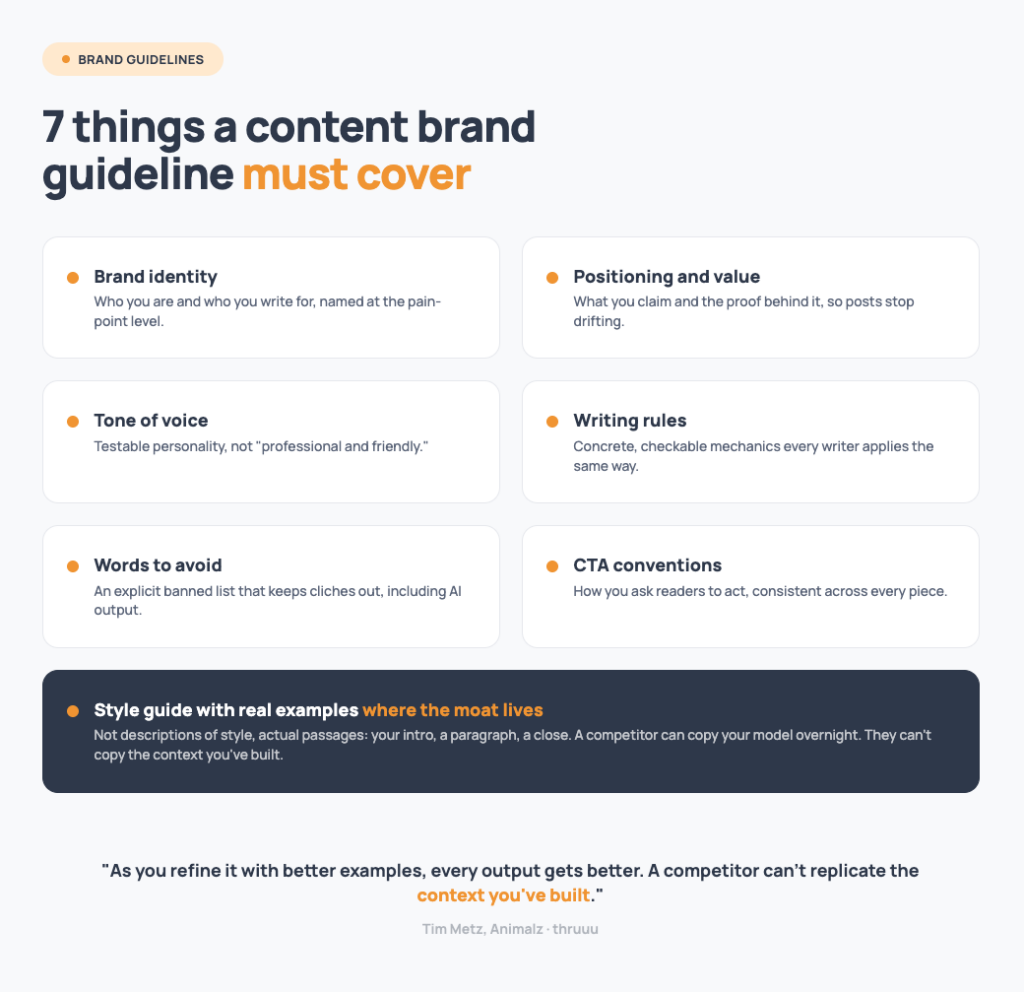
Content-focused guidelines need to cover several things.
- Brand identity: who you are and who you write for. Name your target audience at the level of their specific pain points, not “marketers” but “SEO consultants who publish multiple articles a month and can’t get consistent AI citations.” That specificity shapes every content decision downstream.
- Positioning and value proposition: what you claim and what proof you have. Without this in writing, articles drift. Each post ends up reinforcing a slightly different version of your value, and none of them stick.
- Tone of voice is the personality of the writing. Not “professional and friendly.” Something testable: “practitioner-to-practitioner, direct and staccato, analytical and evidence-led.” A writer needs to hold a sentence up against the tone definition and judge it honestly.
- Writing rules are the concrete, checkable mechanics. Address the reader as “you.” Keep sentences under 25 words. Use sentence case for headings. Concrete rules apply more reliably than vague tone descriptions. Abstract guidance gets interpreted differently by every writer.
- Words and phrases to avoid. A banned list. This is the fastest way to keep clichés and off-brand terms out of everything you publish, including AI-generated titles and descriptions. List them explicitly. Leave nothing to interpretation.
And also examples.
The style guide with examples is where real style lives, shown in actual passages.
Not descriptions of style but examples of style: this is what our intro looks like, this is what a paragraph looks like, this is how we close.
Tim Metz, Director of Marketing and Innovation at Animalz, captured why this matters: “As we improve it over time with better examples, sharper positioning, more refined rules, every subsequent output gets better. A competitor can switch to the same model overnight. They can’t replicate the context you’ve built.”
The style guide with real examples is where the competitive moat lives.
Steps and Tools to Create Brand Guidelines
This is where thruuu’s Brand Kit comes in.
Most brand guideline templates start with a blank form. You stare at “describe your tone of voice” and write something vague, because writing about writing from scratch is genuinely hard.
thruuu inverts this. There’s no blank form. You start from your real content.
Two ways to build your Brand Kit:
- Extract from your URLs. Paste a few of your best article URLs. thruuu reads the pages and fills the Brand Kit with your actual voice and writing style, derived from content you’ve already published.
- Paste your existing guidelines. Drop in an existing brand or style document. thruuu maps it onto the Brand Kit structure.
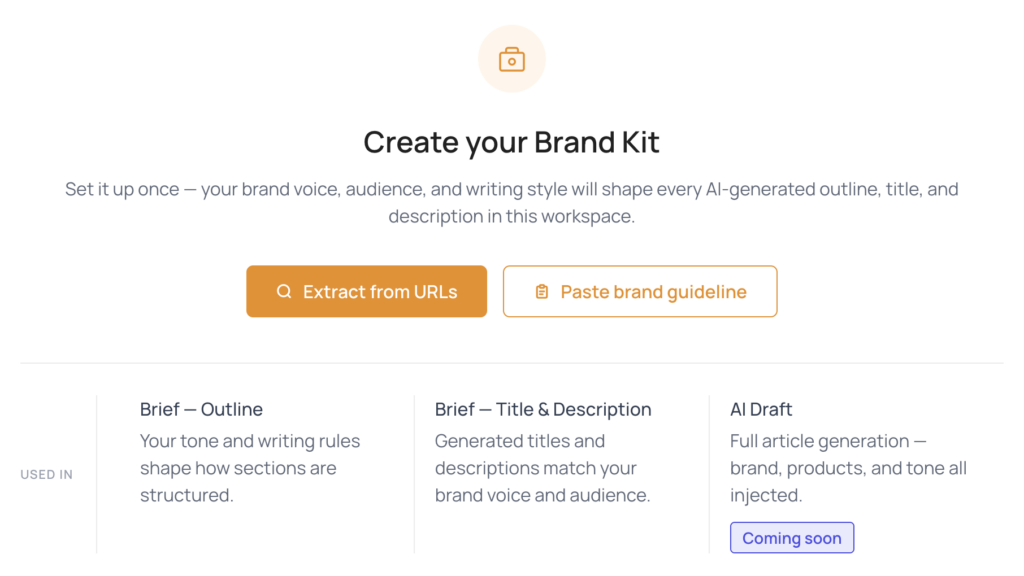
I’ve tried both. Extracting from URLs is faster if you’ve published any content worth pulling from.
Both methods produce the same editable kit. Every field is click-to-edit after generation.
Here’s how to get started:
- Create a free thruuu account
- Log in and open the Brand Kit
- Choose your starting method: extract from URLs, or paste your existing guidelines
- Review each elements and refine any field
- Add your own examples to the Style Guide slots, because this step has the most impact on output quality
Once the Brand Kit is set up, thruuu applies it automatically across your content workflow.
Outlines follow your structure. Titles match your naming convention, with banned words filtered out. Meta descriptions match your style. No extra step required.
You can also export the entire Brand Kit as a markdown file, which is what the next section covers.
Get my Free Brand Guideline Markdown Template
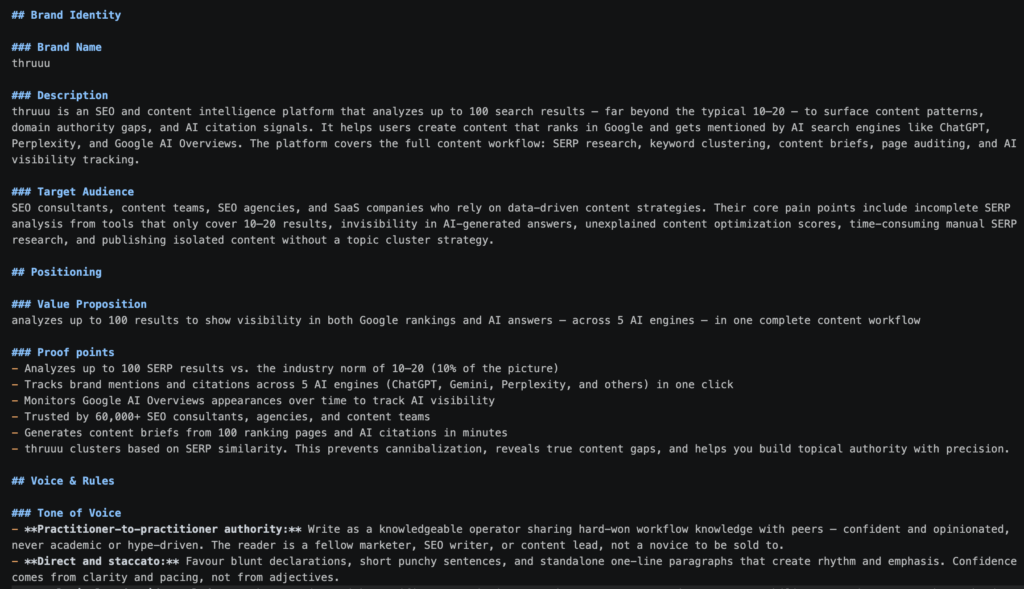
I’m sharing thruuu’s own brand kit below.
Every section shows what a completed brand kit looks like for a real brand.
The template has five sections.
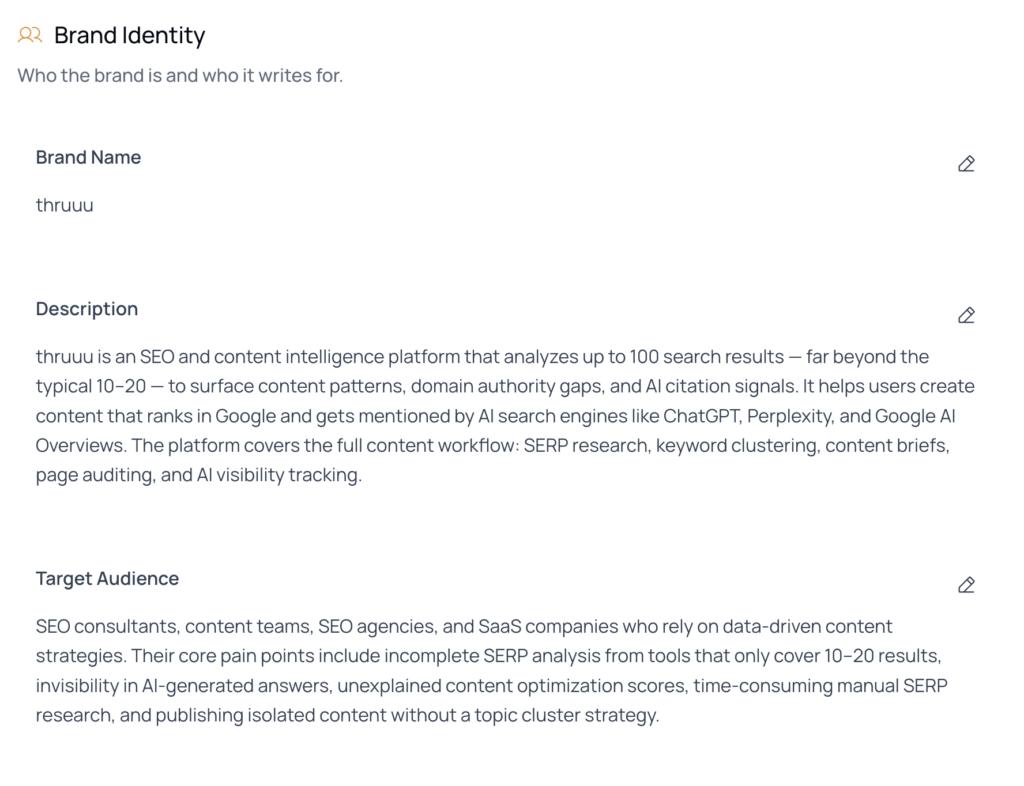
Brand Identity covers brand name, description, and target audience, filled with thruuu’s actual values. The target audience field names specific roles and specific pain points, not broad demographic categories.
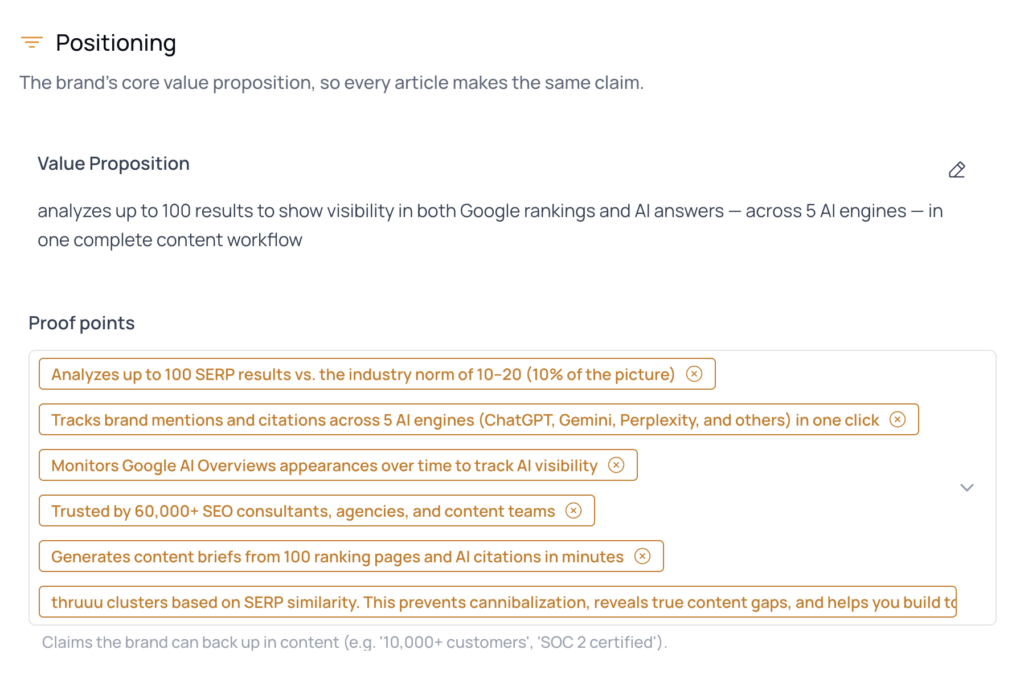
Positioning covers the value proposition and proof points.
The proof points are specific and verifiable: things like “analyzes up to 100 SERP results vs. the industry norm of 10 to 20” and “trusted by 60,000+ SEO consultants.” No generic strength claims.
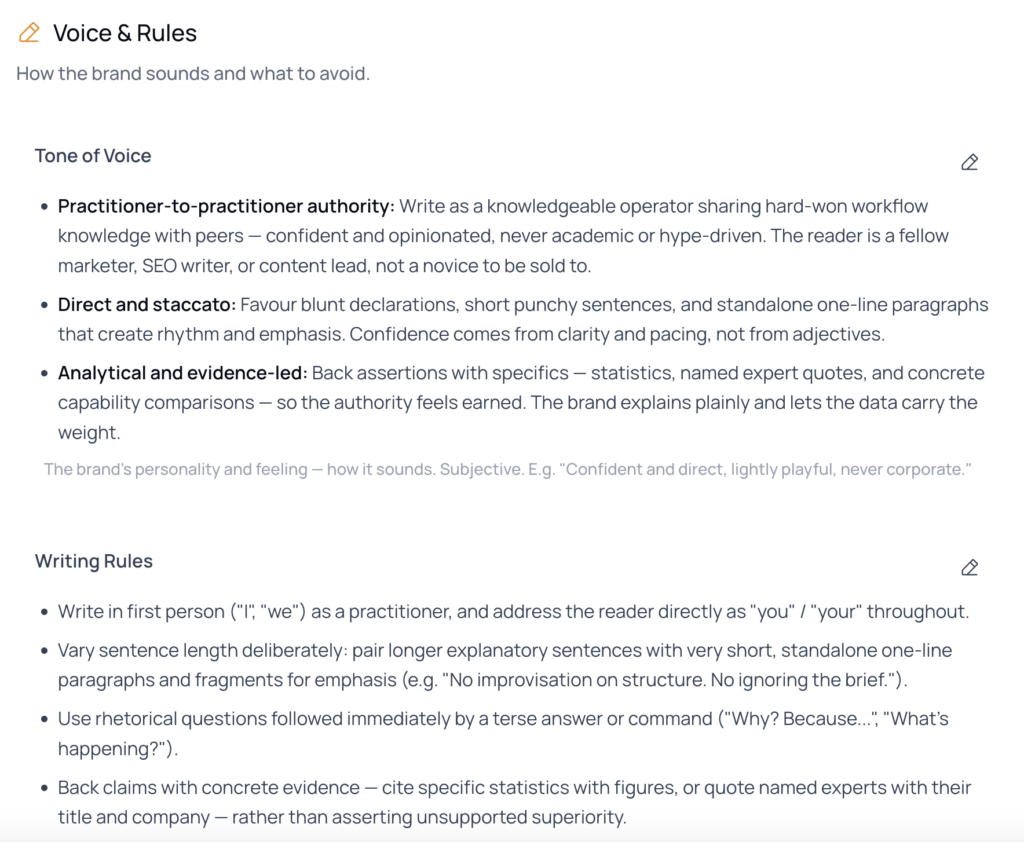
Voice and Rules covers tone of voice and writing rules.
The writing rules are mechanics, not adjectives. “First person, address the reader as you, vary sentence length, use rhetorical questions, avoid vague hedges.” Rules a writer can test a sentence against.
Style Guide is the longest section and the most valuable. It has seven sub-sections: Title Style, Meta Description Style, Outline Structure, Introduction, Paragraph, Transitions, and Conclusion.
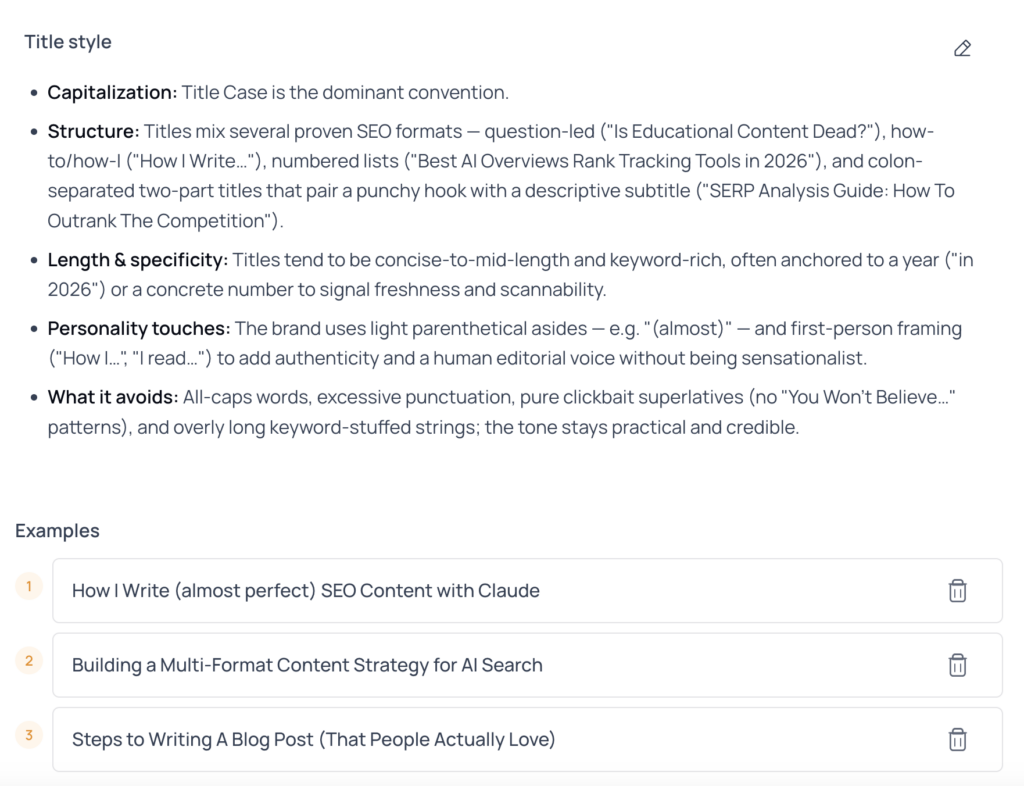
Every sub-section includes a plain-language description plus real prose examples drawn from published thruuu content.
The Introduction sub-section alone includes two full sample intros showing the staccato, first-person, contrarian-hook style in practice.
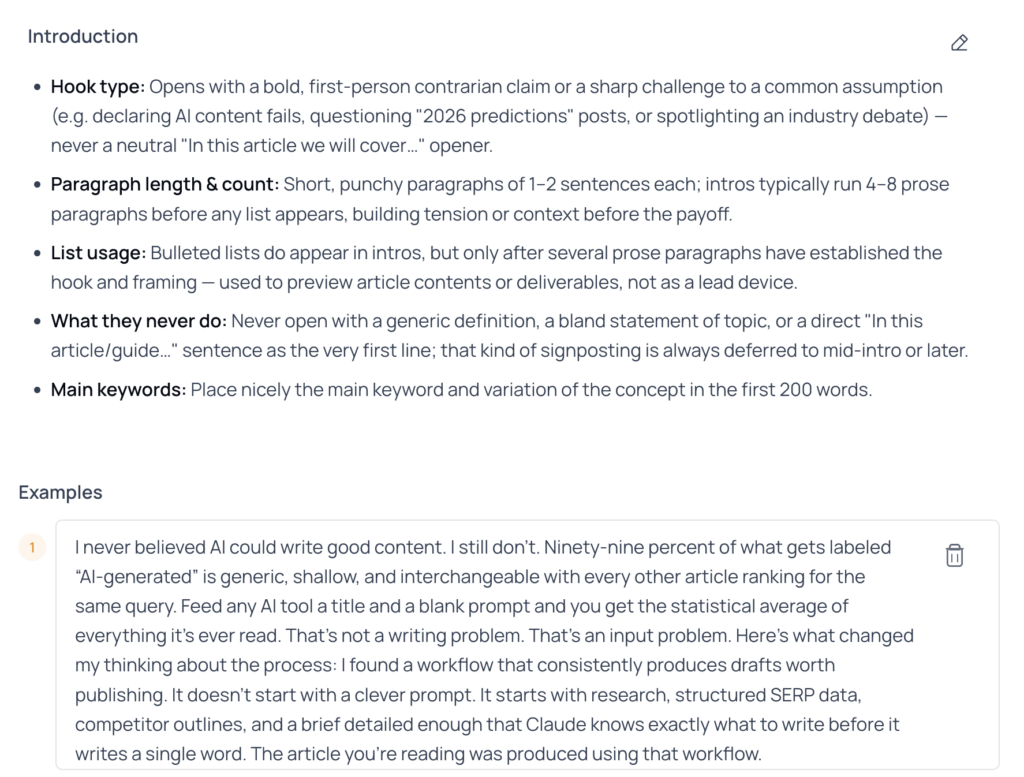
The brand kit can be exported to a markdown. That means it’s human-readable in any text editor and machine-parseable by any AI system.
You can paste it directly into Claude, ChatGPT, or any AI writing tool as a context document or system prompt. No PDF conversion needed. No formatting lost.
Download the template and adapt it to your brand.
FAQ about Brand Guideline
How to share your brand guidelines?
Markdown is the best format for sharing brand guidelines with content teams and AI tools.
It’s human-readable. A writer can open a markdown file in any text editor, no special software required. It’s also machine-parseable: paste it directly into an AI writing tool as a context document, drop it into a Claude system prompt, or feed it to ChatGPT as a knowledge file. A brand guideline in markdown works where a PDF cannot.
PDF is still fine for review and sign-off. But if your team uses AI in the writing workflow, a static PDF is invisible to those tools. Markdown gives you one format that works for both human writers and AI systems.
Who is responsible for creating brand guidelines?
The lead content strategist owns this document. An agency can help draft it, particularly if they’ve worked across many brand voices and know what questions to ask. But someone internal needs to own it, review it, and make sure writers actually use it.
Building a good brand guideline takes real time. It’s not a five-minute task. The Style Guide section alone requires pulling real examples from published content, writing clear descriptions of each element, and checking whether the rules are specific enough to apply consistently.
How often do I need to update my brand guideline
Whenever you update your brand or your content strategy, update the guideline at the same time.
Most teams drift because they shift their positioning, run a rebrand, or change editorial direction, and forget to update the guideline. The document goes stale. Writers work from outdated instructions. AI tools produce output based on voice patterns that no longer match the current brand.
The fix is simple: set a trigger. Any change to positioning, audience, or editorial direction triggers a guideline review. Update both at the same time, every time.
Your brand guideline is the document that makes every subsequent piece of content easier to produce and more consistent to review. Build it once and keep it current. Every writer on your team, human or AI, pulls from the same source of truth on every draft.
Empower Your Content Team
Our end-to-end content optimization solution empowers your team to crack the Google algorithm, craft exceptional content, and achieve remarkable organic search results.