

You’ve spent years implementing Google’s updates, building topical authority, earning backlinks, and optimizing for featured snippets. And just when your organic strategy felt airtight, Google flipped the board.
AI Overviews now sit above everything you’ve worked for. They summarize, answer, and sometimes send users away without a single click to your site.
That’s a ruin on the entire SEO game.
What’s more frustrating is that traditional ranking signals don’t automatically earn you a mention in AI Overviews. A page can rank #1 on SERP and still be invisible inside an AI Overview.
That disconnect is exactly what this guide is here to fix
You’ll learn the actionable steps to get your pages mentioned in AI Overviews.
Table of Contents
Understanding AI Overviews: Brand Mentions & Citations
If you’ve been in SEO long enough, you remember the time when featured snippets first appeared. AI Overviews are that moment times ten.
In 2024, Google rolled out AI Overviews. They are AI-generated summaries that appear at the very top of search results pages. They curate information from multiple sources to answer users’ queries. According to recent data, AI Overviews now appear in nearly 55% of all Google searches.
For users, it means convenience. Meanwhile, for site owners, it means visibility has a new gatekeeper.
Now, two metrics define your AI overview presence: Brand mention and Citation.
| Factors | Brand mention | Citation |
| Appear as | Named reference in AI-generated text | Linked source in the reference panel |
| Drive traffic | Rarely directly | Yes |
| Build authority | Strong brand signal | Strong trust signal |
| How to track | AI monitoring tools, manual SERP checks | AI tracking tools |
A brand mention is when Google’s AI references your company, product, or content by name in the overview text.
For instance, if you search “best tool for creating topic clusters,” Google’s AI Overview includes “thruuu”. That’s a brand mention.
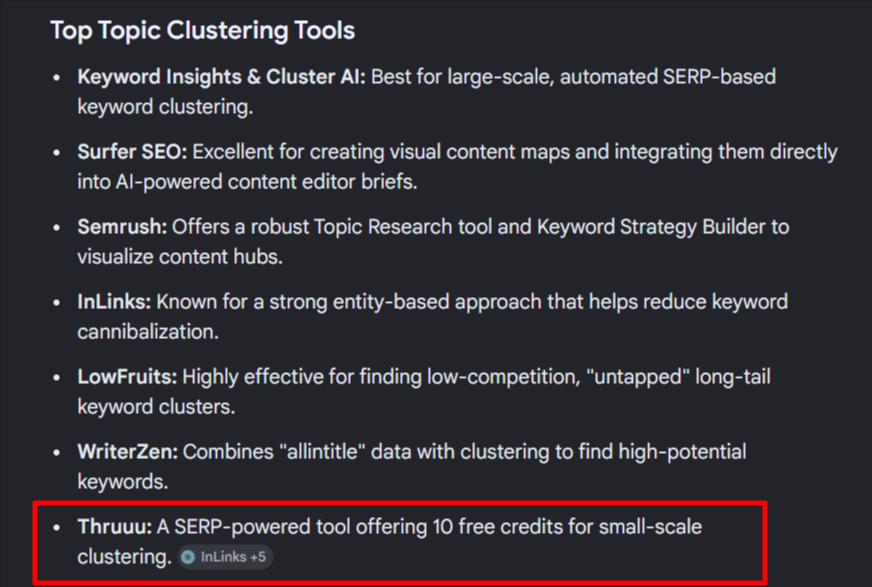
Brand mention positions your brand as a recognized authority in the AI’s “understanding” of a topic.
Citation, on the other hand, is the clickable source links that appear beneath or alongside the AI-generated summary.
These are the direct traffic drivers. They are the AI’s way of saying “we pulled this from here.”
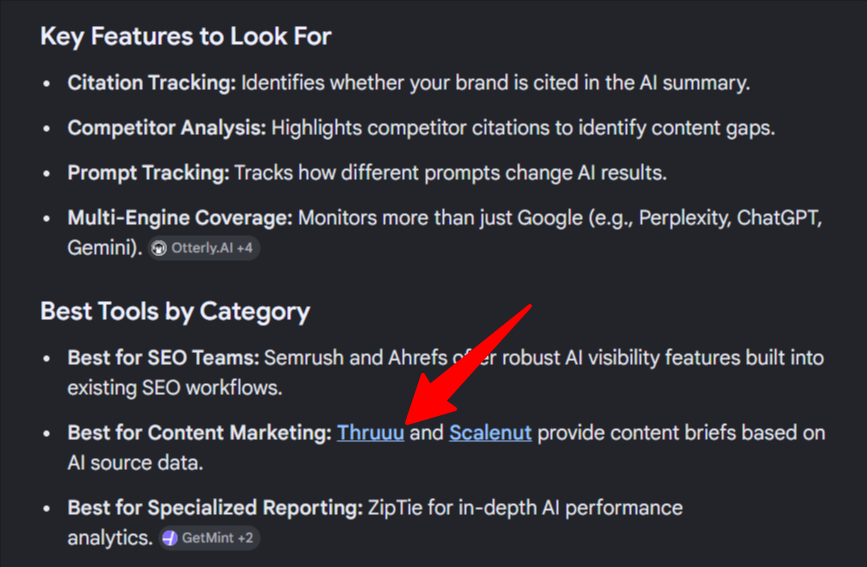
Google may cite your domain as a reference even if your brand name isn’t named in the summary text.
Both matter, but they signal different things.
A brand mention tells you Google’s AI recognizes your brand as a relevant entity for that query. A domain citation tells you your content is trusted as a source. The goal is both.
To either get a brand mention or citation, these three factors must be in place:
- Authority: Are You a Recognized Voice in Your Niche? This factor goes beyond domain authority scores. The AI is looking for signals that your brand has earned its standing in a specific topic area: consistent publishing history on that topic, mentions by other credible sources, E-E-A-T signals embedded in your content (real authors, verifiable expertise, first-hand experience), and engagement patterns that suggest readers find your content genuinely useful.
A high DA site publishing thin, broad content will lose to a mid-DA site that owns a niche with depth and consistency.
- Relevance: Does Your Content Directly Answer the Query? AI Overviews are query-specific. The system isn’t asking “who is the most authoritative SEO site?” Rather, it’s asking “which piece of content best resolves this specific search intent?” That means hyper-relevant, intent-matched content consistently outperforms broad pillar pages.
- Context: Is Your Content Part of the Broader Conversation? LLMs are trained on patterns across the web. If your brand appears across multiple credible sources, i.e., cited in roundups, referenced in industry discussions, and mentioned in forum threads like Reddit, the AI model develops a contextual familiarity with your brand as a relevant player in a given topic space. This factor is why off-page brand building and digital PR aren’t just for traditional SEO anymore. They directly feed the AI’s confidence in referencing your pages.
7 Steps to Get Mentioned in AI Overviews
Let’s get into the real deal. Here are the seven action tips to implement to improve your AI Overviews’ visibility:
Step 1: Monitor Your AI Overview Visibility
You cannot improve what you cannot measure.
You need a clear baseline before creating your pages: which of your target queries are triggering AI Overviews? Are your competitors being mentioned while you’re invisible? Without this data, any optimization effort is just noise.
This is exactly where thruuu’s AI Overviews monitoring tool becomes your starting point.
The tool shows your keywords that trigger AI Overviews, tracks when AI Overviews mention your brand, monitors competitors cited, and when you’re missing.
To start, upload your keyword list, add your domain and brand name, and thruuu scrapes Google to extract AI Overview data. It gives you a structured view of your brand’s presence (or absence) across every query in your set.
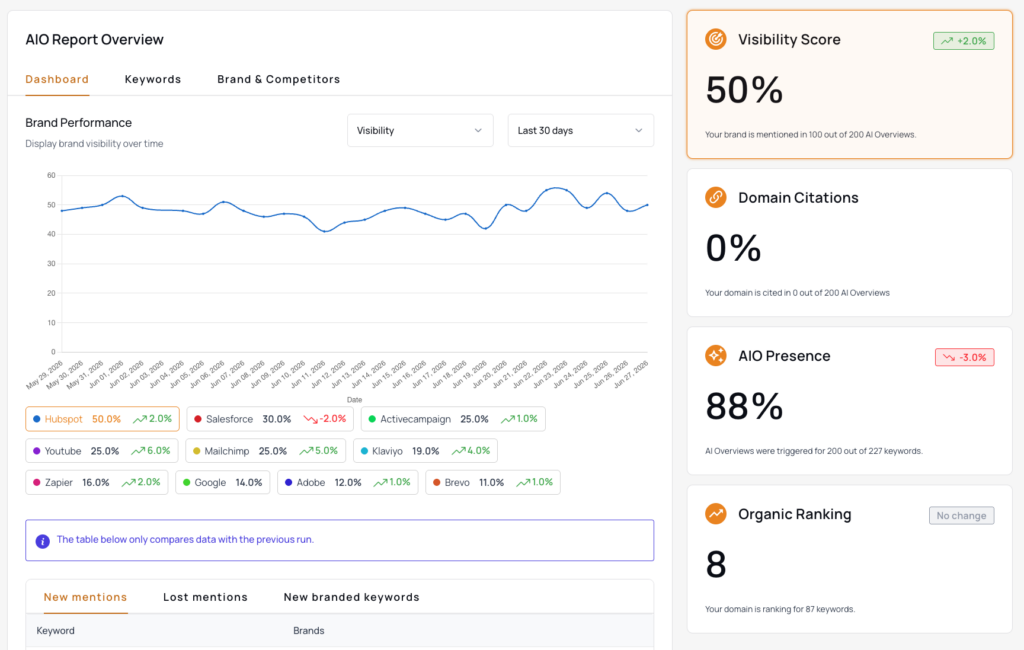
Each report shows four key metrics:
- Visibility Score: How often your brand is mentioned across tracked queries
- Domain Citation Rate: How often your domain is pulled as a cited source
- AIO Presence Rate: What percentage of your keywords actually trigger an AI Overview
- Organic Ranking: Who is getting visible on the classic SERP listing
Pro tip: Don’t dump a long list of random keywords into one report. Rather, create separate reports by topic. This way, you measure visibility by topic and act on clean data rather than blended averages.
Not sure which keywords to include? Read how to find prompts to track for a step-by-step process that builds a keyword list from Google Search Console and People Also Ask data.
Step 2: Identify Queries with Brand
Once your first report runs, your queries will fall into three groups.
The first group does not trigger an AI Overview at all. Set these aside. There is nothing to appear in.
The second group triggers an AIO without any brand names in the summary. These are mostly informational queries. Google synthesizes a general answer without naming specific companies. Competing for a brand mention here is difficult and rarely worth prioritizing.
The third group triggers an AIO that includes brand names. These are your targets. A competitor is already being mentioned, indicating that Google has deemed this query type appropriate for brand visibility. Your job is to figure out why it’s them and not you.
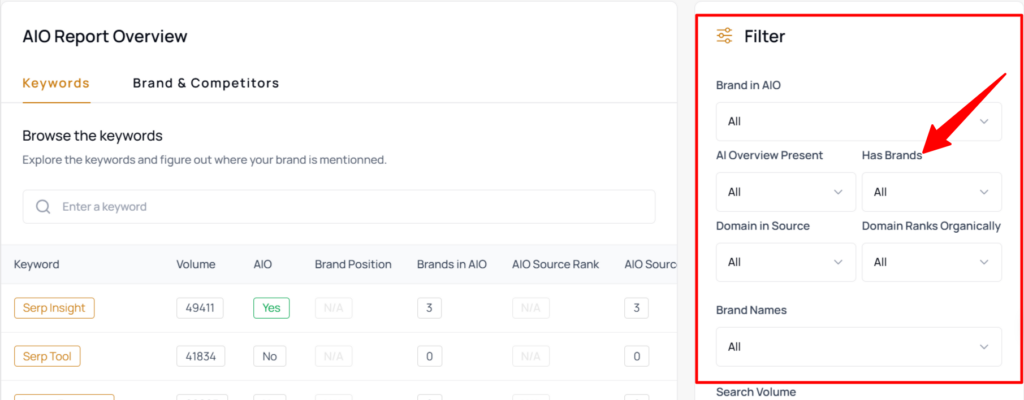
thruuu’s AIO monitoring tool features a filter that helps you streamline the AIO report to only keywords whose AI Overviews mention or cite a brand. These queries have confirmed commercial or comparative intent, and you have a clear opportunity for displacement.
Step 3: Identify Queries with Brand Where You Are a Source
Go one level deeper. In queries where brands appear in the AIO, check whether your site already ranks in Google’s organic top 10 or is cited as a source in the AI Overview.
If Google is already treating your content as a reference but your brand isn’t mentioned in the summary, that’s low-hanging fruit. The content is trusted. The mention may be one content update away.
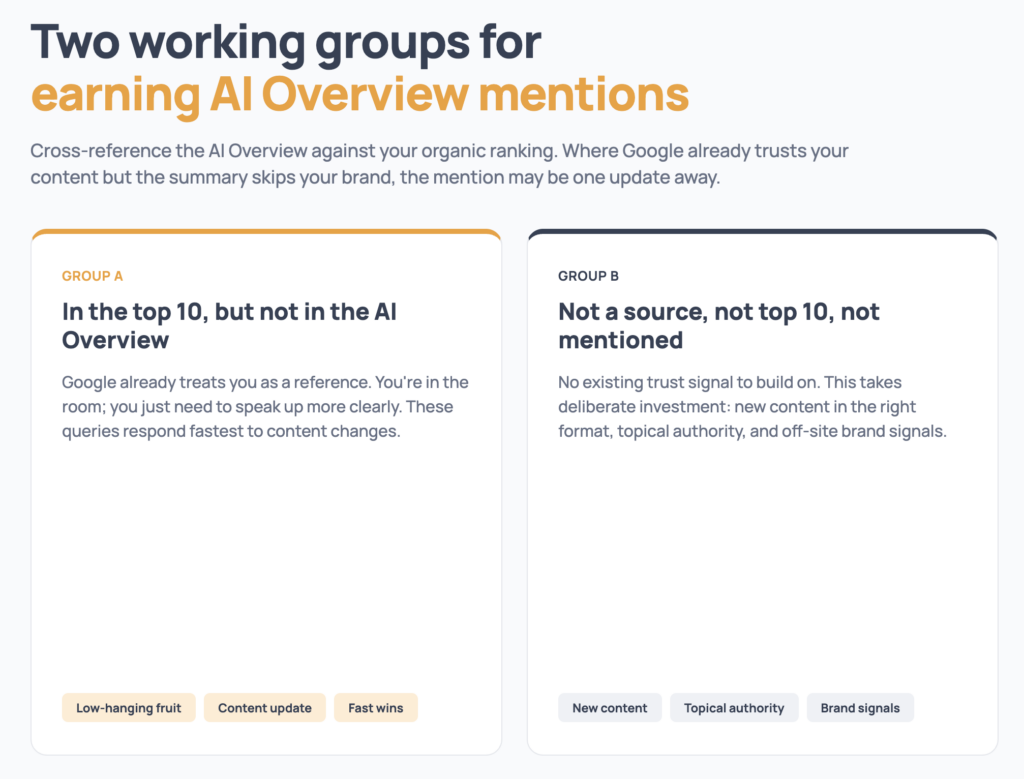
This analysis gives you two distinct working groups:
Group A: You’re already in the organic result top 10, but not mentioned in the AI Overview. These queries respond fastest to content changes. You’re already in the room; you just need to speak up more clearly.
Group B: You’re not a source, not in the top 10, and not mentioned. These keyword groups require a more deliberate investment: either creating new content in the right format, building topical authority, or earning off-site brand signals. More on that in Steps 6 and 7.
Note: You can scrape AI overviews with thruuu’s SERP Analyzer to extract exactly which sources Google is citing, as well as what’s in their headings, word count, topics covered, and brand co-mentions.
Step 4: Figure out Signals Triggering a Brand Mention
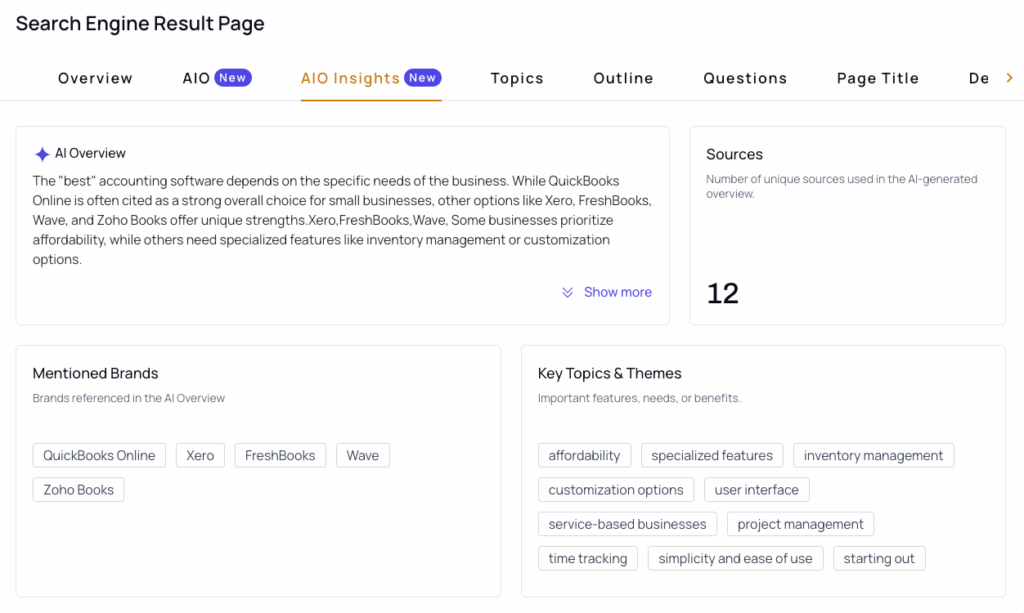
Now comes the analysis. Open the AI Overviews for your target queries, read the summaries carefully, and look at the source pages Google is pulling from.
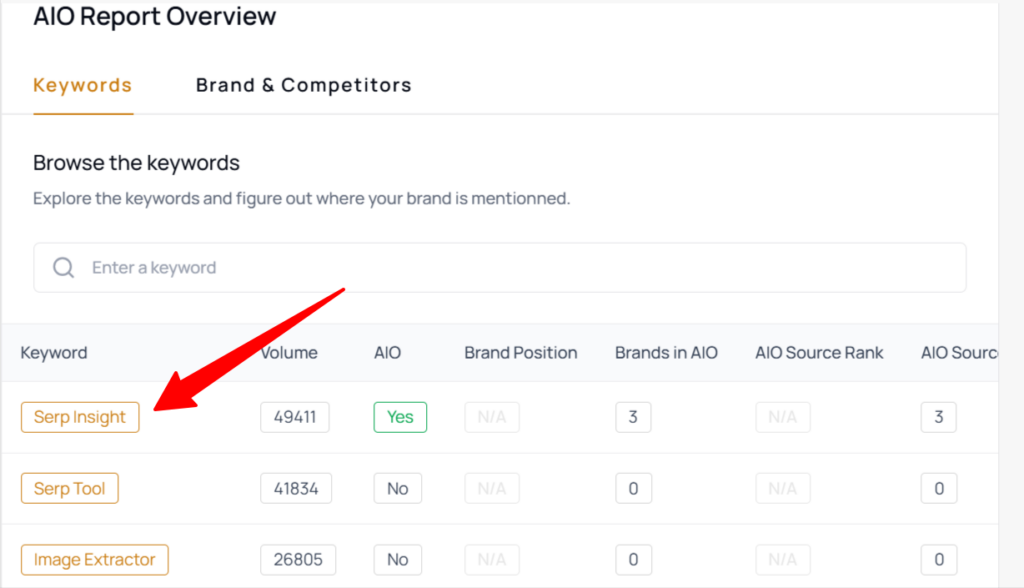
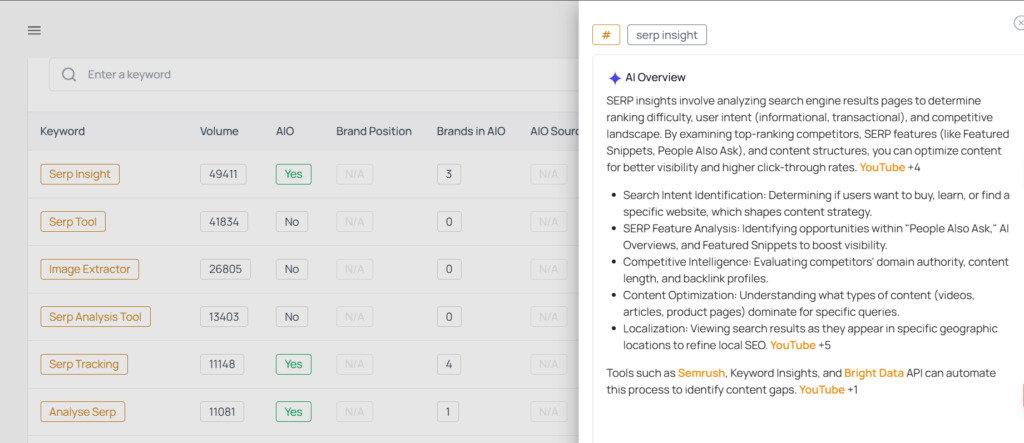
Interestingly, you don’t need to open a new Google search page to check your keywords’ AI Overviews. You can see them directly on thruuu with the brands mentioned and cited.
Click on your keyword that triggers AIO.
thruuu shows the AI Overview, the sources, brands mentioned, and even the organic SERP ranking.
Now, answer these three questions:
- What are the cited pages doing that your content doesn’t?
- Are competitors being named because they appear in third-party content across the web, not just on their own site?
- Is Google sourcing YouTube videos, Reddit threads, or G2 reviews rather than blog articles?
That last point changes your strategy. If YouTube videos appear as AIO sources for a query, the format is the signal, not just the words. Google may weigh community discussion or video explanation more heavily than a traditional article for that query type.
Also, study brand co-occurrence. If cited sources mention your competitors alongside relevant category keywords but never name your brand, you have an off-site gap to close.
Google’s AI learns associations from the content it reads across the web. If your brand isn’t showing up in context on third-party pages, no amount of on-page optimization will fully close that gap.
Step 5: Refresh Your Content
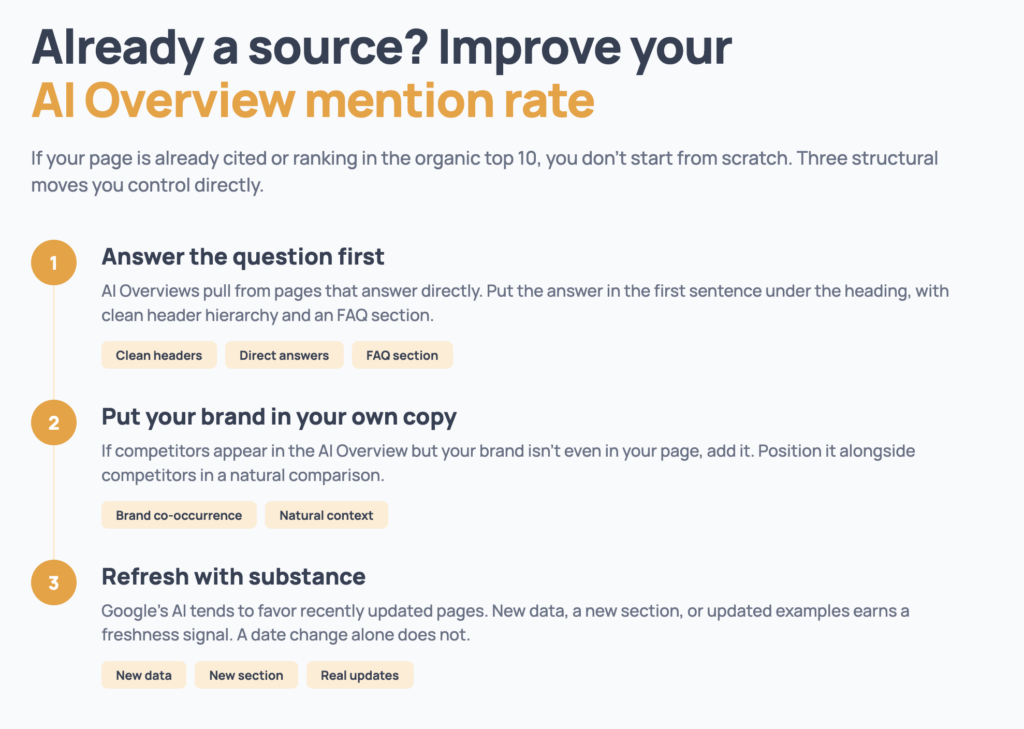
If your site is already a source or in the organic top 10, you have a real opportunity to improve your AI Overview mention rate without starting from scratch.
Content structure matters here.
AI Overviews consistently pull from pages that answer questions directly, use clean header hierarchies, and include FAQ sections. If your page buries the main answer in a long introductory paragraph, rewrite so the answer appears in the first sentence under the relevant heading.
If competitor brands appear in the AIO text but your brand isn’t in your own copy, add it. Position your brand alongside relevant competitors in a natural comparison context. Brand co-occurrence in your own content is a signal you control directly.
Fresh, updated content also matters. Google’s AI tends to favor recently refreshed pages over older ones when content quality is otherwise similar.
A meaningful update, i.e., new data, new section, or updated examples, gives the page a freshness signal. A date change without substance does not.
Pro tip: Highlight something unique about your product or point of view. Content that only you can write, because it draws on data or experience specific to your team, is exactly the kind of pages that earn AI citations over generic summaries.
Step 6: Define Your Next Content and Pick the Right Format
If you are not a source at all for a target query, you need to create content. But content doesn’t always have to be a blog article.
Look at what formats Google is already citing for that query. If YouTube videos appear as AIO sources, a video may earn a citation faster than an article. You can always complement a video with a supporting article to increase your overall reach.
For informational queries where brand mentions are rare, focus on ranking in AI Overviews through topical authority. Publish a cluster of related content that establishes your domain as the go-to source on the topic.
For commercial or comparative queries in which brands are already mentioned, write a page that identifies the relevant competitors, clearly positions your brand, and directly addresses the query.
A comparison page, a ranked roundup where you appear, or a detailed how-to that references your product in context — these formats tend to earn citations.
Use AI Overview trackers to monitor whether newly published content earns citations after it is indexed.
Step 7: Leverage Digital PR and Outreach
Your brand visibility in AI Overviews is not determined solely by what you publish on your own domain. It’s shaped by what the rest of the web says about you.
Google’s AI reads broadly. When your brand appears in articles on high-authority sites, in podcast show notes, in G2 reviews, in Quora threads, and in Reddit discussions, those mentions add up to a signal.
The AI learns that your brand is associated with certain topics because it sees that association repeated across independent sources.
Digital PR is a systematic way to build that signal. Here are some strategies you can implement:
- Get your team quoted in expert roundups.
- Respond to journalist queries in your niche.
- Publish original research that others will cite.
- Get listed in “best of” articles on sites that rank well in your category.
The goal is not just backlinks but brand-entity associations, i.e., your brand name appearing alongside the right keywords and topics in credible, third-party contexts.
This is the work that makes every other step in this guide more effective over time.
AI Search is not an Exact Science
Getting mentioned in AI Overviews follows patterns rather than rules. Google has not published a checklist.
What works for one brand in one category does not always transfer directly to another.
How long does it take to rank in AI Overviews? There is no fixed timeline. Some brands see citation improvements within weeks of a content refresh. Others take months of consistent publishing and PR before Google’s AI begins associating their brand with a topic.
The guarantee is that the steps shared in this guide have worked for us and several sites.
The practical starting point is to track your visibility in AI Overviews to establish a baseline. From here, you will know where you are and take the next step.
Start your free trial to see where your brand stands in AI search and get insights on how to increase your visibility.
Empower Your Content Team
Our end-to-end content optimization solution empowers your team to crack the Google algorithm, craft exceptional content, and achieve remarkable organic search results.