

Want to know what information your competitors actually write about and which topics AI engines consider essential for your keyword?
With the Content Analysis tool in thruuu, you can explore the most common content themes found across top-ranking Google pages and pages cited by AI search engines.
The tool clusters similar paragraphs into topic groups, ranks them by coverage, and surfaces content opportunities that no source covers yet.
What the Content Analysis does:
- Group similar paragraphs from organic and AI-cited sources into topic groups
- Show a coverage tier (Very High, High, Medium, Low) for each cluster so you know what’s essential vs. niche
- Flag topics with an “Only Cited by AI” badge when no organic result covers that theme
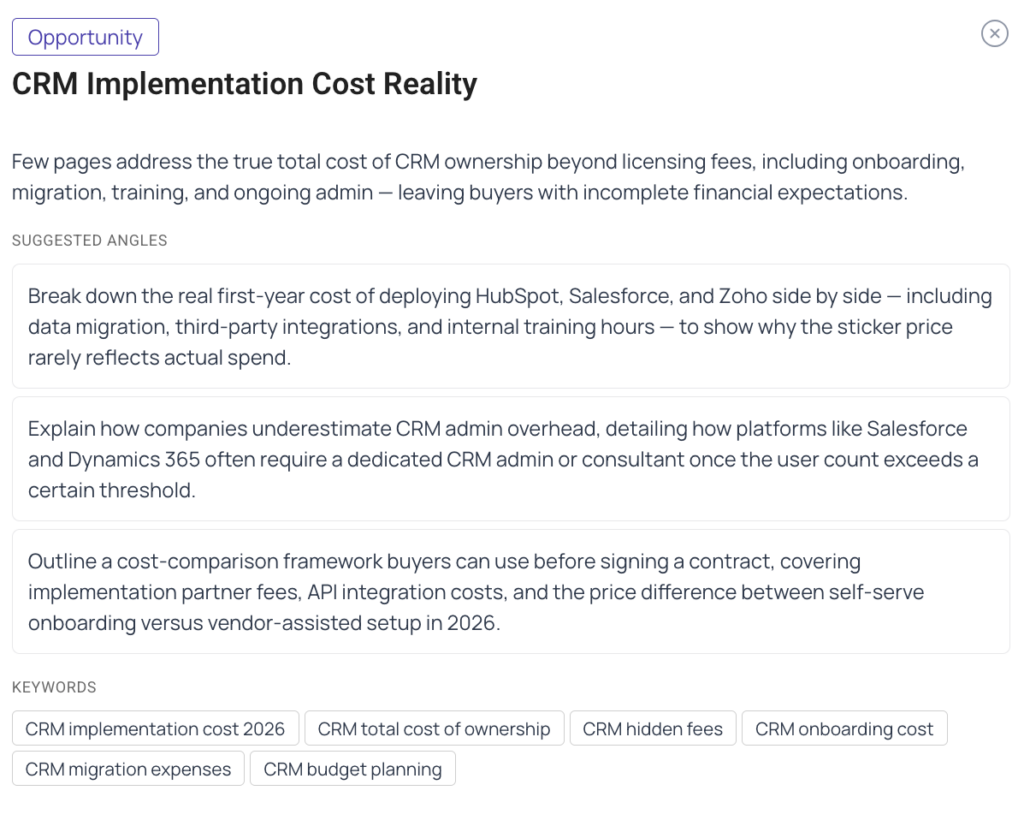
- Surface Content Opportunities: topic ideas that no source covers well
- Display keyword chips for each cluster to connect topics to search terms
- Let you drill into every source behind a cluster, with the actual paragraph text, search position, and engine attribution
While the Heading Analysis shows you what topics competitors cover, the Content Analysis in thruuu shows you what they actually say about those topics.
Use both together to build content that matches intent and goes deeper than the competition.
Overview of the Content Analysis Tool
The Content Analysis lives inside the thruuu SERP Analyzer, under the AI Tools panel.
Select the Content tab and click “Generate” to run the analysis. Results appear automatically once the analysis completes, with no page refresh needed.
The tool analyzes paragraphs from two source pools:
- Organic results: Up to 10 top-ranking pages from Google
- AI-cited sources: Up to 20 pages cited by AI engines (ChatGPT, Gemini, Perplexity, Google AI Mode), shared fairly across engines with no single engine taking more than 10 slots
If your SERP analysis doesn’t include AI engines, the Content Analysis runs on organic results only.
Important: The Content Analysis looks at the pages AI engines cite as sources. It does not analyze the AI engine’s own answer text.
How the Report Works
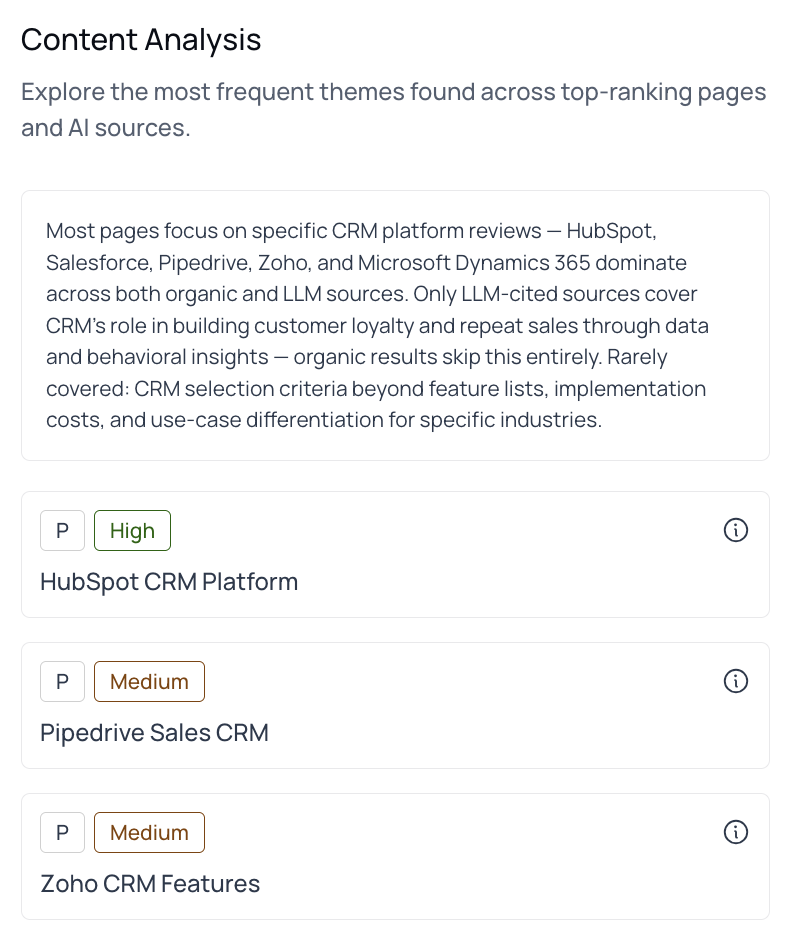
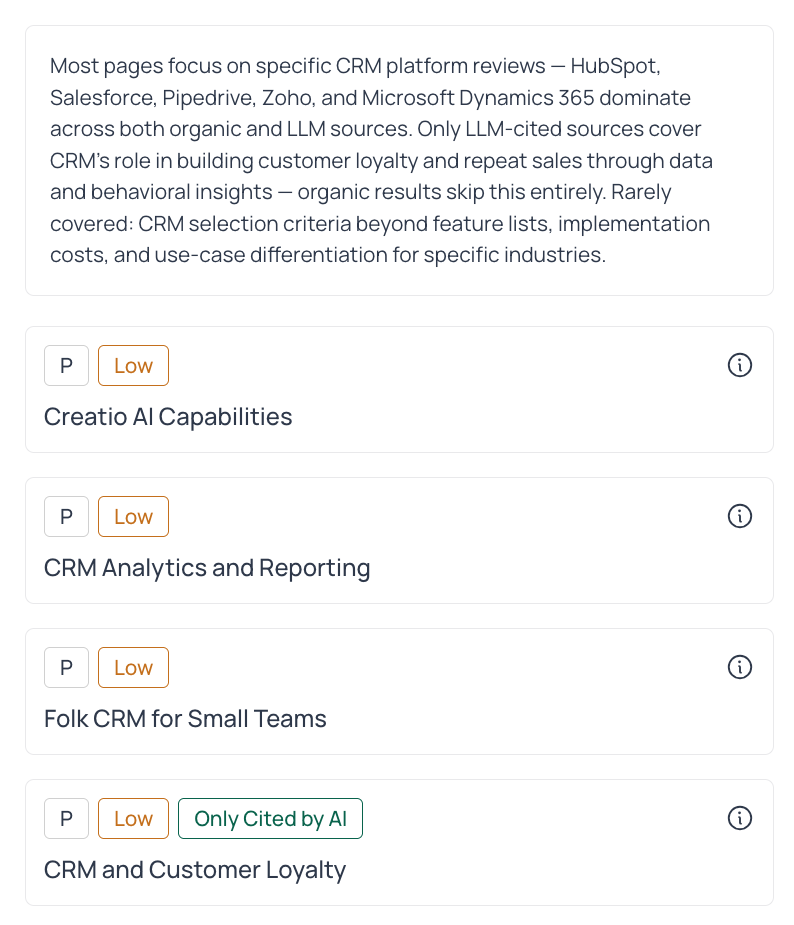
The report starts with a summary paragraph describing the content landscape for your keyword: what most pages discuss, what AI-cited sources uniquely cover, and what’s rarely addressed.
Below the summary, each content cluster appears as a card showing:
- P badge: Indicates this is a paragraph-level (content) cluster
- Coverage tier: How many sources cover this topic
- Cluster label: The topic name
- Info icon: Click to open the source side panel
Coverage Tiers
A cluster’s coverage tier tells you what share of all source pages discuss that topic:
- Very High (70%+ of sources): Core information. Nearly every page includes this. Your content almost certainly needs it.
- High (50–69%): Strong consensus. Most pages address this topic in their body content.
- Medium (20–49%): Moderate coverage. Include if relevant to your angle or audience.
- Low (under 20%): Niche or emerging themes. Can help your content stand out.
“Only Cited by AI” Badge
Some clusters carry an “Only Cited by AI” badge. This means every source in that cluster comes from an AI engine. No organic Google result covers that content topic at all.
This badge marks a genuine gap between traditional search coverage and what AI engines consider relevant.
Topics with this badge are worth investigating: AI engines are already surfacing content on these themes, but no top-ranking Google page addresses them.
Source Side Panel
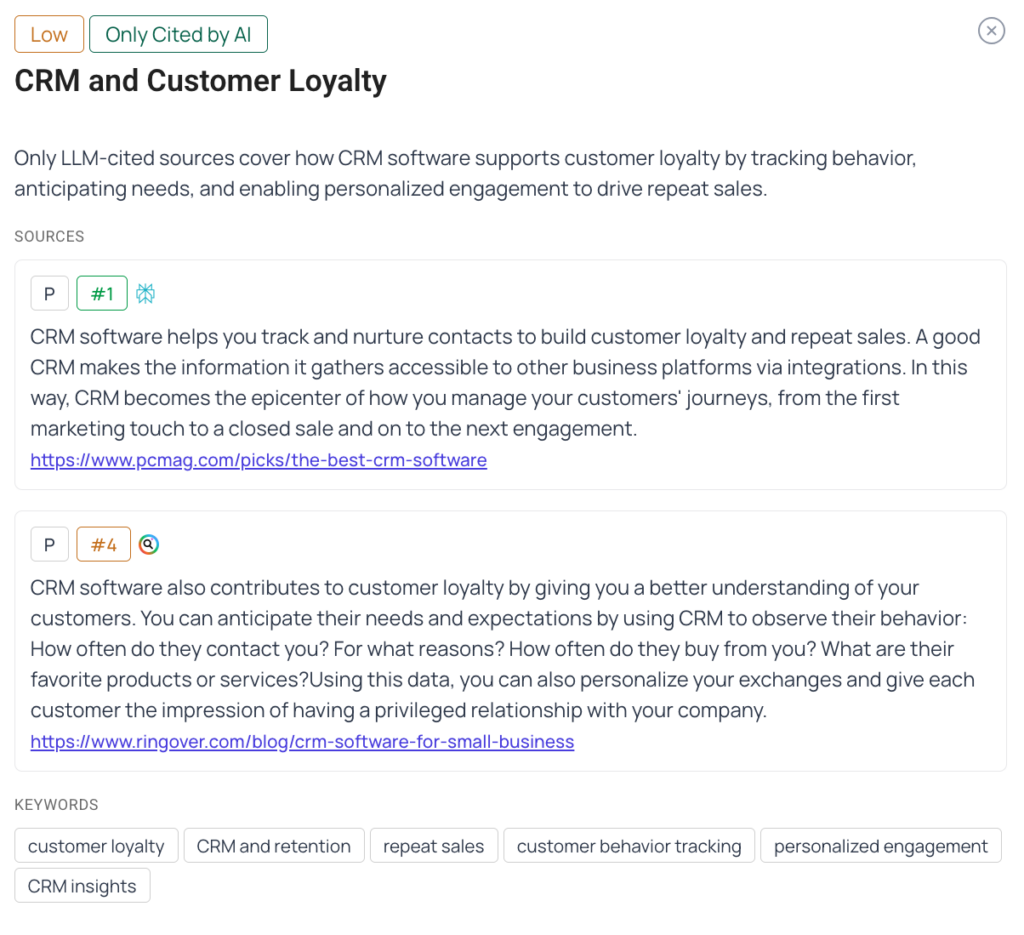
Click the info icon on any cluster card to open the side panel. For each source, you’ll see:
- P badge (paragraph-level content)
- Search position (e.g., #5, #6, #7)
- Engine icon showing which search engine cited this page (Google, ChatGPT, Gemini, Perplexity, Google AI Mode)
- The actual paragraph text from that source page
- Source URL
The content source panel shows you exactly what each page says about the topic, not just that they cover it.
This lets you quickly benchmark the depth and angle of competing content without reading every article in full.
Content Opportunities
Below the content clusters, you’ll find a Content Opportunities section. These are topic ideas that no ranked page currently covers well.
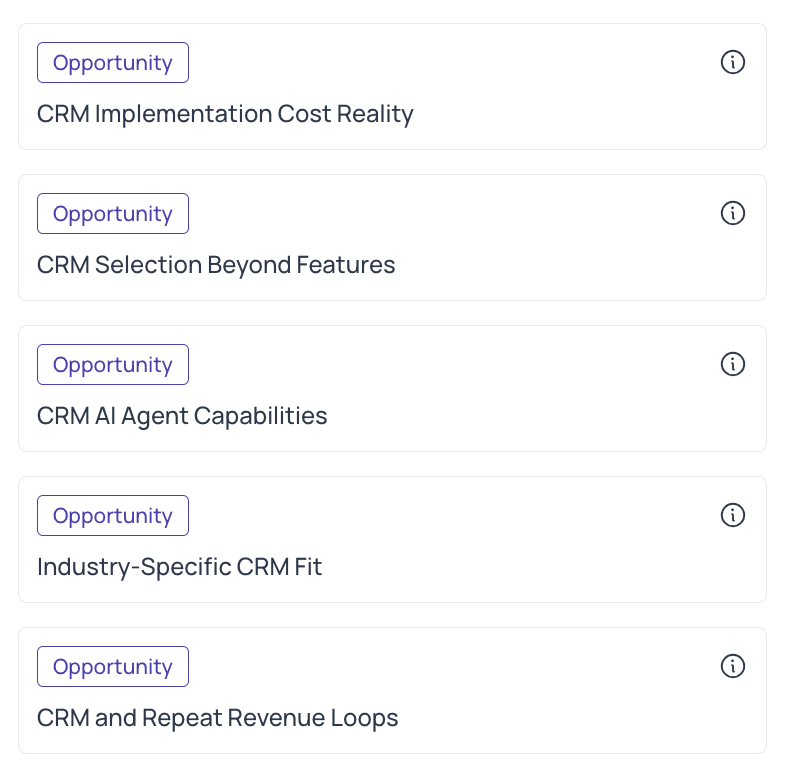
Each opportunity card includes:
- A topic label
- A short description explaining the gap
- Keyword chips to connect the idea to search terms
These are greenfield ideas, not existing clusters. They represent angles and information that are absent from both organic and AI-cited sources.
How to Get Started with the Content Analysis
The Content Analysis is built directly into the thruuu SERP Analyzer.
Steps to get started:
- Create a free thruuu account (if you don’t have one yet).
- Log in and open the SERP Analyzer page.
- Enter a keyword and launch your SERP analysis.
- Open the AI Tools panel and select the Content tab.
- Click “Generate” and wait for results to appear.
What Plan Do You Need?
The Content Analysis is available on the Agency plan only. No extra credit cost. The analysis is included as part of your SERP analysis.
Tips to Make the Most of the Content Analysis
- Use it alongside the Heading Analysis. Headings tell you what sections to include. Content clusters tell you what to actually write in those sections. The two tools complement each other directly.
- Read the source paragraphs. The biggest advantage of the Content Analysis is that you see the actual text competitors use, not just topic labels. Open the side panel on High and Very High clusters to understand the depth and angle you need to match.
- Pay attention to the “Only Cited by AI” badge. These are topics that AI engines value but Google’s top results ignore. Covering them gives you an opportunity to be cited by AI engines while also filling a gap in organic search.
- Don’t skip Content Opportunities. These greenfield ideas are where your content can be genuinely different. Look for opportunities that align with your expertise or your audience’s specific needs, and build dedicated sections around them.
- Check what’s missing, not just what’s there. If a major topic has Low coverage, it might mean most pages haven’t caught up yet or it might mean the topic isn’t relevant for this query. Use the source side panel to judge whether the content behind the cluster is strong enough to warrant inclusion.
Ready to See What Competitors Actually Write About?
Explore the content themes behind top-ranking pages and AI-cited sources. Find what to cover, what to say, and where the gaps are.