

AlsoAsked is one of the best-known People Also Ask tools in SEO.
Mark Williams-Cook, a UK SEO and director of the Norwich agency Candour, built it: the interface is clean, the question tree is sharp, and you can try it without paying. For quick exploration, it earns its reputation.
The friction starts when you need more than a map. AlsoAsked reads one source, the People Also Ask box, its free searches are capped, and deciding which of a few hundred questions belong in the same article is still your job.
There are better-fit options, depending on which of those you hit.
This article compares five AlsoAsked alternatives:
- KeywordsPeopleUse adds Reddit, Quora and Autocomplete to the questions.
- Answer Socrates and the Detailed SEO Extension both let you start free.
- AnswerThePublic suits brainstorming question angles.
- And a Question Explorer that runs inside Claude groups the questions into articles.
You’ll find what AlsoAsked does well and where it stops, a side-by-side table of prices, free plans, PAA depth, exports, API and MCP access, a short profile of each alternative, and how to turn the questions you collect into a content plan.
Table of Contents
AlsoAsked alternatives at a glance
Every tool below is built for the same job, finding the questions people search so you can plan content around them.
Most of them read Google’s People Also Ask box, and they differ in where else the questions come from, how deep they dig and what they do with them.
| Tool | Best for | Free plan | Price range | PAA depth | Export | API available | MCP available |
|---|---|---|---|---|---|---|---|
| AlsoAsked | Visual PAA maps | Limited searches without an account | $15 to $59/month | 2 levels, 3 with Deep Search | PNG, CSV | Yes | Yes |
| KeywordsPeopleUse | PAA plus Reddit, Quora and Autocomplete | No, 7-day trial | $15 to $299/month | 1 level, 3 with Deep Search | CSV, image | Yes | Yes |
| Answer Socrates | Free question research | 3 searches a day | $19 to $299/month | Up to 60 questions, recursive search for the next layer | CSV, PNG | Yes | Yes |
| AnswerThePublic | Brainstorming question angles | Not listed | $20 to $199/month | No PAA tree listed | Not listed | Yes | Not listed |
| Detailed SEO Extension | Quick PAA pulls in the browser | Free | Free | You choose the levels | CSV | Not listed | Not listed |
| thruuu Question Explorer | Questions to a content plan | Free plan with 10 credits | $19 to $99/month | 3 levels | Interactive page, CSV | Yes | Yes |
“Not listed” means the vendor’s own pages do not mention the feature. It is not a claim that the tool lacks it.
What AlsoAsked does well (and where it falls short)
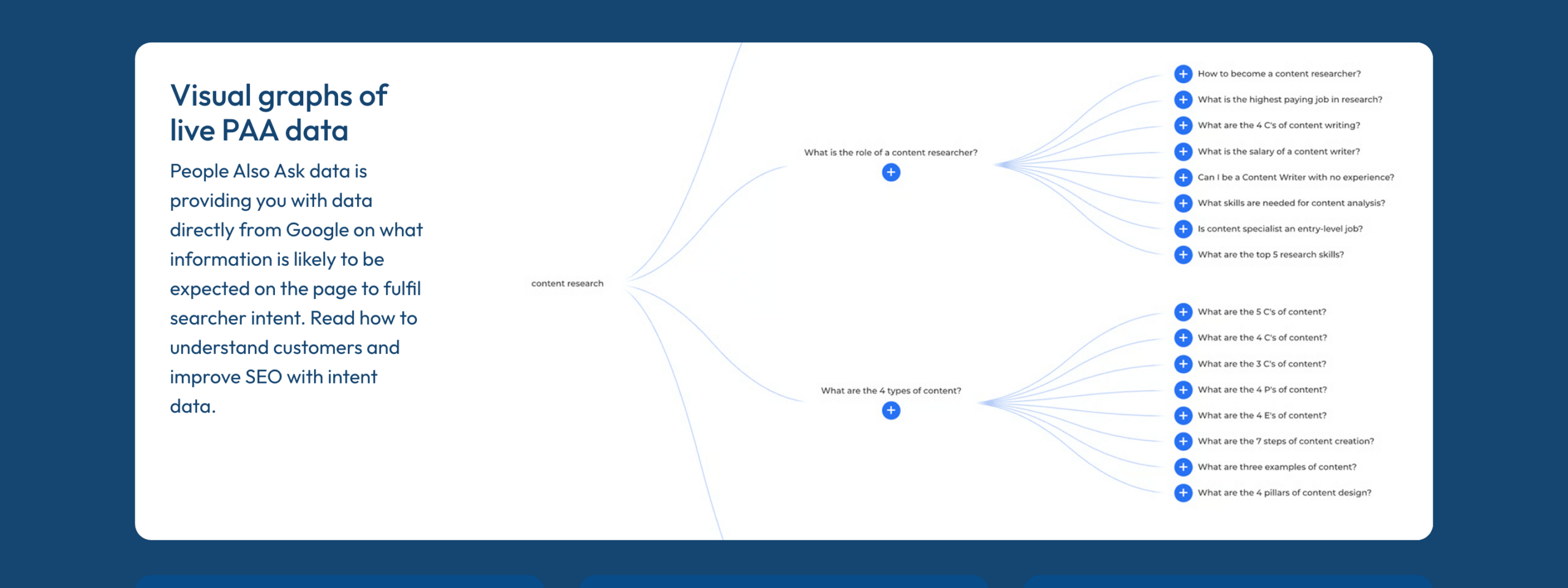
AlsoAsked, built by Mark Williams-Cook, pulls People Also Ask data live from Google and draws it as a question tree you can read at a glance.
A standard search goes two levels deep and returns about 25 questions; a Deep Search goes three levels and returns about 100, for 4 credits instead of 1.
Every paid plan lists PNG and CSV export, bulk searches and API access.
The API and the MCP server are worth knowing about.
The API is synchronous or asynchronous, with webhooks, so a developer can pull PAA data into their own scripts.
The MCP server connects AlsoAsked to Claude, ChatGPT or Claude Code: once you approve access in your browser, the assistant can run searches, read past results and check your credits, with no API key to copy. A Pro account is required.
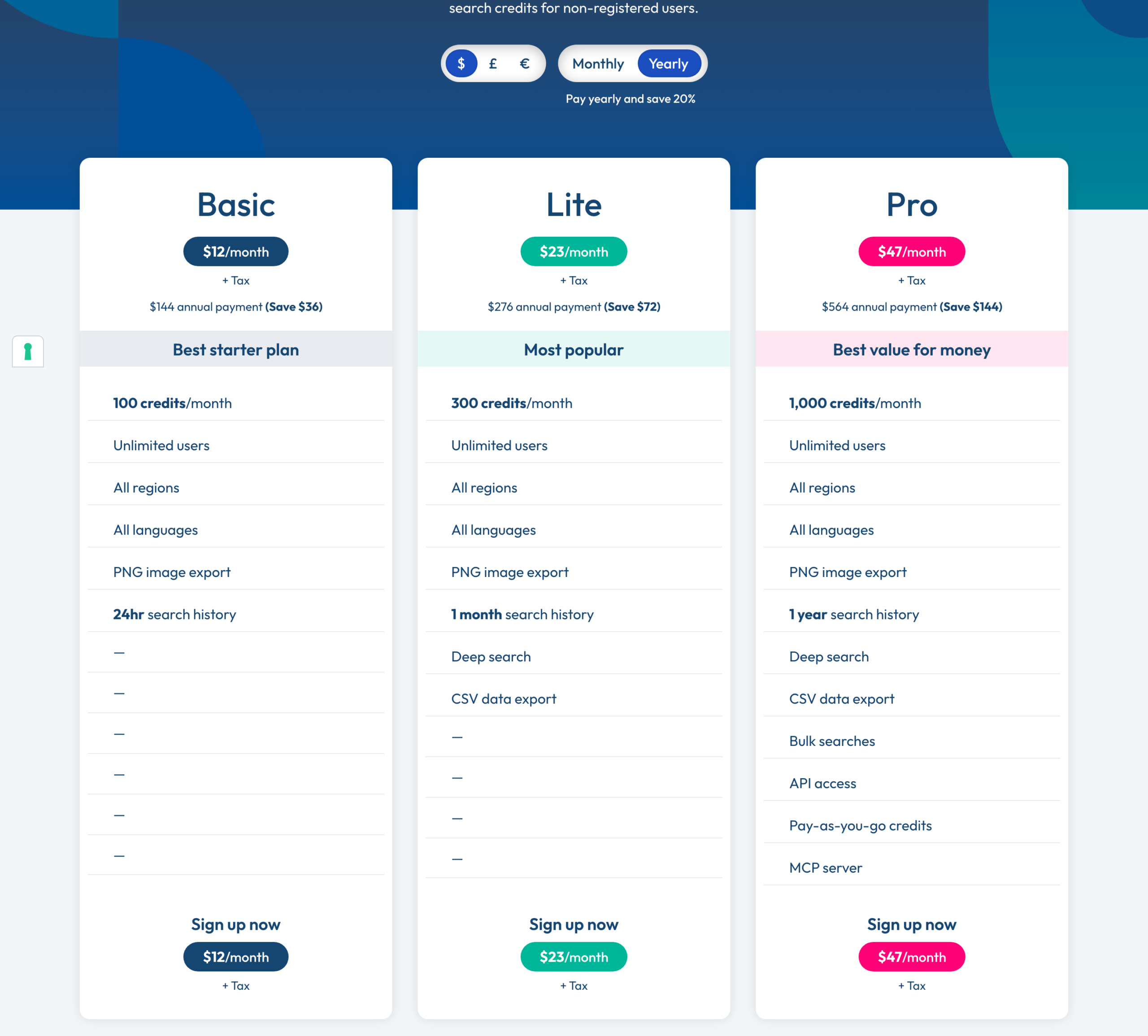
The limits are about what happens after the tree. Searches without an account are capped, CSV export starts with the paid plans, and plans run from 100 credits a month on Basic ($15 billed monthly) to 1,000 on Pro ($59), so Deep Searches use them four at a time. AlsoAsked also does not group questions into articles.
You get a map of what people ask, and you still decide which questions belong in the same piece.
The best AlsoAsked alternatives
KeywordsPeopleUse
Best for: the closest direct replacement for AlsoAsked, with more question sources.
What KeywordsPeopleUse does:
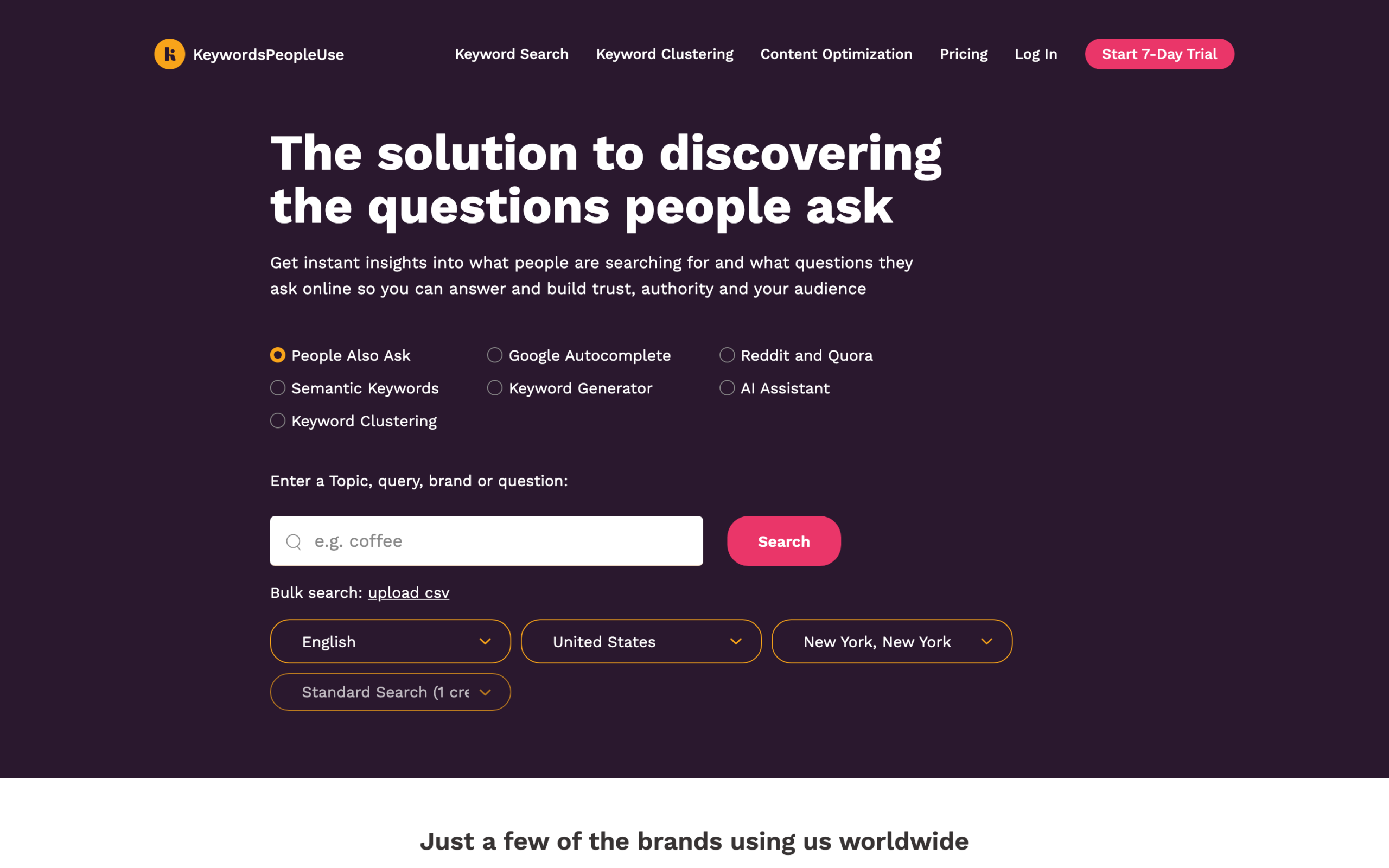
- Pulls People Also Ask live from Google, plus Google Autocomplete, Reddit and Quora, with the answer, source URL and page title for each question.
- Standard Search clicks one level into the PAA box for 1 credit; Deep Search keeps clicking for three levels and “typically” returns well over 100 questions, for 4 credits.
- Groups questions by the search intent Google suggests, and a SERP Analyzer shows the content structure of the top-ranking pages.
- CSV and image export, an API on every plan, and an MCP server that connects with your API key.
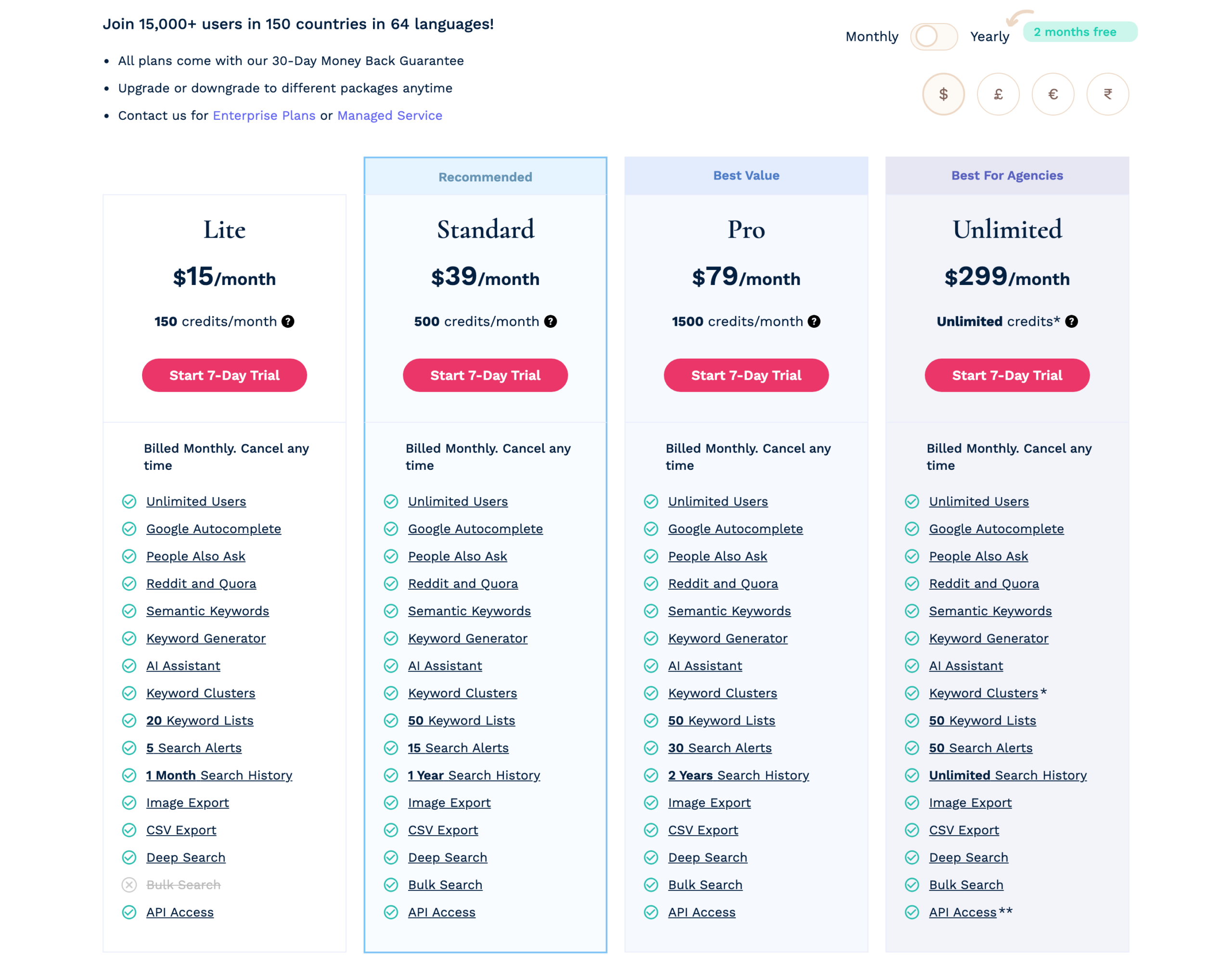
Price: Lite $15 a month for 150 credits, up to Unlimited at $299. Every plan starts with a 7-day trial and a card; no free plan is listed.
Answer Socrates
Best for: the most generous free plan on this list.
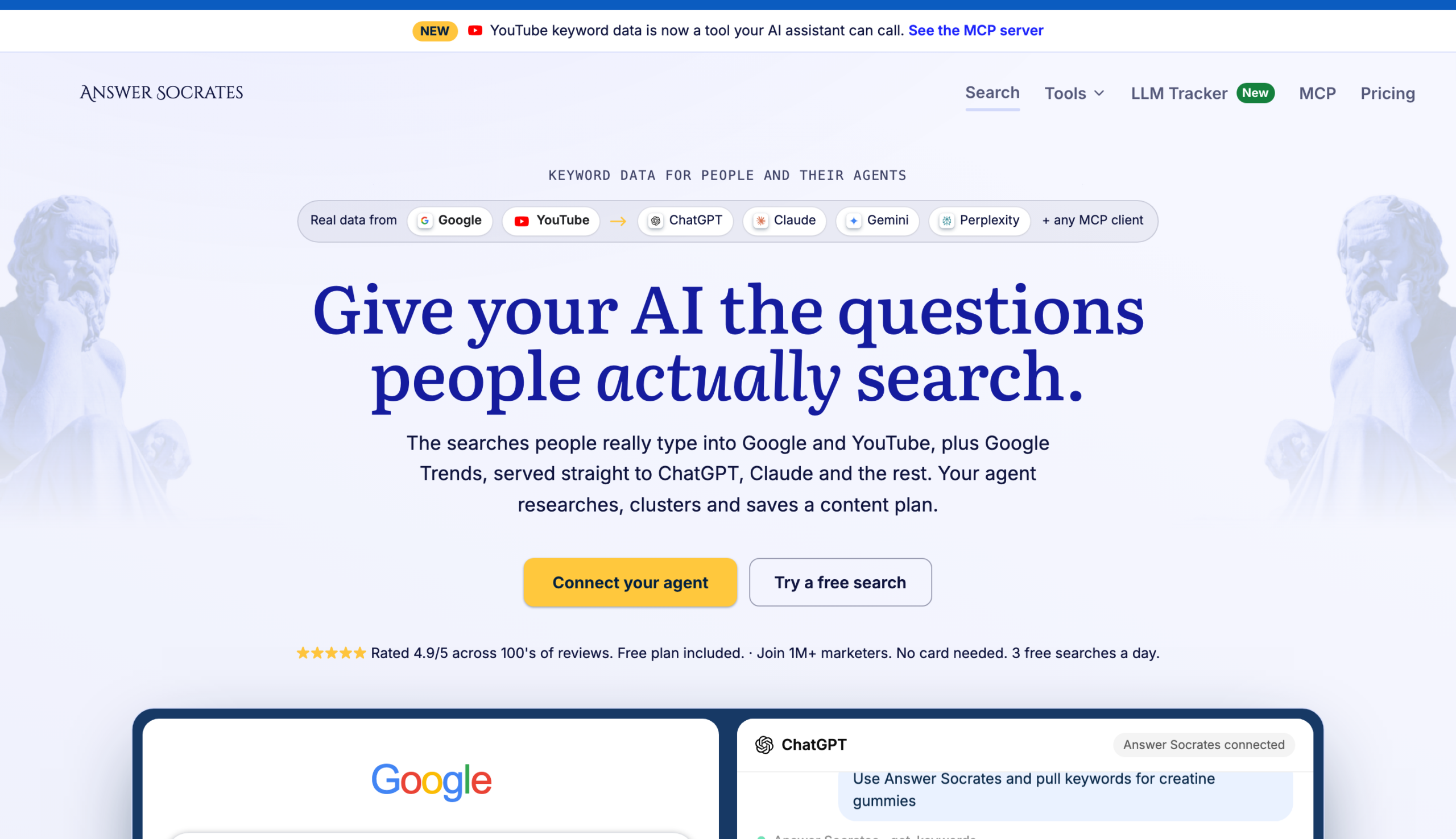
Here is what Answer Socrates offers:
- The PAA extractor returns up to 60 questions for a keyword, and a recursive search goes one layer further
- Groups keywords by meaning and intent, and exports results to CSV with search volume, competition and CPC
- A hosted MCP server for ChatGPT, Claude, Gemini and Perplexity, where you sign in rather than paste a key, alongside an API
- The free plan includes 3 keyword searches a day, 1 recursive search a day and 1 CSV download a month, with no credit card
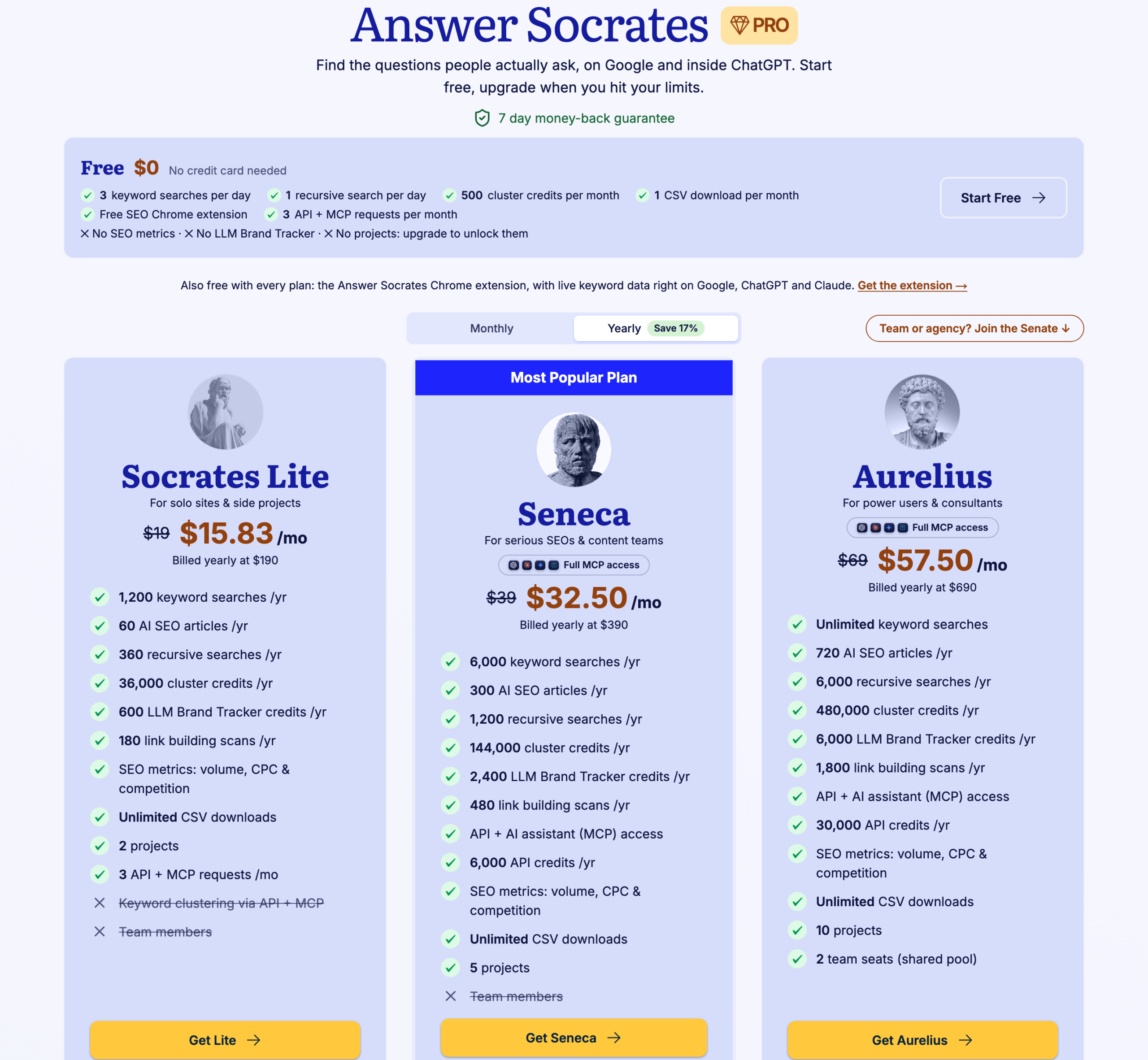
Price: Free, then $19 to $299 a month ($15.83 to $249.17 billed yearly). Full API and MCP access starts on the $39 Seneca plan; the Free and Lite plans get 3 API or MCP requests a month.
AnswerThePublic
Best for: brainstorming question angles around a topic.
AnswerThePublic adds an AI writer and an API:
- Paid plans include Composeo, its AI article writer, with 6 to 80 articles a month depending on the plan
- A public API is documented; no MCP server is listed
Price: Starter $20 a month, Growth $99, Business $199, or $10 to $99.50 a month billed yearly. The pricing page notes that prices are localized by region.
Detailed SEO Extension
Best for: quick PAA data on the Google results you are already looking at, at no cost.
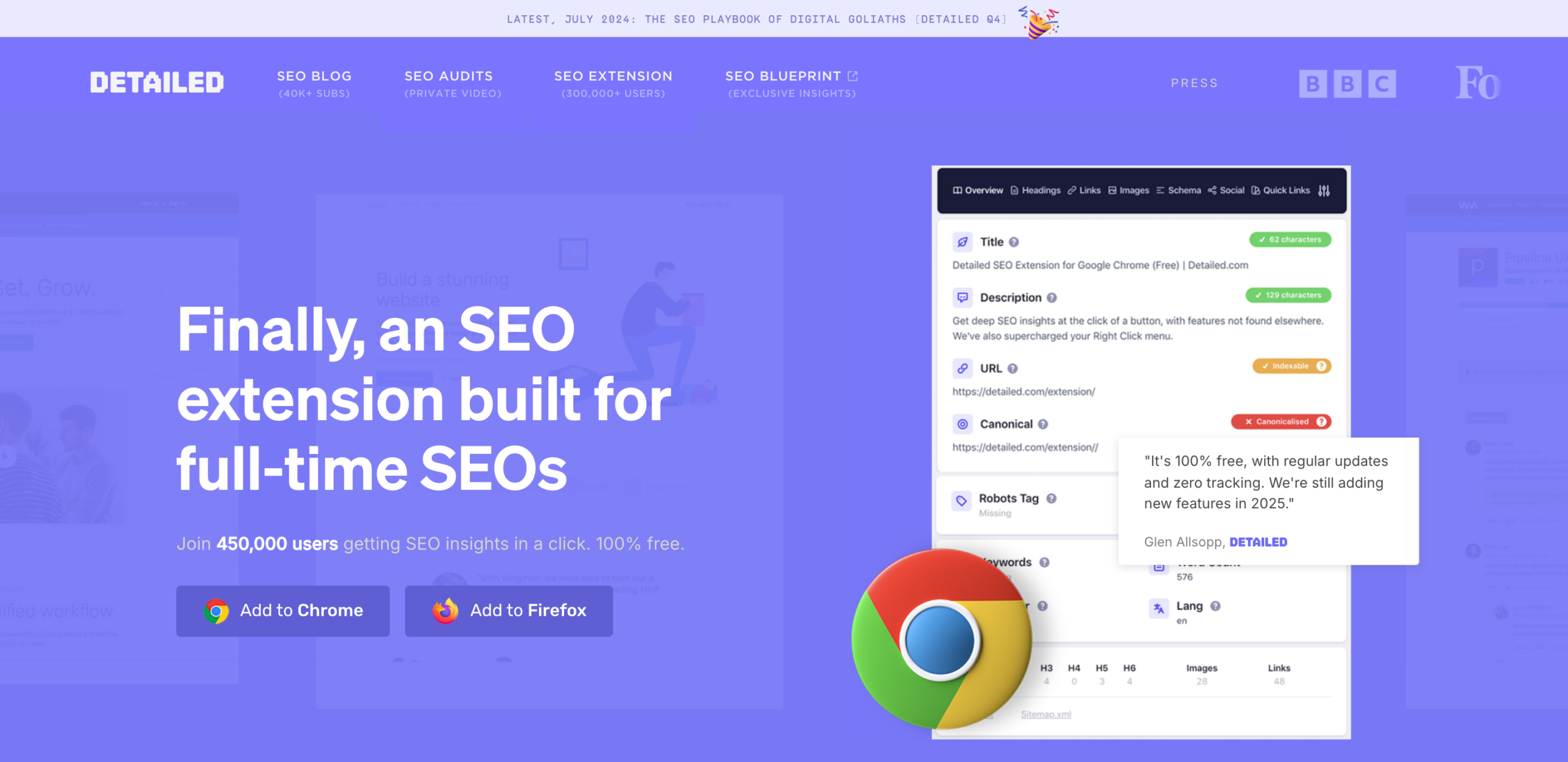
The Detailed SEO Extension at a glance:
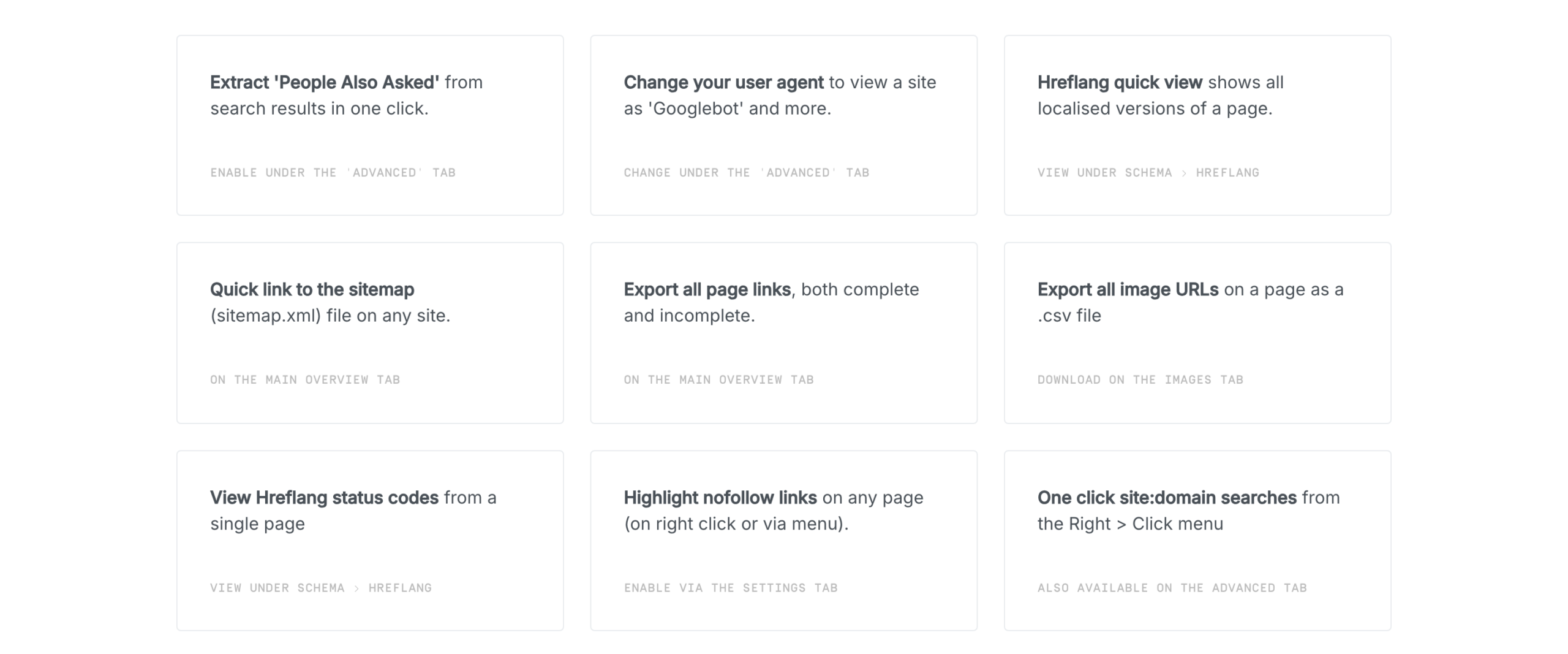
- A free Chrome and Firefox extension that extracts People Also Ask from the results page in front of you
- You choose how many levels deep it goes, and it downloads a CSV of the questions
- The PAA feature is labelled beta, and the extension does not group questions
- Detailed was acquired by Ahrefs, and its creator joined the company
Price: Free. “The extension is 100% free, and we don’t store or save your data in any way.”
thruuu Question Explorer: a different approach
Best for: going from questions to a content plan, from inside your AI assistant.
The Question Explorer is a free skill built on thruuu, an SEO content optimization platform connected to your assistant through MCP tools.
The skill is built for Claude and works best in Claude Code, claude.ai and the Claude desktop app. It is not limited to Claude: the skill follows the open Agent Skills format, which other assistants such as Codex also read, and the thruuu MCP server works with any MCP-capable assistant.
How do you use the Question Explorer in thruuu? It is simple.
You type one prompt, such as “build a question explorer for best crm for small business”, and thruuu will extract the related PAA questions down to three levels. It will also extract the on-page data of the ranking pages and the brands Google’s AI Overview mentions.
On top of that, it will build an interface to explore the question tree, access all the questions and see the content opportunities.
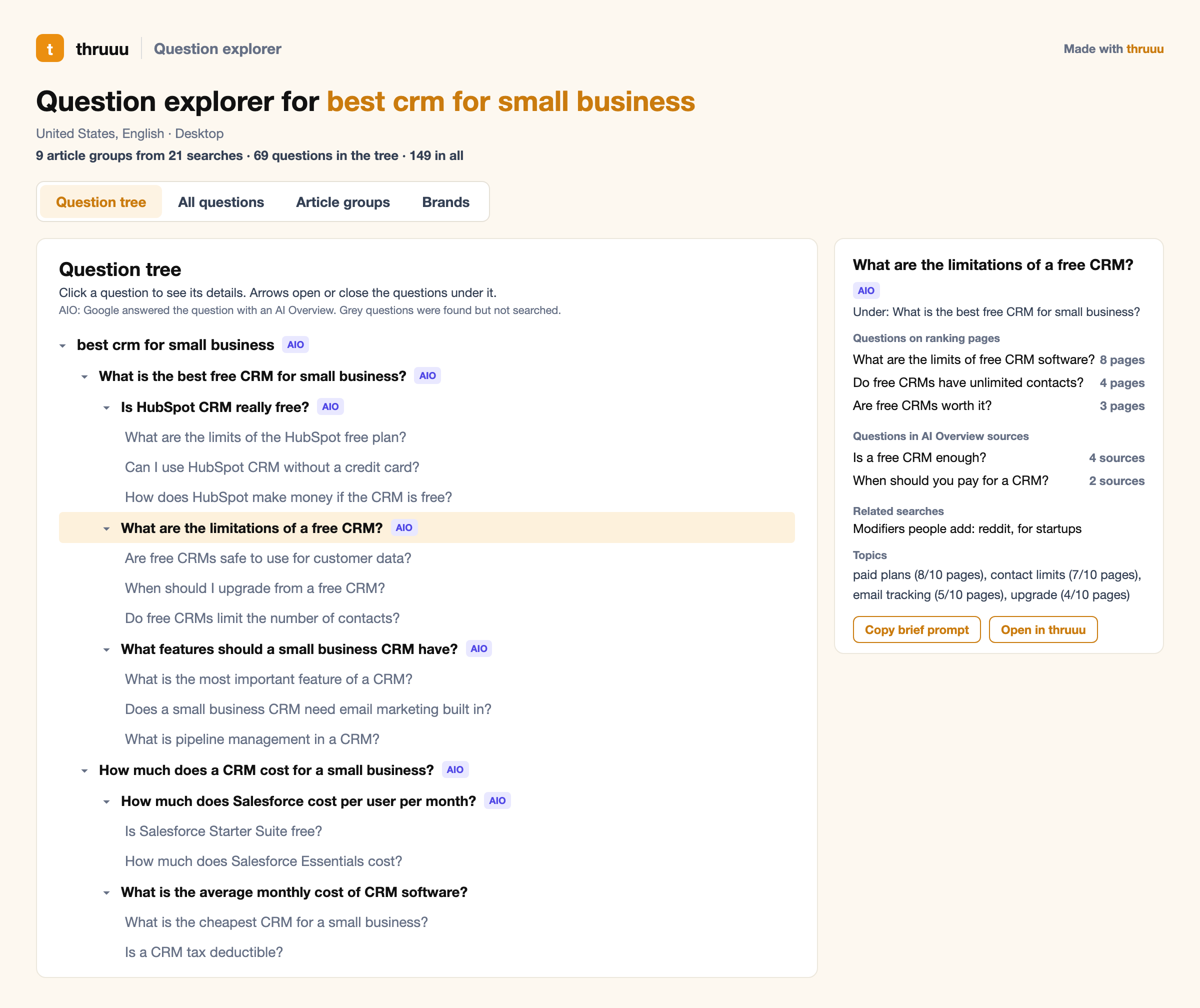
The Question Explorer of thruuu brings the following:
- A People Also Ask tree, three levels deep, or two levels for a cheaper run
- All the questions in one list: People Also Ask, the headings of the ranking pages and the pages Google’s AI Overview cites, with how many searches surfaced each one
- Article groups: questions that share the same Google results are grouped into one article, with H2 candidates from the pages that rank
- The brands Google’s AI Overview names around your topic, and on which questions
You then talk to the data. Ask “which article should I write first?”, or turn one group into a thruuu brief, a topic cluster or an AI Overview report, without searching again. The Explorer reads Google and its AI Overview, not ChatGPT or Gemini.
Get started: setup takes about two minutes.
- Connect the thruuu MCP server to your assistant. In thruuu, open API & Bulk Tools > MCP, which shows your MCP key and the setup for each assistant.
- On claude.ai or the Claude desktop app, turn on code execution, then download thruuu-question-explorer.zip from the thruuu-skills repository on GitHub and upload it, still zipped, under Settings > Capabilities > Skills.
- In Claude Code, add the skill with this command, then restart:
mkdir -p ~/.claude/skills && curl -L https://github.com/thruuu/thruuu-skills/archive/main.tar.gz | tar -xz -C ~/.claude/skills --strip-components=2 thruuu-skills-main/skills/thruuu-question-explorer - Type the prompt and confirm the run. A full run usually takes 5 to 7 minutes.
Price: The skill is free. Each Google search uses 1 thruuu credit, about 21 credits for a full three-level run and about 5 for two levels, and the assistant quotes the cost and waits for your yes. The Free plan includes 10 one-time credits; paid plans run from $19 to $99 a month, or $13 to $66 billed yearly. AI Overview questions start on the $49 Professional plan, and AI Overview brands on the $99 Agency plan.
Getting PAA data by API, MCP or from your AI assistant
Five of the six tools in this article offer an API, and four offer an MCP server. They solve different problems.
An API is for automation and scale. You send keywords from your own scripts or an n8n workflow and get structured data back: hundreds of keywords in a batch, every field the vendor exposes, stored where you want it.
AlsoAsked, KeywordsPeopleUse, Answer Socrates, AnswerThePublic and thruuu all document one.
thruuu’s API runs on paid plans, and its Topic Clusters API returns the People Also Ask questions behind each cluster. Other ways to collect PAA are compared in our selection of tools to scrape PAA.
An MCP server is for interaction. The data comes back formatted for your AI assistant, so you ask a question in Claude, ChatGPT or Codex and work with the answer in the same conversation.
AlsoAsked, KeywordsPeopleUse, Answer Socrates and thruuu each run one.
thruuu’s MCP server is open on every plan, including Free; AlsoAsked’s setup guide asks for a Pro account, and Answer Socrates gives full access from its $39 plan.
The API gets you scale. The MCP server gets you speed inside Claude.
Turning PAA questions into a content plan
A list of 150 questions is research. A content plan tells you which articles to write, and getting from one to the other takes three steps.
Our guide to a content plan from PAA covers the manual version.
First, collect the questions. Any tool above does this, and People Also Ask is the natural starting point because the questions come from Google itself.
Second, group the questions into clusters. The working rule is simple: if two questions return mostly the same Google results, Google treats them as one topic, and one article can answer both.
If the results differ, they need separate pages. Grouping by shared results rather than by wording stops you writing three articles that compete for the same search.
Third, name the articles. Each group becomes one article, its lead question becomes the working title, and the rest of the group becomes H2s or FAQ entries. Then rank the groups by relevance to your business and by how thin the current results are.
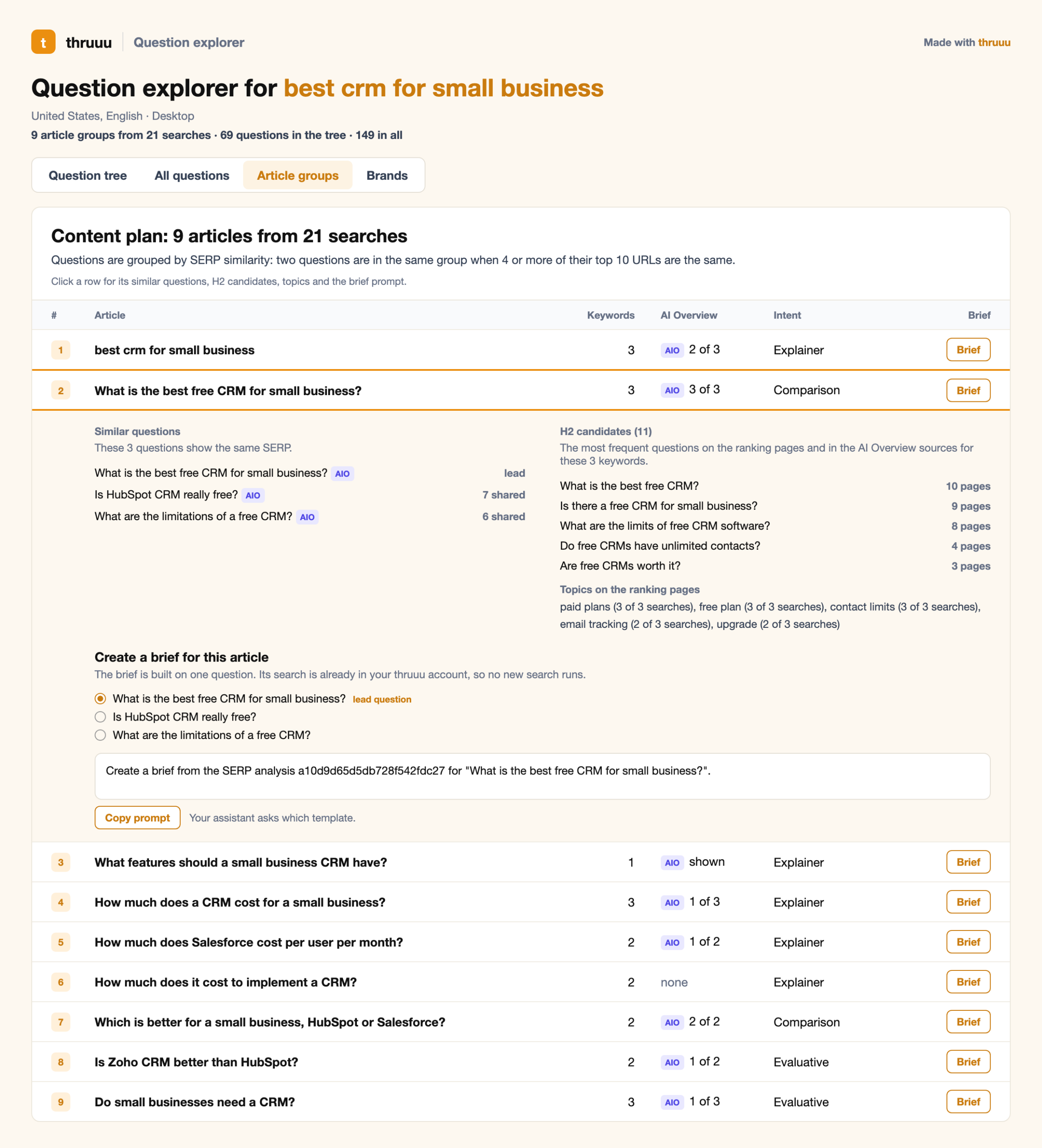
This is the step the Question Explorer was built for. For example, a keyword like “best crm for small business” can return around 150 questions that group into 9 articles.
Questions such as “What is the best free CRM for small business?”, “Is HubSpot CRM really free?” and “What are the limitations of a free CRM?” tend to show the same results, so they land in one group, and one article answers all three.
The Article groups tab puts two questions in the same group when 4 or more of their top 10 URLs match, the same principle as thruuu’s Topic Clusters.
Each row shows the questions in the group and H2 candidates from the ranking pages, with a prompt to start the brief.
Which AlsoAsked alternative fits your needs
The right tool depends on where you are stuck.
- For free PAA data fast, use the Detailed SEO Extension or Answer Socrates.
- For a content team that wants PAA with Reddit, Quora and intent grouping, KeywordsPeopleUse is the closest replacement.
- For brainstorming question angles, AnswerThePublic.
- For turning questions into a content plan from inside Claude, the thruuu Question Explorer.
Frequently asked questions
Is there a free AlsoAsked alternative?
Yes. The Detailed SEO Extension is free, with no plan to buy, and exports a CSV of the questions on the results page you are viewing.
Answer Socrates has a free plan with 3 searches a day, 1 recursive search a day and 1 CSV download a month.
thruuu has a free plan with 10 one-time credits, enough for a two-level Question Explorer run.
The limits are depth and volume: none of the free options is built for hundreds of keywords a month.
Are PAA tools worth it for SEO?
For content research, yes. People Also Ask shows the questions searchers ask next, which is demand you can see rather than guess.
Writing to those questions makes a page more specific, and it answers the follow-up a reader would otherwise go back to Google for.
A PAA tool saves the hours of clicking through the box by hand.
How do I pick which PAA questions to target?
Start with groups of questions that share the same Google results, because each group is one article.
Then keep the groups that matter to your business, and favour those where the current results are thin, dated or off-topic.
Search volume helps order the list, but shared results decide the structure.
Can I use several PAA tools together?
Yes. A simple stack is a free tool for quick checks, such as the Detailed SEO Extension on the results you are reading, and one paid tool for depth and grouping.
If you already work in Claude, the Question Explorer can be that second tool, and its searches feed straight into a brief.
Ready to turn one keyword into a content plan?
Connect thruuu to Claude, ChatGPT, Codex or any assistant that supports MCP, add the Question Explorer skill in Claude or Codex, and your next article starts from the questions people actually ask.