

You can rank #1 on Google and still be invisible in AI answers.
Most teams respond by making surface-level tweaks to their content briefs, like adding FAQ sections. That doesn’t fix the problem because AI citation isn’t a formatting issue.
It’s a clarity and positioning issue that starts at the brief level.
Generic content briefs produce generic content, and generic content doesn’t get cited.
This guide covers the elements every GEO brief needs, the tools that speed up the process, and how to build one using thruuu’s Content Brief Generator.
Table of Contents
How Does a GEO Content Brief Differ from a Traditional SEO Content Brief?
| What the brief focuses on | SEO Content Brief | GEO Content Brief |
| Primary goal | Rank in Google | Rank in Google and get cited by AI |
| Optimized for | Search engine crawlers | AI tools like ChatGPT, Gemini, and Perplexity |
| Headings | Topic-based | Question-based (how users ask AI) |
| Keywords | Target keywords | Keywords + natural questions and phrases |
| Authority signals | Backlinks, domain authority | Expert quotes, experience, named brands |
| Competitor analysis | Google SERP competitors | Google + AI-cited sources |
| Structure | Optimized for ranking | Optimized for ranking and extraction |
| Writer guidance | Headings and keywords | Headings + AI visibility instructions |
What Key Elements Should a GEO Content Brief Include?
SEO briefs have always included these four elements, but GEO briefs require them to be explicitly defined and structured for AI systems. They include:
E-E-A-T Signals
E-E-A-T (Experience, Expertise, Authoritativeness, and Trust) has been in Google’s quality guidelines for years. GEO makes it actionable at the brief level.
Wellows’ analysis of 2,400 AI Overview citations found that 96% of citations came from sources with strong E-E-A-T signals, and pages ranking #6–#10 with strong E-E-A-T were cited 2.3× more often than #1-ranked pages lacking it.
Instead of telling writers to “sound authoritative,” a GEO brief should specify the exact experience signal to include: a personal observation, a case study, a quote from a named expert, or a survey result with real numbers.
This element matters because LLMs prioritize credibility signals that identify expertise over generic advice.
For example, an article that says “In my testing of thruuu’s Content Brief Generator across 50,000+ briefs, writers consistently miss the E-E-A-T section when briefs don’t explicitly call for it” is more citable than one that says “experts recommend including experience signals.”
For example, an article that says “In my testing of thruuu’s Content Brief Generator across 50,000+ briefs, I noticed that writers consistently skip the E-E-A-T section when briefs do not explicitly call for it” is more citable than one that says “Experts recommend including experience signals.”
The difference is specificity. A good GEO brief tells the writer exactly what experience to include, who to quote, and what observation to anchor the section around.
Brand Mentions
A GEO brief should include clear instructions on how to position your brand and which competitors to mention. This helps writers place your brand within the right category.
Moreover, LLMs learn which brands belong together based on how they appear together in the same content, especially in structured comparisons.
For example, if your article compares thruuu, Surfer, and Frase, AI engines learn that these tools belong in the same category. Over time, your brand becomes more likely to appear in AI-generated comparisons for similar queries.
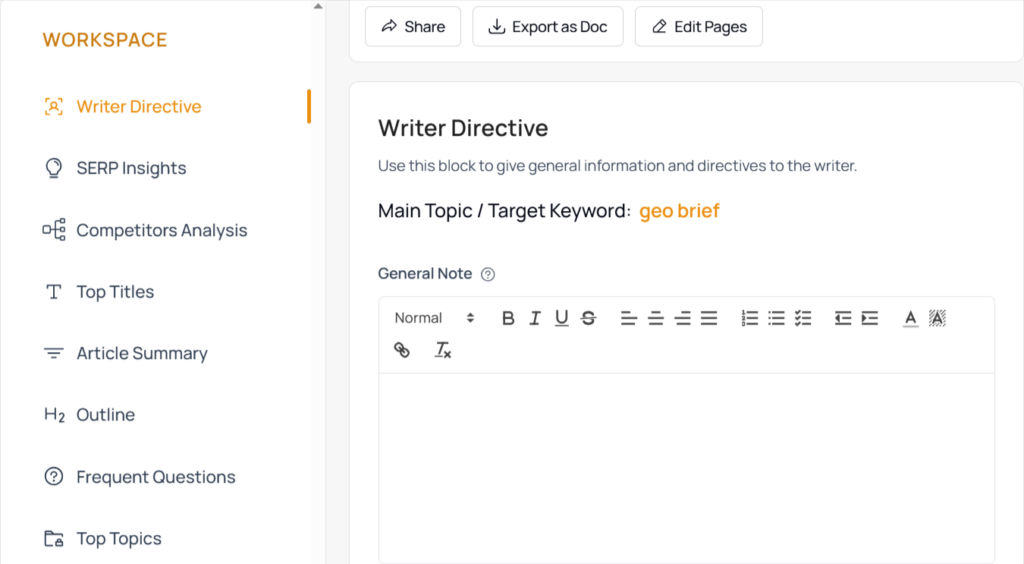
That’s why thruuu content brief generator starts with a Writer Directive section where you can give instructions to your writer.
That one instruction changes how the writer frames every comparison in the article.
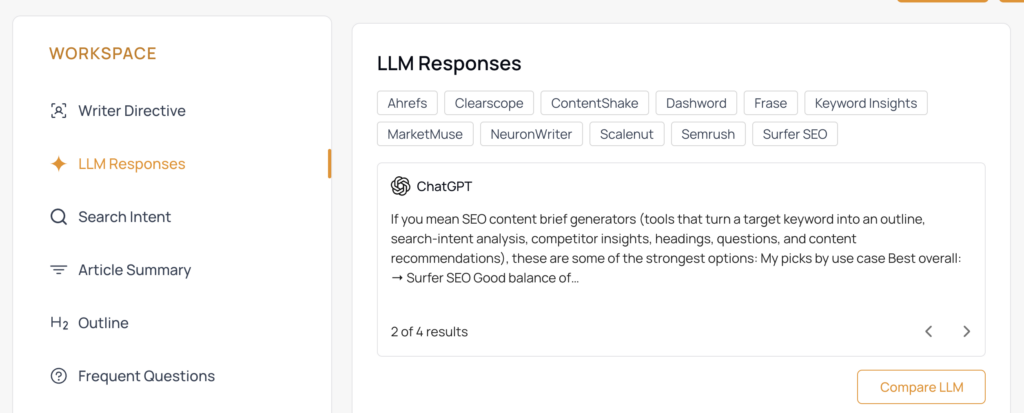
thruuu also include the brand mentionned in the most popular LLMs.
Create your next brief for free and share all the information needed for your article on a single page.
User Intent Analysis
LLMs answer questions, not keywords. A user doesn’t type “geo content brief” into ChatGPT. Rather, they ask “what’s the difference between a GEO brief and an SEO brief?” or “how do I write a content brief for AI search?”
Your brief should be structured around the specific question the article must answer. That’s why you must know your topic’s search intent before writing a word in your brief.
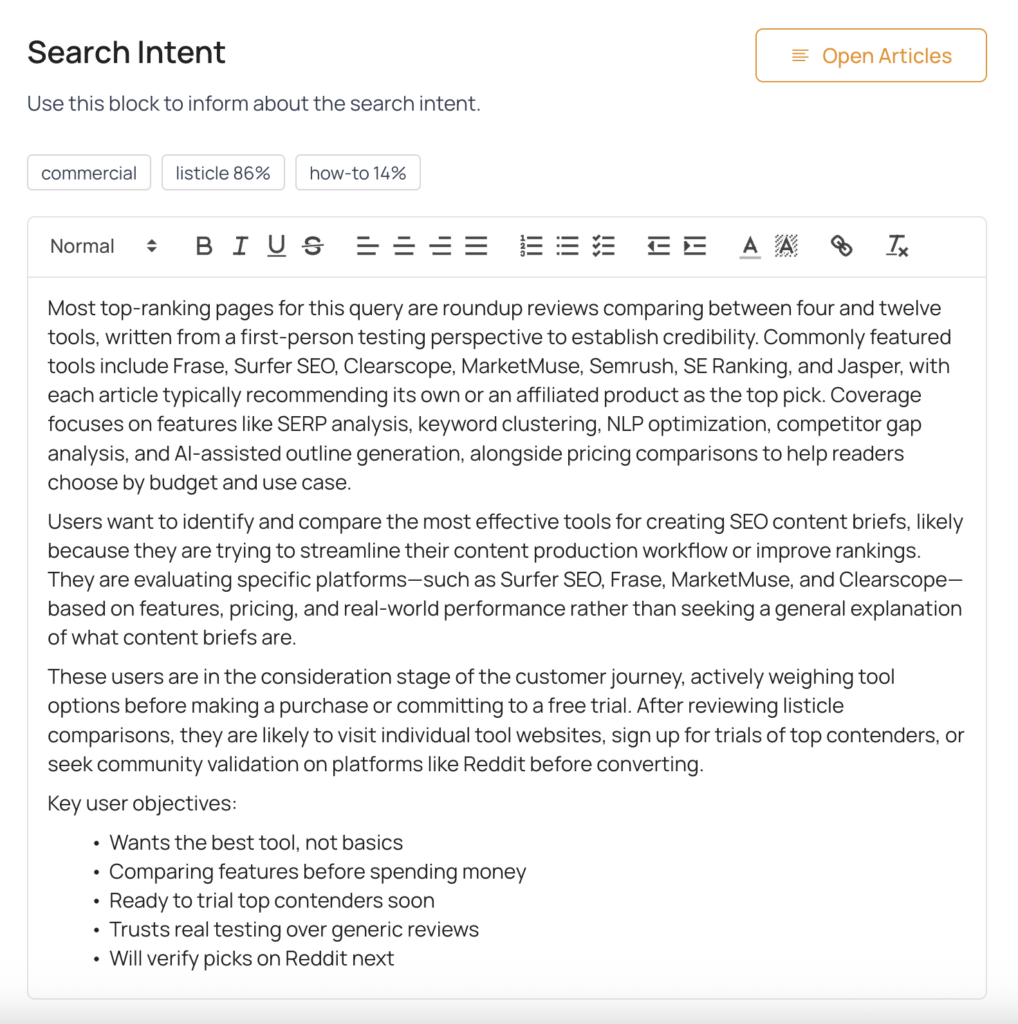
SEOs advise analyzing the SERP to understand a topic’s search intent. That strategy works, but most of the time, you might miss things. The through content brief tool eliminates that imperfection by providing your topic’s search intent based on SERP analysis.
thruuu automatically analyse the search intent and includes it in your content brief.
Semantic Keywords, Phrases, and Questions
Your GEO brief should include:
- Core terms: key concepts related to the topic (e.g., GEO content brief, AI search, LLMs, SEO, generative engines)
- Related phrases: longer variations people might search for (e.g,. how to create a GEO content brief, content structure for AI search)
- Questions: the queries users ask (e.g, What is a GEO content brief, how does GEO differ from SEO
The thruuu content brief tool automatically includes these elements in all its briefs.
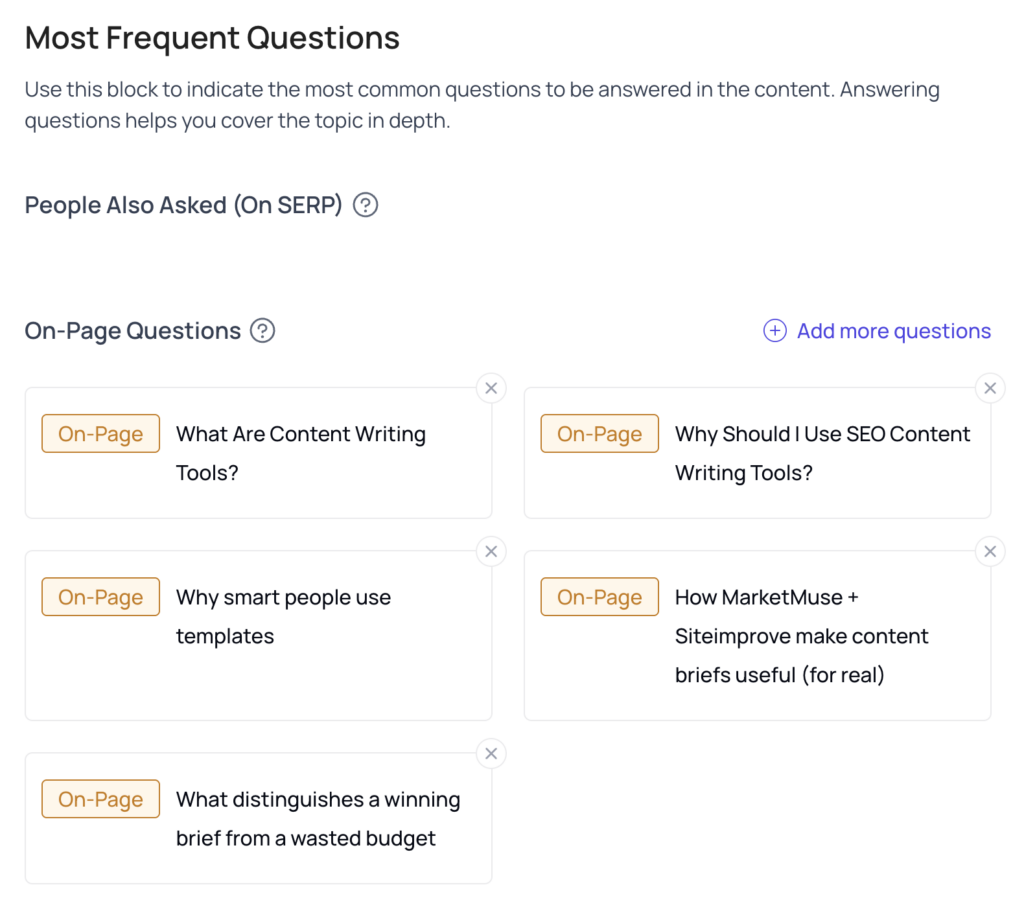
You can optimize these queries in your article to fully cover the topic in a way that is easier for both readers and AI systems to understand and cite.
AI Visibility Guideline for Your GEO Brief
If you already include style guides or voice instructions in your briefs, add an AI Visibility section alongside them.
Here are seven principles to include. Each one directly improves your content’s chances of being cited by LLMs.
The Ski Ramp Rule
The Ski Ramp Rule means placing the most important insight at the beginning of the article, then expanding on it. Instead of building toward a conclusion, you start with the answer and develop it further.
Think of it as a funnel: the direct answer to the reader’s question sits at the top, and the rest of the article builds on that foundation with supporting detail and context.
For example, in this thruuu’s article on the best AI Overview rank-tracking tools, we began the section with a table comparing the tools we reviewed.
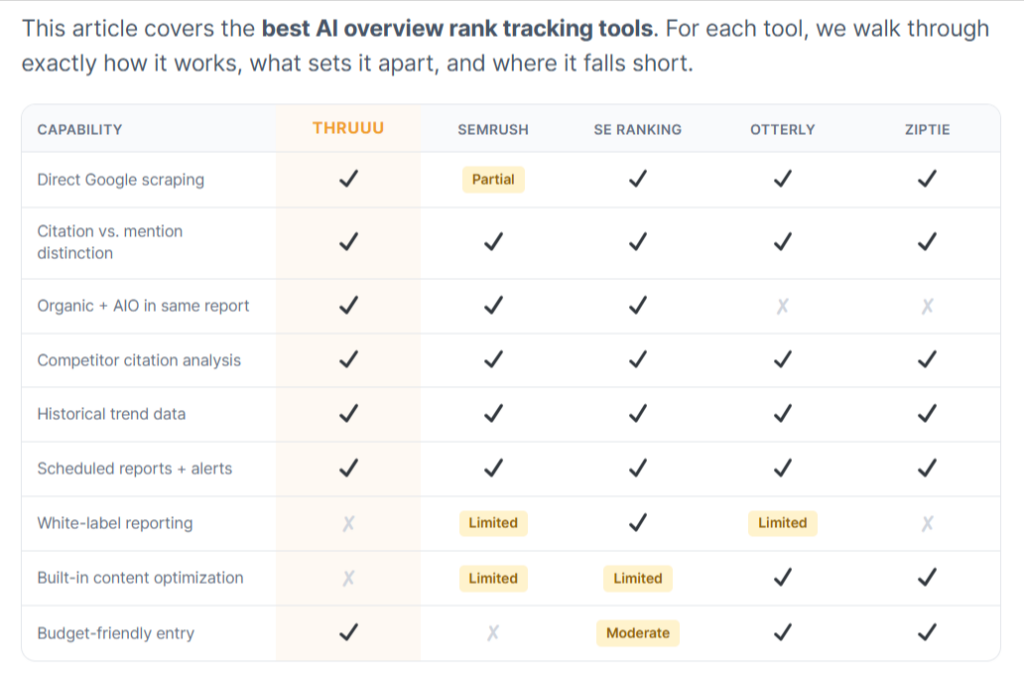
Pro tip: Your brief should start with the key takeaways section or a summary table. This way, AI bots extract definitions and key claims from the early sections of your content. If your core insight is buried several paragraphs later, it is less likely to be cited.
H2s as User Prompts
Frame H2 headings as questions users would type into AI tools, then answer the question immediately in the first sentence.
For instance,
- Weak heading: “The History of SEO.”
- Strong heading: “When did SEO start?” followed immediately by “SEO started in the mid-1990s…”
This structure mirrors how users interact with AI. When your headings match real questions, and the answer appears immediately below, AI systems can easily extract and reuse that information.
Definitive Language
Use clear “X is Y” structures and avoid vague openers.
- Weak language: “Content optimization is becoming increasingly important in the age of AI.”
- Strong language: “A GEO content brief is a structured document that prepares content for AI citation.”
The word “is” acts as a strong semantic bridge for LLMs. Instruct your writer to open definitions with it.
Entity Richness
Use specific names instead of generic descriptions; mention brands, tools, people, and platforms directly.
For example, instead of writing “many AI tools,” write “ChatGPT, Perplexity, Gemini, and Google AI Overviews.” Naming specific tools makes the content easier for AI systems to understand.
This also helps AI place your content within the right category. When your article mentions related tools together, such as Semrush, Ahrefs, Surfer SEO, and thruuu, AI systems learn that they belong to the same topic.
Balanced Sentiment
Avoid writing in a purely factual or opinion-based way. Instead, state a verified fact and then briefly explain what it means for the reader.
Look at this example:
Too factual: “AI Overviews launched in May 2024.”
Too opinionated: “AI Overviews are a revolutionary game-changer everyone must embrace.”
Balanced: “AI Overviews launched in May 2024, which has reduced click-through rates by 34.5% for pages that are not cited in AI answers. This means 1 in 3 readers now skip your content entirely.”
This structure keeps the content informative while still providing context.
Business-Grade Writing
Use clear, professional language that is easy to scan and extract information from. This aligns with a Flesch-Kincaid Grade 16 level, which favors precise, structured sentences over conversational or overly complex writing.
Instead of packing multiple ideas into one sentence, break them into shorter statements. Aim for sentences under 25 words and ensure each paragraph is skimmable in five seconds.
Example: “Because AI search is evolving rapidly and many marketers are still adapting, it’s important to consider how content briefs may need to change to remain competitive.”
This sentence is vague and unnecessarily long.
A better version would be: “AI search is changing how content is discovered. Content briefs must adapt to remain competitive.”
This version is clearer and communicates the idea immediately.
Paragraph-Level Insight
LLMs read and evaluate entire paragraphs, not just opening lines. They look for sentences that contain specific and verifiable information they can extract and reuse. If a paragraph is vague or generic, it is less likely to be cited.
Each paragraph should include at least one sentence with a concrete insight: a definition, a data point, a named entity, or a clear claim.
For example, instead of writing: “GEO content briefs help improve AI visibility by making content more structured.”
Write:“A GEO content brief improves AI visibility by instructing writers to include named experts and question-based headings, which LLMs prioritize when selecting content to cite.”
How to Create a Geo Content Brief LLMs Will Cite
Below are the steps to building GEO content briefs using thruuu’s content brief generator:
1. Start with a Template
Sign up and click “Content brief > My brief templates” in the left-side bar drop-down menu.
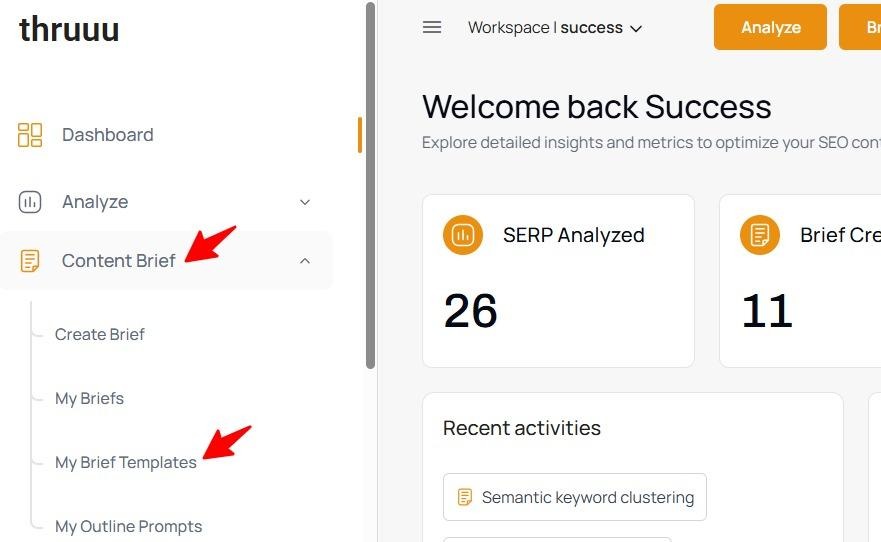
thruuu’s content brief templates provide 15+ brief elements, including Writer Directive, Search Intent, Outline, and FAQs.
You choose from a brief element, save the configuration, and apply it with one click for your next brief.
Pro tip: For GEO briefs, use these elements as containers and add your own instructions. For example, include E-E-A-T requirements inside the Writer Directive section and AI visibility rules as guidance for the writer.
Start a free trial to create your brief templates for future content.
2. Analyze Your Competitors on LLMs and Google Search
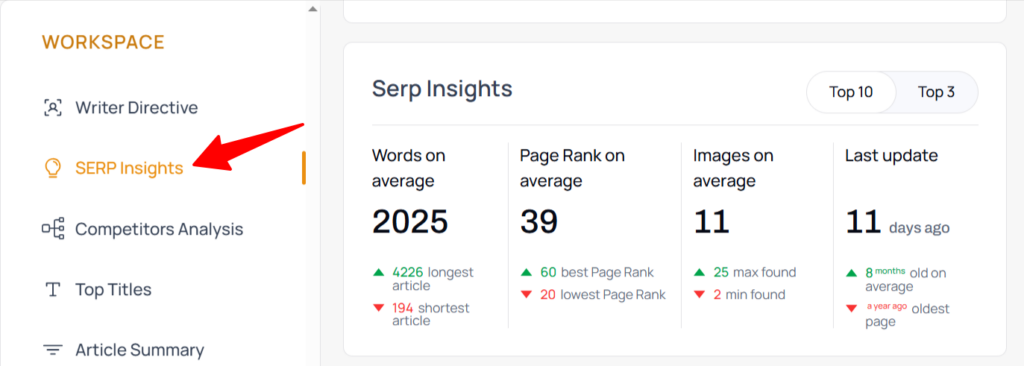
thruuu SERP Insights section, which compares the top SERP ranking pages and provides insights to implement in your article. You will see the average word count, image, and page rank of the ranking pages
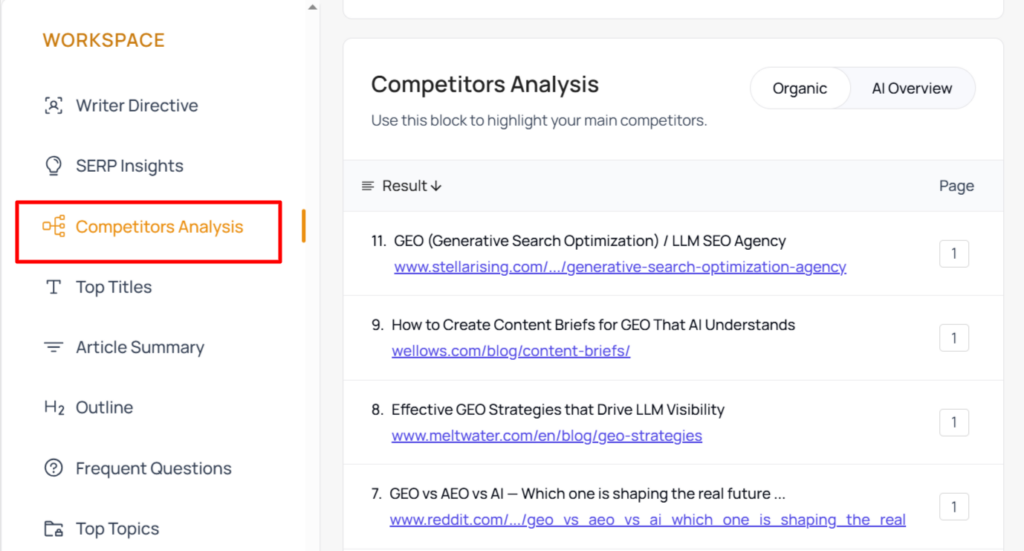
Next, the Competitor Analysis section analyzes the ranking pages on SERP and AI Overviews.
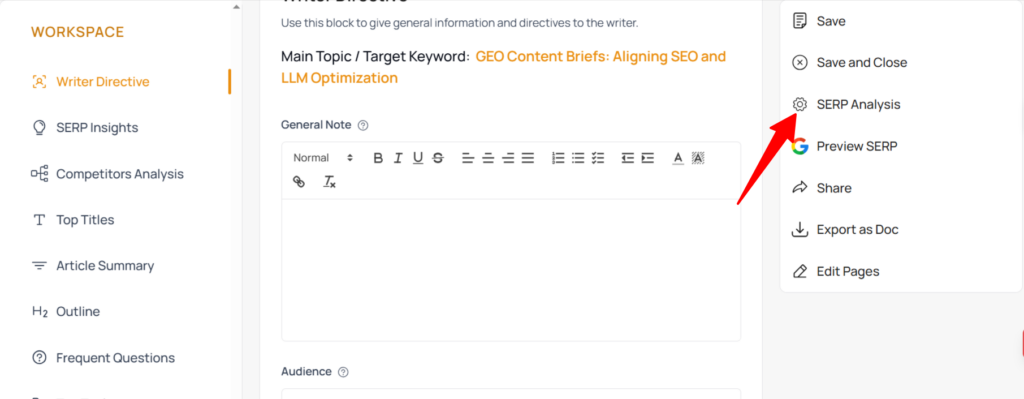
You can take a step further to see a comprehensive SERP analysis.
Click “SERP Analysis” on the right-hand side of the page.
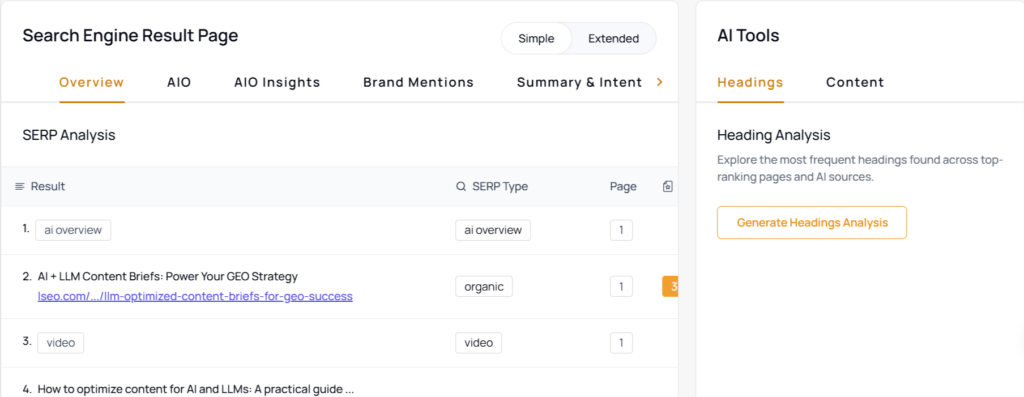
The analysis shows the top-ranking pages on SERP and AI Overview for your keyword, along with recurring headings, questions, and frequently used terms.
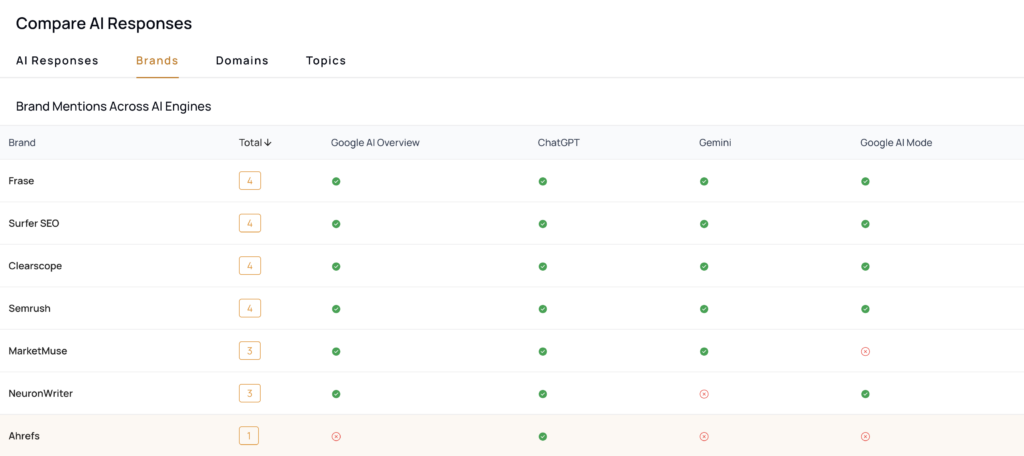
You’ll also get a side-by-side view of how each AI engine answers your target keyword, which brands get mentioned and how often, and which websites AI engines trust and cite.
You can compare Google organic rankings against AI citations in a single view, and see the most frequent terms used across all sources.
Note: For your GEO briefs, highlight the brands that appear most often and the sources that are commonly referenced. These patterns indicate what AI systems are likely to cite.
3. Provide Comprehensive Guidelines in Your GEO Briefs
thruuu suggests that every content brief opens with the Writer Directive.
This section explains why the article exists, who it is for, and how the brand should be positioned. thruuu also auto-populates the Writer Directive with SERP-derived search intent, audience insights, and competitor data, turning analysis into strategic positioning.
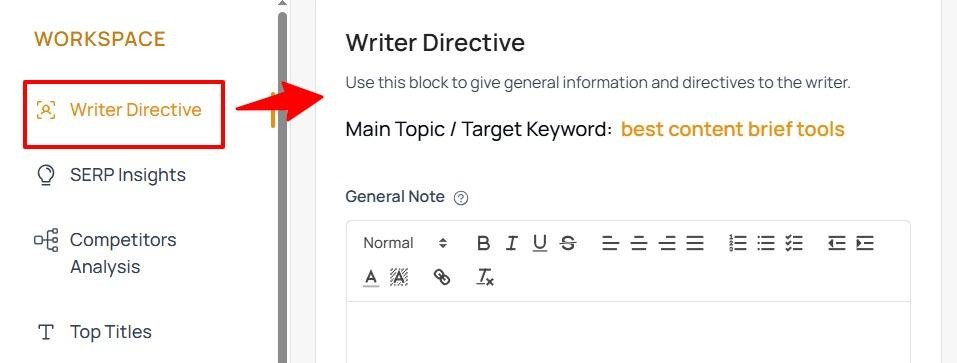
You can also highlight key competitors and link to the main sources the writer should review before drafting.
4. Spend Time on Structuring Your Headings and Outline
thruuu’s AI outline feature analyzes the SERP and generates an outline based on the SERP competitors’ content, giving you a starting structure for your article.
The feature also allows you to generate a structure using four sources: Organic, AI Overview, Competitors + AIO, and Keyword.
You can also create personalized outline templates using custom prompts. Browse your saved prompts by entering a target keyword, or create a new one to guide how the AI generates your article structure.
Pro tip: Look at recurring competitor headings, scan the extracted questions, and prioritize the topics that appear most often.
For GEO briefs, refine these headings so they match how users ask questions in AI tools. Instead of generic headings, use clear prompts that the article can answer directly.
For example, instead of “GEO Brief Differences”, use “How does a GEO content brief differ from an SEO brief?” This makes the structure easier for both readers and AI systems to follow.
Add short notes under each heading to guide the writer. Even a single instruction is enough, such as:
- “Open with the definition,”
- “Include one tool comparison,”
- “Answer this question in the first paragraph.”
This step turns an auto-generated outline into a structured GEO brief that guides both content flow and AI visibility.
5. Add Unique Angle
Include a section in your brief for expert quotes, original data, or firsthand observations.
In your thruuu brief, you can specify this directly in the Writer Directive or as notes under individual headings. The goal is to clearly indicate where and how the writer should introduce original insight rather than simply repeating competitor content.
6. List the Questions, Topics, and Competitors to Mention.
thruuu extracts the most relevant questions from People Also Ask data and competitor content across 100 ranking pages + 6 AI sources (ChatGPT, Claude, Gemini, Perplexity, Google AI Mode), not just Google SERP. Add them to your brief with expected answers.
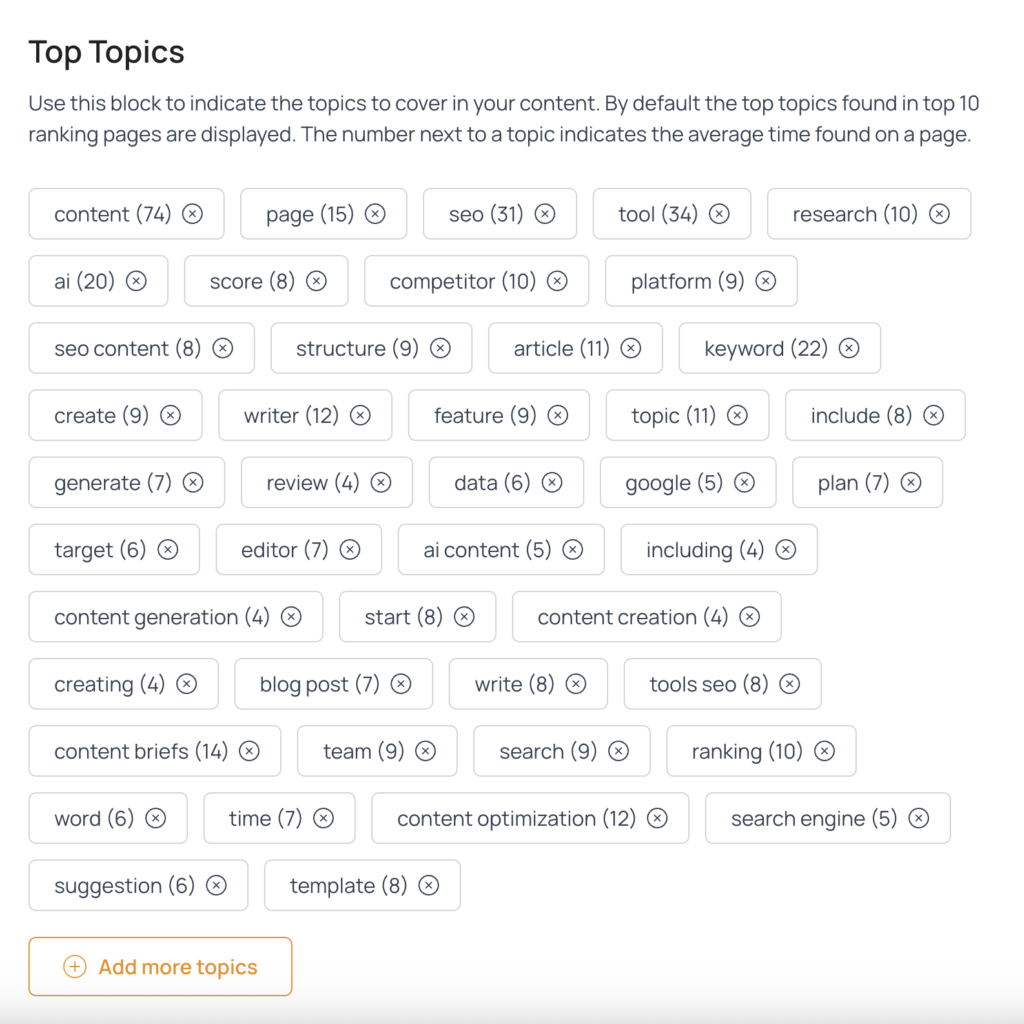
Do the same for key topics and competitor names. thruuu’s topic extraction pulls the most frequent terms across all ranking pages, weighted by occurrence. Use that list in your brief.
7. Guide Your Writer Research
thruuu extracts the key sources your competitors cite and includes them in the brief as a “Food for Thought” section.
Also, add notes specifying what to extract from each source, such as: “Read the first 800 words. Focus on how they define GEO. Use this to inform the opening section.”
8. More Best Practices for a Brief
The GEO-specific additions above do not replace the standard brief elements.
Include target word count, image suggestions, internal and external links, and meta title and description. For links, Thruuu’s content brief generator pulls competitor links and suggests placements automatically. For teams that integrate briefs with external publishing tools, the Content Brief API provides programmatic access to every element of the brief.
If you want to build your starting point on proven examples, review SEO briefs to see how thruuu briefs are structured in practice, then adapt the format for GEO.
Best Geo Content Briefs Tools
Now that you know what goes into a GEO brief, here are the tools that make building one faster:
Frase
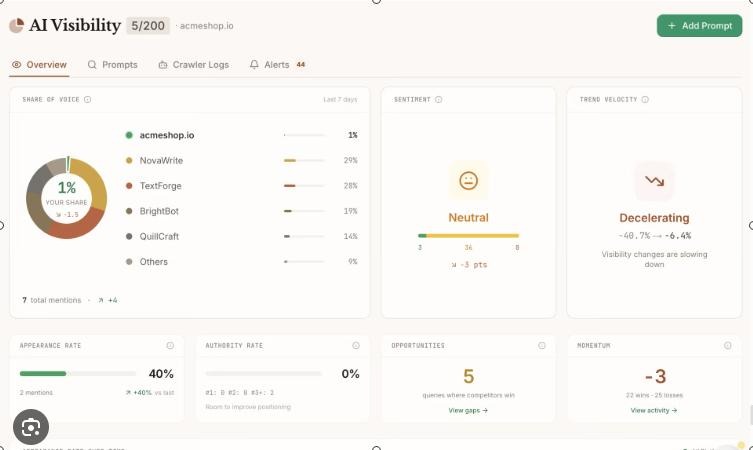
Frase 2.0 supports GEO content briefs by combining SERP analysis with AI-focused optimization signals. It generates outlines from the top 10 Google results and surfaces common questions from People Also Ask and Reddit.
The tool evaluates drafts using a GEO score designed to improve AI citability. This feature helps you structure content for both Google rankings and AI-generated answers. The rebuilt editor and integrated workflow also combine research, brief creation, and optimization in one place.
However, Frase focuses on optimizing content for AI readability rather than analyzing which sources LLMs actually cite. This means it improves AI-friendly structure but does not provide direct visibility into AI citation patterns across tools like ChatGPT, Perplexity, or Gemini.
What Users Say
“My favorite feature is building article outlines. It allows me to see what ranking articles are doing at a glance and structure our content logically.” – Evelyn M.
“The interface can feel a little cluttered at times, especially with so many features packed in. That said, support has been helpful whenever we have had questions or needed guidance.” Parsa M.
Pricing
$38–$297/month (project-based limits, not credits). Free trials available.
SurferSEO

SurferSEO converts competitor analysis into structured recommendations, including target word count, heading range, and required topic coverage. For example, if top-ranking pages average 1,800 words and consistently mention “AI Overviews” and “E-E-A-T,” Surfer includes these as targets in the brief.
The platform also includes a content editor with NLP scoring, which assigns a content score based on how closely a draft matches these patterns. However, it does not analyze AI citation sources, so its briefs reflect search-engine behavior rather than LLM visibility.
What Users Say
“The biggest advantage is Surfer’s NLP-driven content optimization and SERP-based recommendations. It removes guesswork from on-page SEO and helps writers, editors, and SEO teams stay aligned.” – John P.
“I haven’t found the new brief section in the content editor too useful yet, but this is a very new feature that may be improved over time.” Claire B.
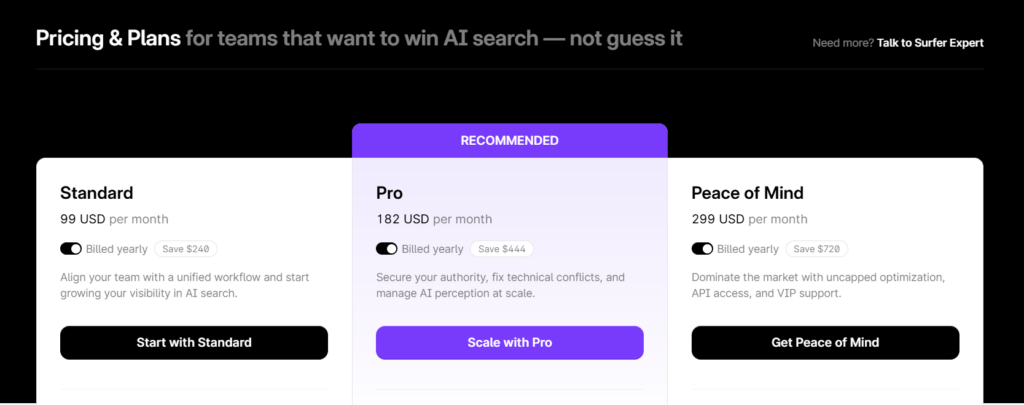
Pricing
thruuu Content Brief Generator
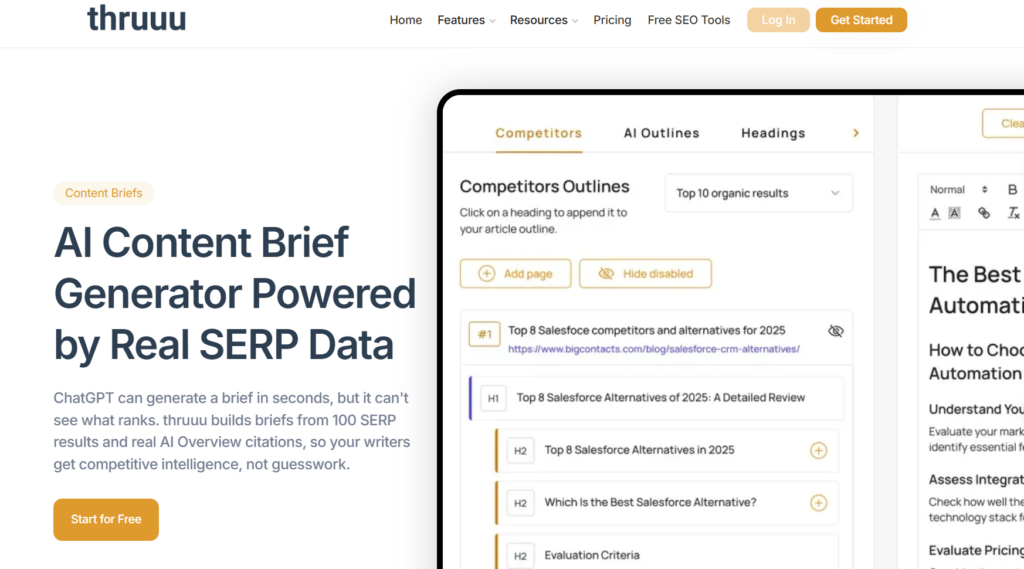
thruuu is an exemplary option for GEO briefs. The content brief generator has processed over 50,000 briefs, building from 100 SERP results and real AI Overview citations.
It analyzes Google SERPs and AI Overviews to extract key topics, questions, competitor mentions, and citation sources, and compiles them into a single, structured brief.
Here are four things that make thruuu’s Content Brief Generator different:
- It builds every brief from a 100-result SERP analysis rather than assumptions, pulling real heading structures, competitor-covered topics, and questions from pages that already rank.
- Briefs include insights pulled directly from AI Overview sources, so the content your writers produce addresses what Google’s AI already considers trustworthy and citation-worthy.
- You can create custom outline prompts that shape how headings are structured, meaning the tool analyzes competitors and then formats the brief according to your specific content architecture, not a generic template.
- The template builder lets you embed boilerplate text directly into reusable brief structures, so every brief you send to a writer arrives pre-filled with your standing guidelines, client directives, and formatting rules without you retyping them each time.
Pricing
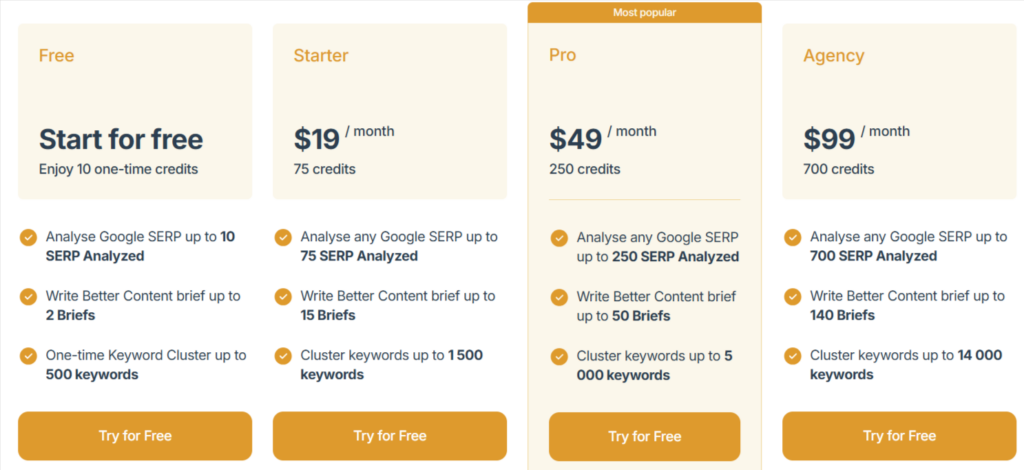
thruuu uses a credit-based system: each action (like a SERP analysis or content brief) costs credits, and credits roll over as long as you remain subscribed. Credits range between 10 and 700 credits.
Final Thoughts on Geo Content Brief Creation
A GEO content brief is an extension of what you already do with SEO briefs. Clear heading structure, keyword context, word count guidance, internal links, and competitor intelligence all still apply.
What changes is the level of instruction inside the brief. Writers now need clearer guidance on how to make content both extractable for AI systems and readable for humans.
This includes defining the experience signal, specifying key entities, framing headings as questions, and instructing writers to lead with direct answers instead of building toward them.
None of this requires starting from scratch. It requires being more intentional about what goes into the brief before writing begins.
Start your first GEO brief at thruuu.com/content-brief-generator.
Frequently Asked Questions (FAQs)
Does GEO content brief creation require a different workflow than SEO briefs?
Not completely, but it is more deliberate at key stages. Research now includes both Google SERP analysis and how LLMs surface or cite information. The writer directive also becomes more specific, with instructions for AI visibility rather than just tone and keyword use. Finally, the outline stage shifts focus from general topics to question-based headings that mirror how users prompt AI systems.
What should every GEO content brief include?
Every GEO brief should include an E-E-A-T signal (expert quote, original data, or personal observation), brand positioning instructions, conversational intent analysis, and semantic keyword clusters with related phrases and questions.
How do I optimize content for AI search engines like ChatGPT and Perplexity?
Structure content so the most important insight appears in the first 20–30% of the article. Use question-based H2 headings and answer immediately in the first sentence. Name specific brands, tools, and people instead of generic descriptions. This gives AI systems clear, extractable claims to cite.
What tools help create GEO content briefs?
The main tools for creating GEO briefs are thruuu, Frase, Surfer SEO, and MarketMuse. thruuu stands out because it analyzes results from both Google SERPs across up to 100 sources and multiple AI engines (ChatGPT, Claude, Gemini, Perplexity, and Google AI Mode), then combines citation patterns and search data into one brief.
How does thruuu help with GEO content briefs?
thruuu’s content brief generator pulls from 100 SERP results and real AI Overview citations, analyzes which brands AI engines cite, and surfaces recurring questions and topics across sources.
Empower Your Content Team
Our end-to-end content optimization solution empowers your team to crack the Google algorithm, craft exceptional content, and achieve remarkable organic search results.