

I dropped a content brief into a folder, typed “create article,” and walked away.
Twelve minutes later, a fully linked, humanized 2,000-word draft was sitting in my draft folder.
The article you are reading right now was produced by that system, from the exact brief I will show you later in this piece.
That system is six agents working in parallel: researcher, head of research, writer, humanizer, linker, and editor.
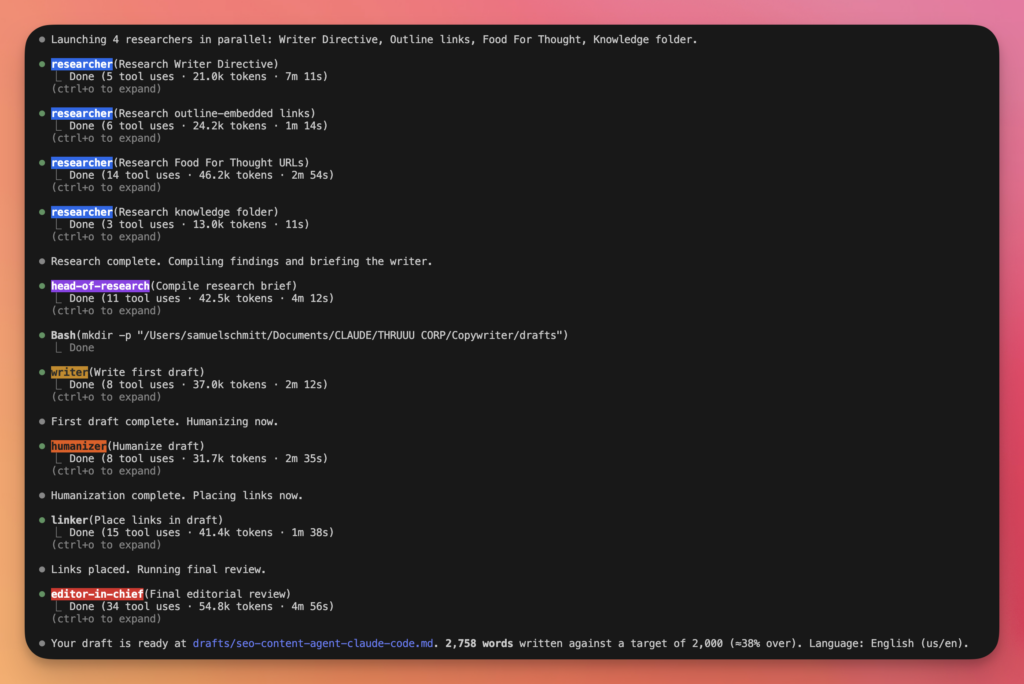
Each runs in its own context window, each owns one job, and they coordinate through handoffs rather than a shared brain.
I will show you how my agentic framework is set up so you can replicate it and adapt it to your own needs.
I will also share the exact brief I used for this article and the GitHub repo with the full setup.
Table of Contents
What are Claude Code Agents?
A Claude Code agent (or subagent) is a specialized AI assistant that runs in its own separate context window, with its own system prompt, tool access, and permissions.
When Claude encounters a task that matches a subagent’s description, it delegates automatically.
The subagent does the work and returns only a summary to the main conversation. The official sub-agents documentation covers the technical details.
The reason subagents matter here is context management.
If you ask a single Claude session to research dozen of URLs, write a 2,000-word article, humanize it, place links, and run a review checklist, by the end of the run the context window is carrying tens of thousands of tokens of research notes that are no longer useful.
Quality degrades because Claude is spending attention on data it does not need anymore.
Isolating each phase into its own context window solves this.
What this article builds is slightly more than subagents in the traditional sense: it is an agent team.
A coordinated pipeline where each agent receives a handoff from the previous one, runs its task, and writes output to a file the next agent reads.
The orchestrator coordinates the sequence.
Note: the Claude Code subagents docs distinguish between agents working within a single session and true multi-session agent teams. What the thruuu-claude-writer repo implements is closer to a coordinated pipeline: agents run sequentially and in parallel, with file-based handoffs between stages.
The SEO Writing Agent Team
The team has six defined agents and one orchestrator brain. Here is how to think about each one.
CLAUDE.md is the orchestrator brain. It is the master instruction file Claude reads automatically on startup.
It defines the pipeline sequence, coordinates which agent runs when, and passes context between stages.
When you type “create article,” CLAUDE.md is what decides what happens next. It is the conductor; the agents are the musicians.
The six agents:
| Agent | What it does |
|---|---|
| researcher | Spawned in parallel for each research scope. Fetches URLs from the brief, extracts key facts, data points, direct quotes, and arguments. Multiple researcher instances run simultaneously, one per research area. |
| head-of-research | Compiles all researcher outputs. Analyzes search intent, maps findings to outline sections, and produces a single strategic research brief for the writer. |
| writer | Reads the full brief plus the research brief. Follows the Content Outline heading structure exactly. Produces the first complete draft. |
| humanizer | Removes AI writing patterns. Improves flow between sections, adds personality, applies the GUIDELINE.md voice. |
| linker | Places all internal and external links from the brief naturally into the draft. Minimal text adaptation, maximum contextual relevance. |
| editor-in-chief | Runs the final review checklist. Scores the draft against SEO criteria: keyword density, heading hierarchy, internal link slots. Fixes what it can and presents the checklist before handing back to you. |
The SEO Content Agentic Worklfow
Think about what a content team actually does.
- A junior researcher reads competitor articles and pulls data.
- A research lead compiles a brief for the writer.
- The writer drafts.
- An editor reviews for voice and quality.
- A production person places links before it goes to the CMS.
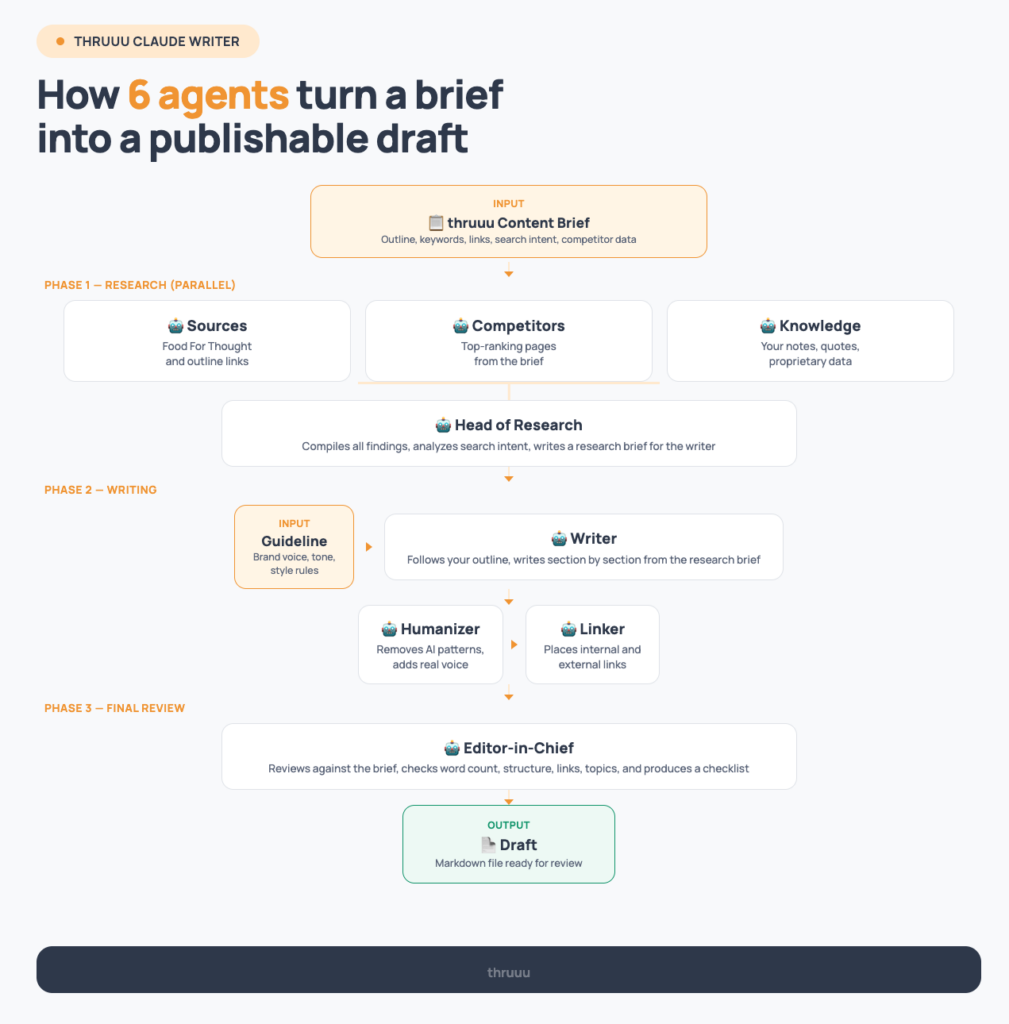
This agent team maps to that structure exactly, except the handoffs happen in seconds.
The input is a thruuu content brief and an editorial guideline. The output is a draft file. Everything in between is automatic.
The workflow runs one direction: research phases complete first, then writing, then humanization, then linking, then review.
Each step locks its output before passing it forward.
Step 1 – Start with a brand guideline
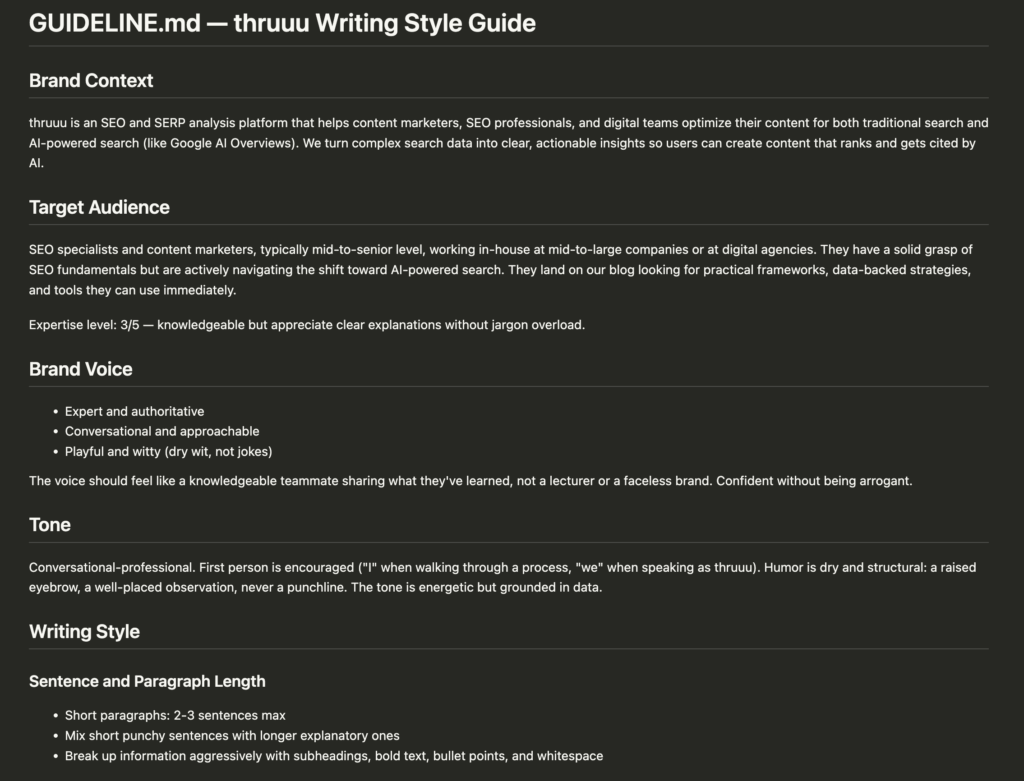
Before you create your first article, you need a editorial guideline.
Type “create guideline” after launching Claude. Claude will walk you through your brand voice, tone preferences, intro style, formatting rules, and AI visibility settings.
The result is a plain Markdown file stored locally as GUIDELINE.md.
Two people using the same CLAUDE.md and the same thruuu brief will produce different articles because their GUIDELINE.md files are different.
That is the personalization layer, and it is worth spending 15 minutes on the interview before your first run.
Step 2 – Compile research in an SEO Content Brief
A content brief is a key element in this process. It provides detailled information about the research to do, the structure to follow and the topics to include.
A thruuu content brief help you to compile all of these information in an automatic way.
A thruuu brief contains several elements that each agent handles differently:
| Element | What the agents do with it |
|---|---|
| Writer Directive | Highest priority writing instructions. Overrides GUIDELINE.md where they conflict. |
| Article Summary | Source of truth for title, slug, meta description, word count, and tone. |
| Content Outline | The heading structure, followed exactly by all agents. No heading is ever changed. |
| Food For Thought | URLs the researcher reads to build expertise before writing begins. |
| Top Topics | Keywords woven naturally into the content by the writer and checked by the editor-in-chief. |
| Frequent Questions | PAA data. Answered within body copy, never promoted to headings. |
| Links | Internal and external links placed naturally by the linker agent. |
You can generate a thruuu brief in under 10 minutes using the AI content brief tool.
It analyzes the SERP, create a content outline from competitor heading patterns, and lets you edit in an interface that shows your outline side by side with competitor outlines.
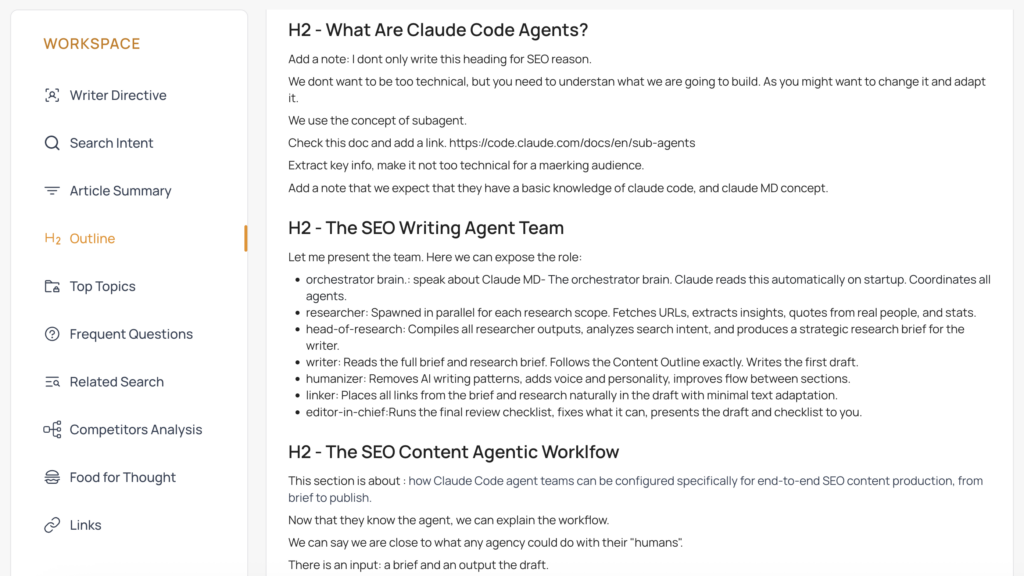
After you download the brief, drop it into the briefs/ folder. That is the only manual step between brief and draft.
If you haven’t created a brief yet, here’s how to create a content brief with thruuu.
Step 3 – Add extra knowledge
The knowledge/ folder is where your proprietary context begins.
Drop any file in there: a client data export, internal research, a founder interview transcript, a PDF with stats that no competitor has published.
The knowledge researcher agent scans it before the writing phase starts and surfaces the most relevant content to the writer.
This is how you close the gap between a 90% draft and something that actually sounds like you.
The brief provides SERP structure and competitor intelligence.
The knowledge/ folder provides the 20% that no AI can invent: the data point from your own research, the client example, the observation from a campaign you ran last quarter.
Step 4 – Create the draft
Drop the brief in briefs/, run claude in the project directory, and type “create article.” The pipeline runs automatically from that point.
Researchers launch in parallel, each assigned to a specific research scope.
Each researcher extracts key facts, arguments, data points, and direct quotes worth preserving: short, punchy, citable, verbatim where possible.
Then the handoffs run in sequence:
- Head of research compiles all researcher outputs into a single strategic brief, maps findings to outline sections, identifies gaps.
- Writer reads the full brief plus the research brief, follows the Content Outline heading structure exactly, and produces the first draft.
- Humanizer removes AI writing patterns, improves flow, applies
GUIDELINE.mdvoice throughout. - Linker places every link from the brief naturally into the draft.
- Editor-in-chief runs the final review. This is the quality gate.
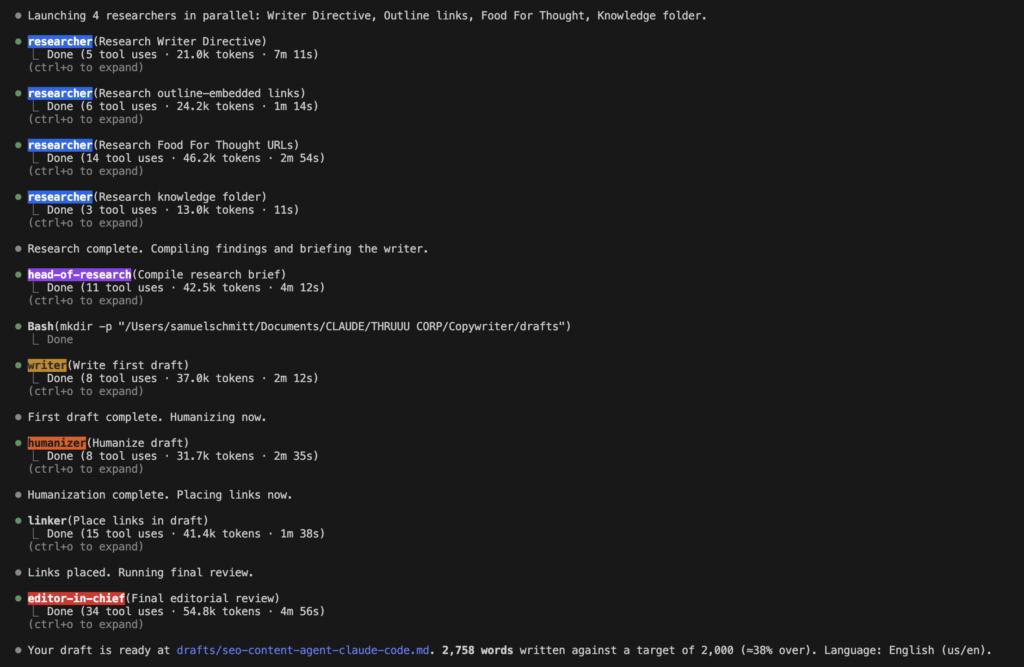
The editor-in-chief can invoke the writer or humanizer again if the draft fails a critical check. It presents the final checklist to you before closing.
A full run for a 2,000-word article takes roughly 10 minutes.
What this workflow doesn’t replace? Your input!
The draft is 90% done when the pipeline finishes. That is the honest position, and it matters because the remaining 10% is not the AI’s job.
The editor-in-chief runs a checklist before it hands back to you.
That checklist catches structural problems: a heading that got reworded, a link that landed in an awkward sentence, a PAA question that did not get answered.
What the checklist cannot catch is whether the article is actually correct.
Will Scott, who runs a digital marketing agency and uses Claude Code for SEO data analysis, put it plainly: “The tool finds the interesting data. The strategist decides what to do with it.“
The same principle applies here. The agent team finds the structure, covers the intent, places the keywords, and follows the brief.
Whether the argument is right, whether the claim is accurate, whether the tone fits the moment: that is your call.
Here is what human review covers that the pipeline does not:
- Fact verification. The researcher reads and extracts. It does not verify. Any statistic or claim that matters should be checked before publishing.
- Proprietary insight. If the
knowledge/folder was empty, the article has no unique data. You add that in review. - Brand judgment. GUIDELINE.md approximates your voice. It does not know what your CEO said last week or what your audience is currently sensitive to.
- Editorial discretion. Sometimes the brief points in one direction and the data points in another. A human notices that. An agent follows the brief.
Treating the draft as a finished article is the fastest way to publish something generic.
Treating it as a fully structured, research-grounded first draft that needs one pass of expert review is how the pipeline pays off.
Example of content created with the SEO Agent Team
The brief I used for this article is a useful example because this article was produced from it.
Click here to open it and I will guide you through it.
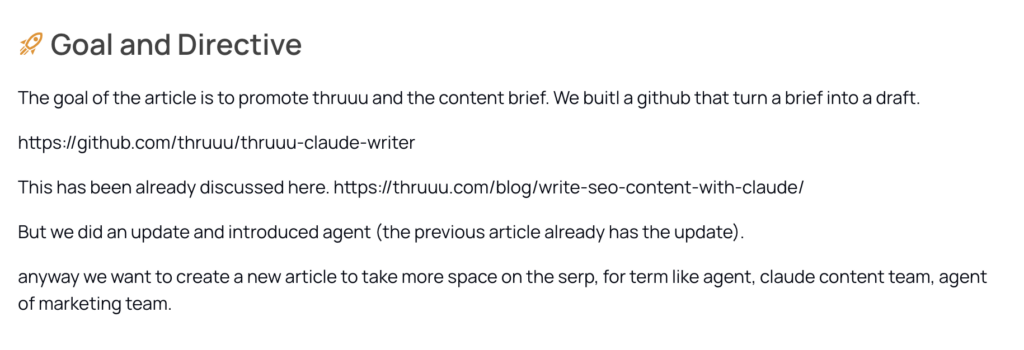
It opens with a Writer Directive: two articles to reference without repeating, the GitHub repo goes at the end, and the audience is SEOs already using Claude Code.
These are editorial instructions, not keyword targets, and the agent treats them as highest-priority guidance.
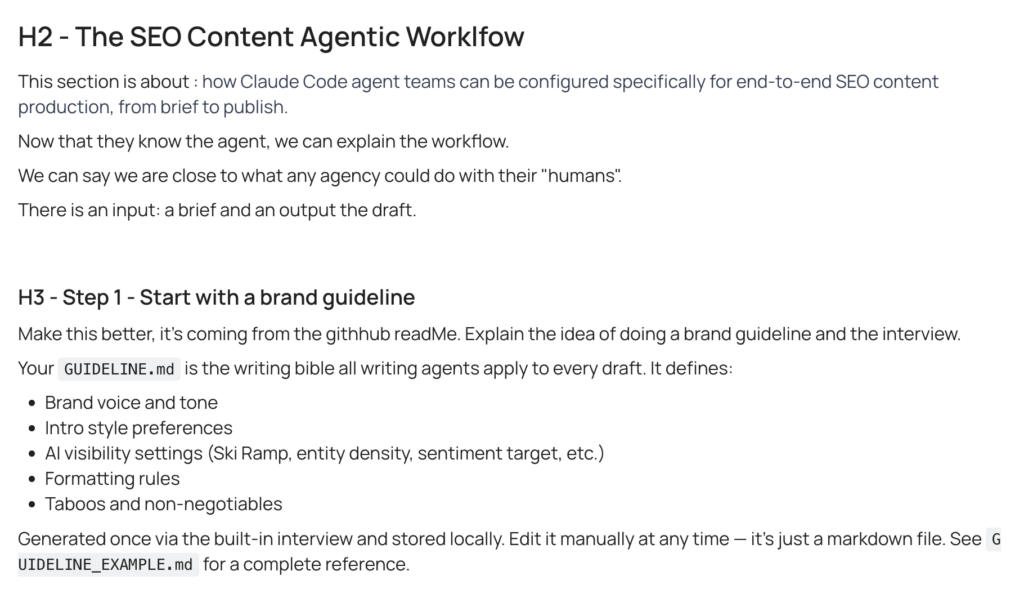
The Content Outline carries section-level notes like “make this better, it’s coming from the GitHub readme” or “explain the idea of doing a brand guideline and the interview.”
The notes don’t become headings. They become the substance inside each section.
The Food For Thought section points to three URLs.
The researcher reads all three in parallel, builds a content-to-avoid list from the two thruuu articles (nine points already owned by existing content), and extracts Will Scott’s Search Engine Land piece as citable evidence for the human-review section.

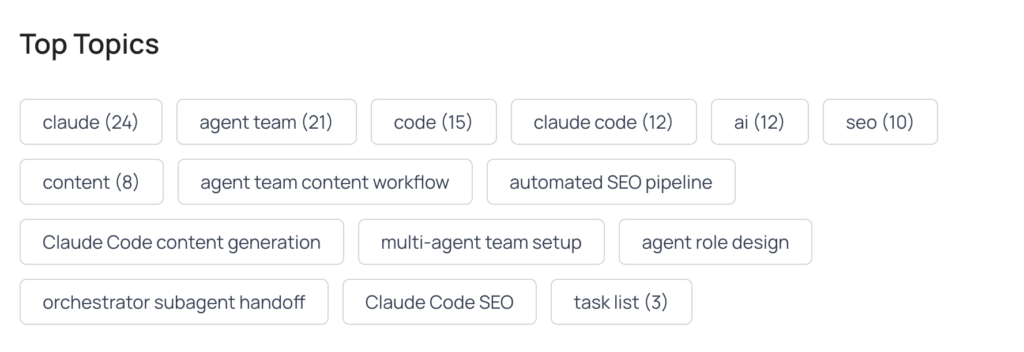
The Top Topics table names thirteen keywords the writer weaves into the content. They come from the SERP and reflect terms used frequently across top-ranking pages.
I picked the ones that mattered and added a few manual ones the data missed.
The Links element specifies four anchor texts with target URLs. The linker places them. The writer does not touch links during drafting.
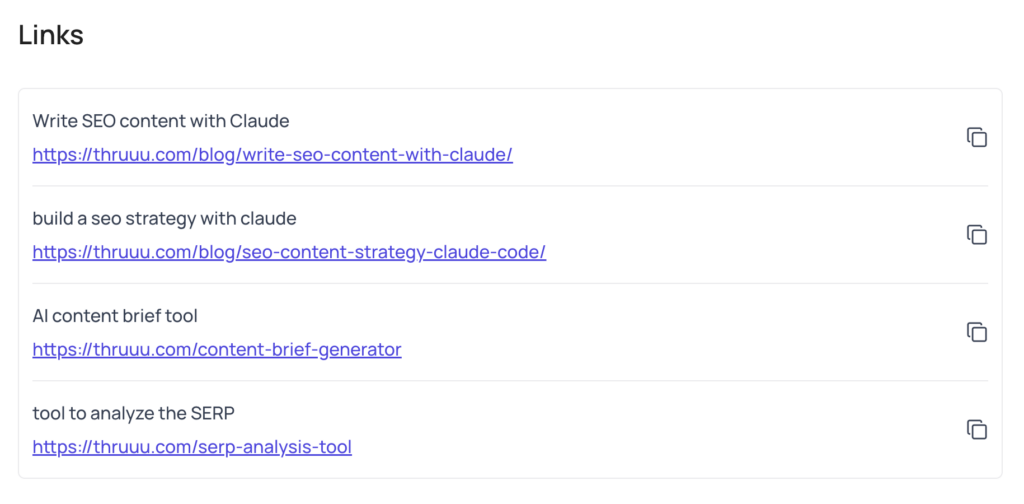
Note: A thruuu brief offers 15 elements and you can add your own. Each of them is handled differently by the agent team.
Turn your content briefs into article drafts using Claude Code
Here is what to do from here:
- Create a free thruuu account and generate your first brief. The free trial includes two briefs. Use thruuu’s content brief generator to analyze the SERP, build your content outline, and export the brief as a file.
- Clone the repo. The thruuu-claude-writer repository on GitHub has everything you need.
- Run the interview first. Type “create guideline” and answer the questions. Worth doing before your first brief run.
- Drop the brief in
briefs/and type “create article.” The pipeline handles the rest. - Review the draft and checklist. Read for accuracy, add your proprietary observations, and publish.
If you want more context on how the single-agent writing setup works before the team architecture made sense, the write SEO content with Claude article covers the mechanics.
If you want to understand how to build a keyword strategy that feeds into this pipeline, the build a seo strategy with claude article walks through that layer.
The agent team is the middle step: between the strategy that tells you what to write and the publishing step that puts it live. It is an execution layer. And it runs in 10 minutes.
Empower Your Content Team
Our end-to-end content optimization solution empowers your team to crack the Google algorithm, craft exceptional content, and achieve remarkable organic search results.