

Most SEO advice about AI search stops at the surface: AI engines are changing how results look and query fan-out is the mechanism underneath all of it.
Query fan-out is why one prompt to Google AI Mode, Perplexity, or ChatGPT triggers not one search but many, fired in parallel, pulling from different sources, assembled into one answer before the user sees anything.
If your content doesn’t show up across those decomposed queries, it’s absent from the answer.
Not buried on page two. Absent.
This article breaks down how query fan-out works technically, why the major AI search platforms all rely on it, and what it means for your content’s visibility.
Then it gets practical: how to map the questions AI systems generate for your topic, build cluster coverage that qualifies you as a source across multiple retrieval passes, and measure whether it’s working.
Table of Contents
What is query fan-out?
Query fan-out is an AI search mechanism where a single user prompt is broken into multiple sub-queries, each executed independently against a retrieval system, with the results synthesized into one comprehensive answer.
Google AI Mode, ChatGPT, and Perplexity all use this approach. It goes beyond traditional keyword matching, which maps one query to one results set.
Fan-out runs several, often covering distinct angles of a topic simultaneously: definitions, comparisons, use cases, objections.
The system then stitches those separate answers into a single coherent response.
A prompt like “best project management tool for remote teams” gets decomposed into sub-queries covering pricing, integrations, team size fit, and user reviews.
All in parallel. All feeding the final answer.
ChatGPT ( with search mode on ) and Perplexity apply the same retrieval logic, though they differ in how aggressively they cite and diversify their sources.
Why does this matter for your content?
Because if your content only answers the surface-level query and ignores the questions the model will generate around it, you’re invisible to the fan-out pass. Even if you rank on page one.
How query fan-out works technically
Query fan-out follows a four-step process inside AI search systems: intent decomposition, parallel retrieval, passage extraction, and synthesis.
Understanding each step tells you exactly where your content can enter the process, or miss it entirely.
From one query to many
When a prompt hits a system like ChatGPT or Perplexity, the model runs query decomposition before it touches a single search result.
It identifies entities, infers topic clusters, and anticipates what a complete answer would need to cover. From there, the system fans out into sub-queries, each targeting a distinct facet of the original prompt.
Here’s the four-step decomposition process in sequence:
- Intent decomposition, the LLM parses the prompt, extracts named entities, and maps the gaps between what was asked and what a thorough answer requires.
- Parallel retrieval, fan-out queries are fired simultaneously across multiple angles, covering sub-topics the user may never have typed explicitly.
- Passage extraction, the system pulls granular chunks from individual pages rather than ingesting whole documents, prioritising dense, specific passages.
- Synthesis, the retrieved chunks are merged, weighted, and assembled into one attributed response.
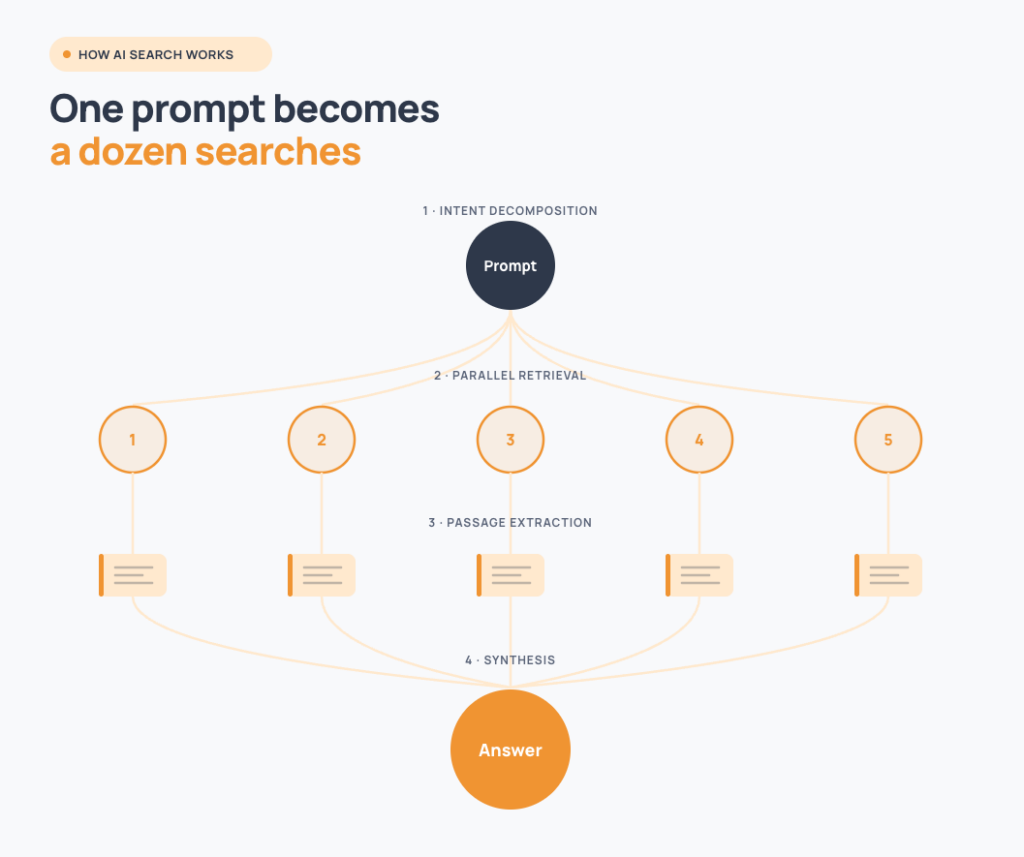
To make this concrete: a prompt like “how to build a topic cluster for SaaS SEO” triggers far more than one search.
The model decomposes it into sub-queries covering pillar page structure, internal linking logic, keyword grouping methods, SaaS-specific content depth signals, and competitive gap analysis.
One prompt can trigger dozens of sub-searches, each looking for a different article or passage that addresses one facet of the whole.
Every sub-query is a door your content either opens or stays behind.
How results get merged into one answer
Parallel retrieval generates a pool of candidate content, but the answer the user sees is built from a filtered subset of that pool.
The model evaluates chunks across all retrieved sources and selects the passages that best cover each angle of the original query, including the implicit intent baked into it.
Three distinct outcomes follow from this synthesis stage:
- The AI summary, the generated response itself, assembled from the most relevant chunks across sources.
- Brand mentions, a brand or domain name woven into the summary text, even when that source is not explicitly linked.
- Citations, the sources displayed as references below or alongside the answer.
The gap between these three matters. A source can contribute a chunk that shapes the answer and still receive zero citations in the final output.
The LLM extracts the information it needs from a passage, folds it into the synthesis, and may attribute it loosely or not at all in the visible interface.
In other words, your content can be doing real work inside an AI answer without appearing as a clickable reference.
This is why covering only the surface-level query leaves content invisible to the fan-out pass.
The synthesis stage rewards content that addresses topic clusters deeply, because the model needs chunks covering all the questions it fired, not just the headline question.
Building that depth systematically, across a coordinated content cluster, is what gives AI search systems enough material to pull from across multiple retrieval passes.
Why AI systems use fan-out
AI systems use query fan-out because a single retrieval pass can’t satisfy layered, multi-part questions.
When a prompt implies several distinct information needs, one search surfaces one angle. Fan-out lets the model fire parallel sub-queries, pulling evidence from different sources before synthesizing a complete answer.
Google introduced this pattern at scale, baking it into AI Mode as standard retrieval behaviour.
Traditional search hands you a ranked list of ten blue links and stops. You decide what to click, what to read, and what follow-up to run next.
An AI search system does all of that internally. It decomposes your prompt, runs 8 to 12 parallel sub-queries, and returns a synthesized answer that already accounts for context you haven’t consciously articulated yet.
How fan-out handles complex, layered queries
Complex queries rarely have a single correct answer sitting in one document.
A question like “what content format works best for a new SaaS product targeting SMBs?” folds together competitive intent, audience segmentation, format preference, and distribution context.
Feed that into a traditional search engine and you get results that match the surface keywords.
Feed it into an LLM-backed system and the model decomposes it: audience behaviour, format performance by industry, SMB buying patterns, and more. Each strand retrieved separately, then woven together.
Fan-out is how LLM reasoning scales to handle this complexity.
The model identifies every implicit question buried in the original prompt, treats each as its own retrieval task, and runs them concurrently. Multi-query retrieval means the final answer reflects depth, not just keyword proximity.
Anticipatory search: answering questions users haven’t asked yet
Fan-out also enables what’s sometimes called anticipatory search. The model predicts what you’ll need next and retrieves it before you ask.
If your prompt is about query fan-out, the system might simultaneously pull information on LLM reasoning architecture, source diversity signals, and content structure best practices, because those follow-up needs are statistically predictable from the original intent.
For brands and SEO, this is where the stakes shift.
Your content only enters the retrieval pool if it covers the topic cluster deeply enough to satisfy those anticipated queries. One optimized page answers one question. A coordinated cluster of pages answers the ten questions the model fires behind the scenes.
Traditional search rewarded individual pages. AI search behaviour rewards coverage across an entire topic.
How fan-out differs across Google AI Mode, Perplexity, and ChatGPT
The three major AI search platforms all use fan-out, but they differ meaningfully in how deep they decompose queries, how they select citation sources, and how diverse those sources are.
Understanding the differences helps you prioritise where to focus your content coverage.
| Dimension | Google AI Mode | Perplexity | ChatGPT |
|---|---|---|---|
| Sub-query depth | High. Decomposes into many parallel sub-queries, drawing on Google’s full index. | Medium-high. Aggressive decomposition with visible cited sources per sub-answer. | Medium. Sub-query generation is less transparent; answers can synthesise without surfacing many sources. |
| Citation behaviour | Cites sources inline; Google AI Mode integrate organic ranking signals alongside citation signals. | Cites sources prominently per section, rewarding content that directly answers a specific sub-query. | Cites sources, but with a preference for high-authority domains; fewer total citations per answer. |
| Source diversity | Broad. Draws from a wide range of domains, including niche specialists. | Broad, but skews toward sources that directly match the sub-query’s phrasing. | Narrower. Tends to concentrate citations on established, high-traffic brand domains. |
The practical implication:
- Perplexity rewards granular, sub-query-specific content that matches the phrasing of a decomposed question.
- Google AI Mode rewards existing organic authority combined with topical coverage.
- ChatGPT Search favours well-established brand signals across a topic.
Cover all three by building out your topic cluster with depth, individual pages targeting specific angles, rather than one long-form page trying to answer everything.
What fan-out means for AI Search visibility
Query fan-out compresses organic click-through rates because AI engines assemble complete answers by pulling chunks from multiple sources, routing the answer directly to the user rather than routing the user to any single page.
The result: zero-click AI search is the default outcome for many queries, and no individual source owns the answer.
That gap is measurable: organic CTR falls 61%, from 1.76% to 0.61%, on queries where an AI Overview appears
The opportunity flips this logic. The more of your site covers a topic cluster’s sub-queries, the more often your pages qualify as chunk-sources and earn a citation.
Coverage is the new moat.
When a model fires off a dozen queries in the background, it pulls from whichever sources best answer each one.
If your site covers only the parent topic, you’re a candidate for one slot. Cover the full spread of related questions, the comparisons, the how-tos, the definitions, and you become a candidate for many slots simultaneously.
This is why topic cluster methodology is the right strategic response to fan-out.
A cluster gives you a page for each question the model is likely to decompose your topic into. Each page increases your probability of being retrieved. Across an entire cluster, you stop depending on one piece of content to carry your brand into AI answers.
Being cited repeatedly across related queries also signals to AI engines that your brand is an authoritative source on the topic, not just on one angle of it.
That pattern of cross-cluster citation reinforces source authority in ways that a single optimized page simply can’t replicate.
How to optimize for query fan-out
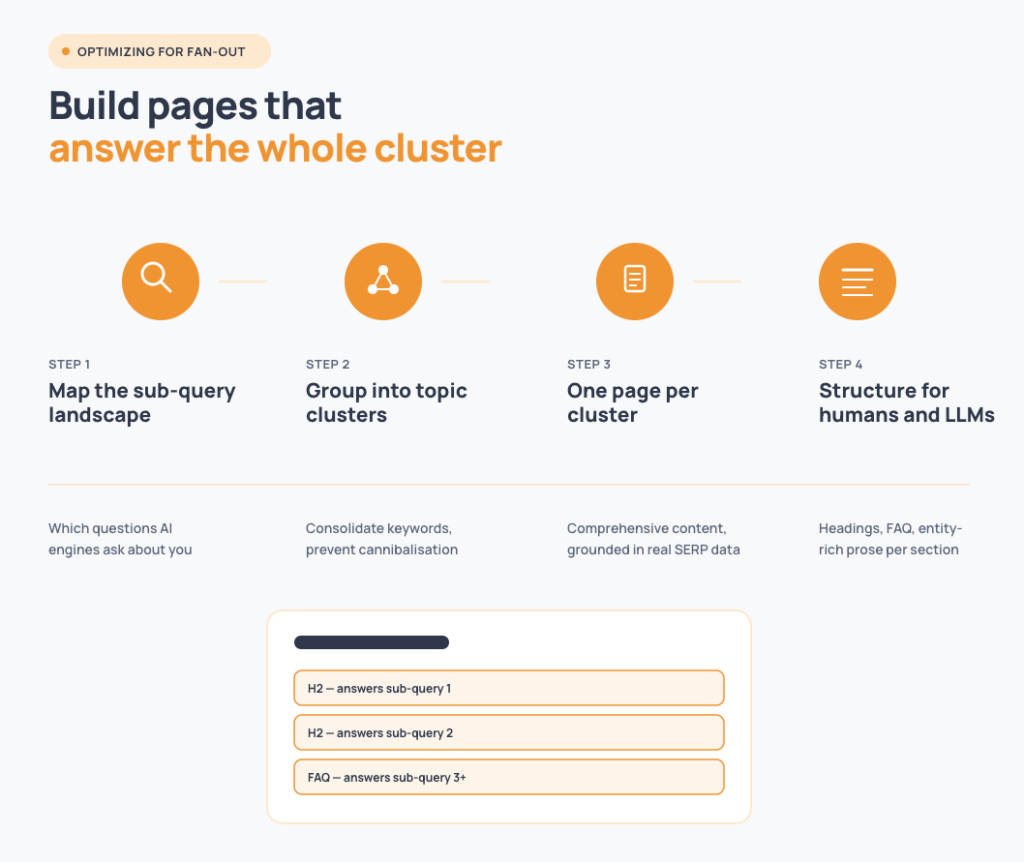
To optimize for query fan-out, identify the sub-queries AI systems generate for your topic, group them into keyword clusters based on SERP similarity, create one comprehensive page per keyword cluster, and structure each page with headings, FAQ, and entity-rich prose so individual sections satisfy distinct fan-out sub-queries.
Here’s the step-by-step breakdown:
- Identify your sub-query landscape, map the questions AI engines generate around your topic
- Group queries into topic clusters, consolidate related keywords to prevent cannibalisation
- Create one page per cluster, produce comprehensive content grounded in real SERP analysis
- Structure for human and LLM readability, use headings, FAQ, and entity-rich prose to satisfy sub-queries within a single page
Each step builds on the last. Skip one and the whole framework leaks.
Identify sub-query landscape
To map the questions AI engines generate for a given topic, use fan-out mapping techniques across at least three sources: ChatGPT’s network tab, Google’s People Also Ask boxes, and a direct LLM prompt.
Each source surfaces a different slice of related queries, and combining them gives you a fuller picture of the information space the model will try to cover.
The ChatGPT network-tab method is the most direct.
When you run a search in ChatGPT, the model fires multiple sub-queries in the background before composing its answer.
You can inspect those sub-queries in your browser’s developer tools under the Network tab.
Watch this step-by-step walkthrough of inspecting ChatGPT’s network tab to extract live fan-out sub-queries
Google PAA boxes work on the same underlying logic.
Each “People Also Ask” question is effectively a fan-out decomposition: Google breaking one main search into related searches it predicts the user will need.
Pull the full PAA tree for your seed keyword and you have a ready-made sub-query map.
LLM prompting is the third route.
Ask ChatGPT, Perplexity, or Gemini directly: “What specific questions would you search to fully answer [your topic]?” Run the same prompt several times. The sub-queries will differ across runs.
That variability is the point. Fan-out queries shift with each inference pass, so precise prediction matters less than building broad coverage across the space those queries inhabit.
A practical target: aim for 50 to 100 related questions from all three sources combined before you move to the next step.
Group your queries into Topic Clusters
Fifty to a hundred related questions sounds manageable until you try to build content around all of them individually.
You can’t publish 100 articles, and if you attempt it, a significant share will cannibalise each other in search results.
Cannibalisation happens when two pages on the same site compete for nearly identical queries. Say you have “how does query fan-out work” and “query fan-out explained” as separate targets.
Both pages answer the same underlying question.
Google and AI engines struggle to pick between them, splitting retrieval probability across two weak pages rather than concentrating authority on one strong one.
The fix is keyword clustering: grouping related queries into clusters where a single comprehensive page can cover the entire group.
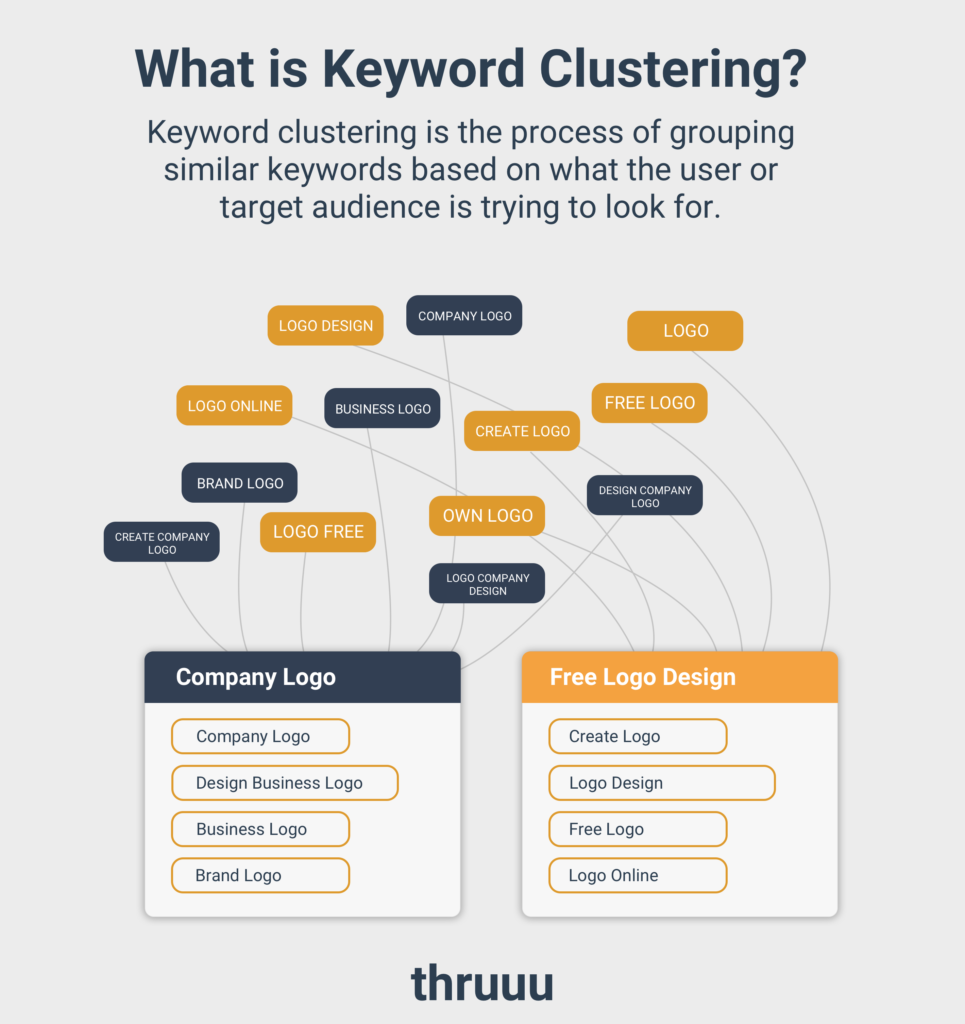
The most reliable method for this is SERP similarity. If two keywords return overlapping search results, they share search intent and belong in the same cluster.
thruuu’s keyword clustering tool uses exactly this SERP-similarity method, grouping keywords based on shared ranking pages rather than surface-level text similarity.
The result is clusters that reflect how search engines actually interpret topics, not just how keywords look side by side.
Once you’ve clustered, your 100 questions likely collapse into somewhere between 8 and 15 topic groups. That’s a workable content plan.
Create one page per group of keywords
Each keyword cluster needs one well-built page. Not a thin overview. A genuinely comprehensive piece that covers each specific question in the group with real depth.
Before writing, analyse the SERP and what AI engines are already surfacing for your cluster’s keywords.
Look at which pages Google ranks and which sources Perplexity and ChatGPT cite. Both signals tell you what information the systems consider authoritative for that topic.
Pages that appear in AI Overviews for a cluster tend to share a few properties: they address multiple related questions, they use clear heading structures, and they go deeper on the topic than the pages that only rank organically.
Pull the top-ranking pages for your cluster’s keywords, identify the subtopics they all cover, spot the questions they leave unanswered, and build your brief around filling those gaps comprehensively.
A content brief generator is the practical tool for translating that analysis into a writing plan.
thruuu generates content briefs from up to 100 ranking pages in minutes, pulling SERP structure, common headings, and AI citation patterns together into a single reference.
That breadth matters because the content patterns that appear consistently across a full SERP analysis are far more reliable signals than those from the top 10 pages alone.
Write for human and LLM satisfy multiple sub-queries
Structuring a page to satisfy multiple fan-out sub-queries means treating each major section as an independently retrievable unit. A system performing passage extraction across your page needs to pull a relevant chunk for a specific sub-query without the surrounding context.
If your headings are vague and your prose runs without clear boundaries, passage retrieval becomes unreliable.
Four structural moves raise passage-level retrievability across fan-out sub-queries:
- Question-shaped headings, write H2 and H3 headings as the exact question a sub-query would ask. Each heading becomes an addressable retrieval target for that specific question.
- FAQ schema markup: FAQ schema signals to AI engines that a specific question-answer pair exists at a known location on the page. Perplexity in particular shows strong citation patterns for pages with structured FAQ markup on complex multi-part topics.
- Entity-rich prose, name the specific entities (platforms, people, tools, concepts) relevant to each section. ChatGPT Search and Google AI Mode both perform entity-level matching when selecting chunk-sources; sparse prose with weak entity signals gets deprioritised.
- Self-contained answer blocks, open each major section with a 40-60 word direct answer that reads coherently out of context. If that block is extracted verbatim by a system, it should still make complete sense to the reader who sees it.
The goal is a page where any H3 section, lifted out in isolation, still fully answers its own question. Build each section to that standard and the page as a whole becomes a reliable source across the entire fan-out query space.
Measuring your fan-out coverage
Once you’ve built cluster coverage, you need to know whether it’s working. For each topic cluster, your content falls into one of four positions: ranked and cited by AI engines, ranked but skipped as a source, ranking too low to matter, or absent from the topic entirely.
Each position calls for a different response. The gap between where you rank and whether Google AI Mode or ChatGPT actually pulls from you is often wider than you’d expect.
Here’s how to diagnose each scenario fast. thruuu’s clustering workflow surfaces your current ranking position per cluster, so the gap becomes visible before you waste time optimising the wrong pages.
| Scenario | Diagnosis | Action |
|---|---|---|
| Rank and cited | Your content is performing in both Google and AI answers | Maintain. Protect freshness and internal linking. |
| Rank but not cited | Google sees the page; AI engines skip it as a chunk-source | Improve chunking: tighten H3 structure, write more self-contained passages, check whether the content type matches what AI Mode pulls for this sub-query |
| Don’t rank well | Neither Google nor AI engines surface the page | Optimise the existing article: improve topical depth, add missing sub-queries, build supporting cluster pages |
| Absent from topic | No page targets this cluster at all | Create a new article scoped to the cluster’s primary sub-queries |
Running this audit per cluster is more useful than chasing an overall traffic number. A single cluster where you rank and get cited compounds across all the related queries that platform fires.
To create a topic cluster with thruuu, you can leverage its cluster analysis to show you, for each keyword group, where you already have a ranking page and where you have nothing.
That makes it straightforward to prioritise new content creation over optimisation, or vice versa.
Work through each cluster in your topic map this way. Rank and cited is the only scenario where you walk away. Every other scenario has a concrete next step.
From One Page, One Query to Full Coverage
Query fan-out changes the fundamental unit of SEO competition. It’s no longer one page versus one query. It’s your whole topic coverage versus the full spread of sub-queries a system fires.
The brands that show up consistently in Google AI Mode, Perplexity, and ChatGPT answers aren’t winning on a single optimized article. They’re winning because they’ve built enough pages to satisfy the decomposed question set behind each prompt in their niche.
Comprehensive topic coverage beats keyword targeting, every time a system runs fan-out decomposition.
The next step is practical. Audit your existing content against the sub-query landscape for your core topics. Find the clusters where you have a ranking page but no AI citation. Find the clusters where you have nothing at all. Then prioritise from there.
thruuu’s keyword clustering workflow is built for exactly this. It groups your target queries by SERP similarity, shows where you already have coverage and where you don’t, and generates content briefs grounded in what AI engines actually pull from.
You can explore the full methodology with guidance on how to build pillar pages and supporting cluster content.
Empower Your Content Team
Our end-to-end content optimization solution empowers your team to crack the Google algorithm, craft exceptional content, and achieve remarkable organic search results.